While decentralized perpetual exchanges, or perp DEXes, clocked an eye-popping $1.2 trillion in volume in October, the data reveals their November tally eased slightly, trading a bit softer than the prior month’s fireworks. While the dip clocked in at just $70 billion, November’s perp DEX haul still loomed 71.7% above September, making it clear the momentum didn’t exactly curl up for a long winter nap.
Perp DEX Momentum Holds Strong With Another Heavyweight Month in November
At its core, a perp decentralized exchange (DEX) in DeFi operates as a DEX where traders lean on smart contracts to trade perpetual futures contracts — derivatives with no expiration date — straight from their own wallets, often with a pinch of leverage.
Everything remains onchain and non-custodial, letting collateral, funding payments, and liquidations play out in full view without a centralized hall monitor meddling in the process. Last month, data from defillama.com shows perp protocols pulled in $1.2 trillion in volume, marking their highest tally to date.
November’s perp DEX volume cooled a bit, slipping just 5.83% after stacking up $1.13 trillion over the 30-day stretch. Defillama.com figures show more than $240 billion flowed through Hyperliquid, while Aster chimed in with $258 billion during the same period. Together, Hyperliquid and Aster logged 44.07% of the total volume. Lighter grabbed the bigger slice, racking up $284 billion — a full 25.13% of the total.
Read more: Blackrock Credits Bitcoin ETFs With Leading Its Global Revenue
The remaining share flowed to perp protocols such as Vertex Edge, Synthetix, ApeX, Dydx, Satori Finance, Orderly Network, Pacifica, Synfutures, Drift, EdgX, Aevo, Jupiter, Reya, and GMX — with EdgX and ApeX both putting up notably competitive volume tallies for November.
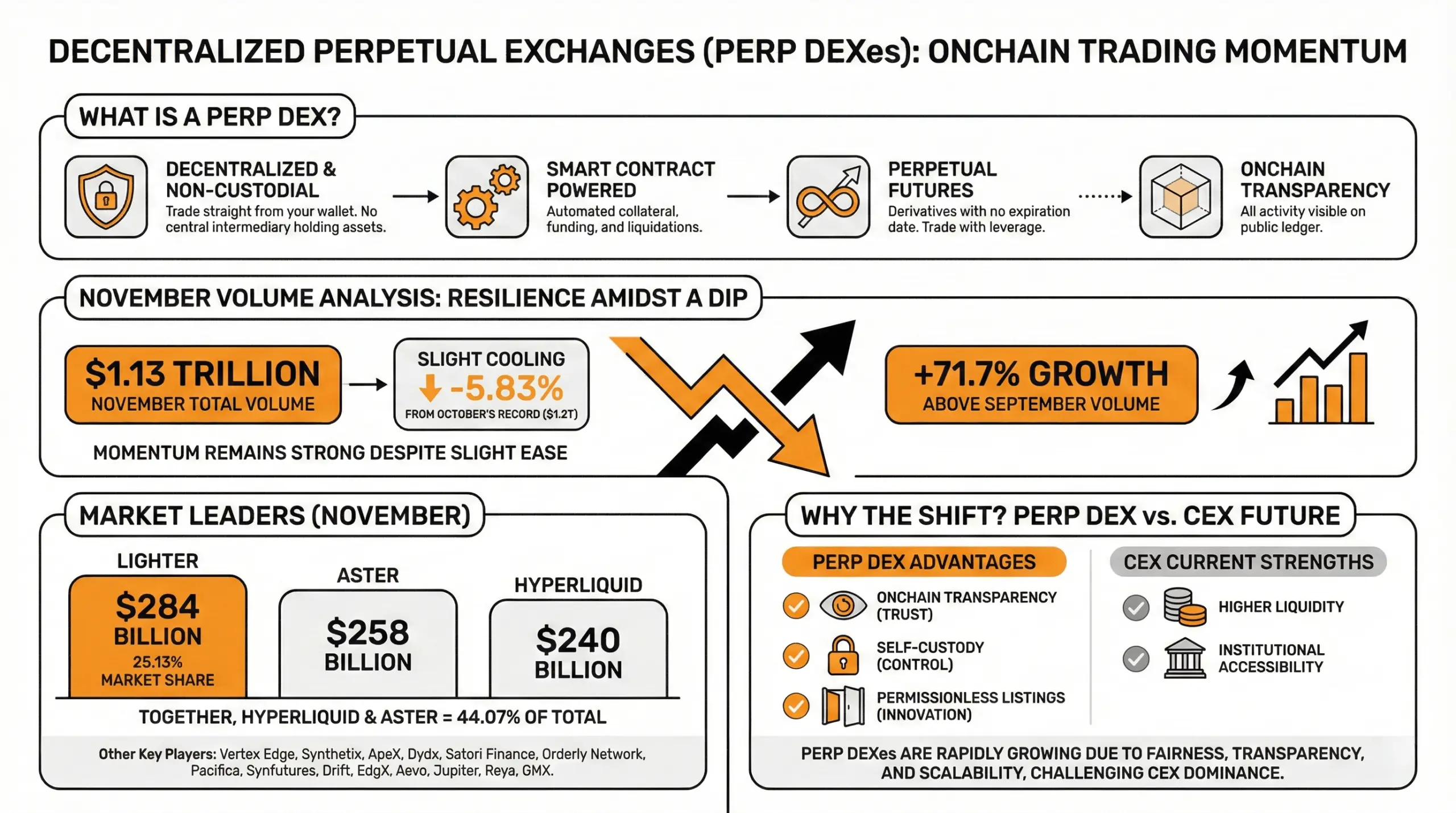
Over the long run, people believe perp DEXes will outpace centralized exchanges (CEXes) mainly because perp DEXes offer onchain transparency, self-custody of assets, and permissionless listings, which build trust and foster innovation in derivatives trading.
Although CEXs currently lead in liquidity and institutional accessibility, perp DEXs are rapidly growing in volume due to their fairness, transparency, and evolving scalability. As November wrapped, the takeaway was clear — even with a slight cooldown, perp DEXes kept the tempo high enough to remind everyone they’re not fading from the main stage anytime soon.
FAQ ❓
- **What is a perp DEX?**A perp DEX is a decentralized exchange that lets traders swap perpetual futures contracts onchain without relying on a centralized intermediary.
- **How much volume did perp DEXes handle in November?**Perp DEXes recorded $1.13 trillion in November, slipping just 5.83% from October’s all-time high.
- **Which platforms led November’s perp DEX activity?**Hyperliquid, Aster, and Lighter dominated the month, collectively handling a large share of total onchain derivatives volume.
- **Why are traders shifting toward perp DEXes?**Traders favor perp DEXes for transparency, self-custody, and permissionless access, which continue to draw volume from centralized exchanges.
Disclaimer: The information on this page may come from third parties and does not represent the views or opinions of Gate. The content displayed on this page is for reference only and does not constitute any financial, investment, or legal advice. Gate does not guarantee the accuracy or completeness of the information and shall not be liable for any losses arising from the use of this information. Virtual asset investments carry high risks and are subject to significant price volatility. You may lose all of your invested principal. Please fully understand the relevant risks and make prudent decisions based on your own financial situation and risk tolerance. For details, please refer to
Disclaimer.
Related Articles
A huge Ethereum whale moves 2,000 ETH, seemingly preparing to sell
On April 17, an on-chain analyst, Ai Auntie, disclosed on the X platform that a long-term whale who has held a large amount of tokens since the Ethereum ICO period transferred 2,000 ETH (about $4.63 million) to a multi-signature address. The receiving address has been identified as a “designated sell” address in its history—funds are typically deposited to an exchange shortly after the transfer.
MarketWhisper4h ago
ORDI Liquidations Hit $36.6M in 24 Hours, Short Positions Account for Two-Thirds
In the past 24 hours, ORDI saw $36.6 million in total liquidations, with shorts at $24.27 million and longs at $12.33 million. The largest single liquidation was $879,629, marking a significant spike compared to the weekly average.
GateNews5h ago
Bitcoin Hovers Near $75K as Whales Accumulate 270K BTC Over 30 Days, Largest Since 2013
Bitcoin nears $75,000, driven by significant whale accumulation of 270,000 BTC and low exchange reserves. Despite fluctuations and negative funding rates, it rebounded after geopolitical news, with futures inflows increasing since March.
GateNews9h ago
XRP Consolidation Signals Reset as Bullish Setup Emerges
XRP has recently rebounded to $1.39 after trading between $1.20 and $1.40 due to improved market sentiment. A significant drop in futures open interest reflects reduced speculation, while technical indicators suggest a potential bullish breakout, targeting $1.50 and possibly $1.80.
CryptoNewsLand13h ago
Ripple's RLUSD Approved as Futures Collateral on Bitrue; Deloitte Confirms Full Reserve Backing
Ripple's RLUSD stablecoin is now collateral for futures trading on Bitrue, enhancing capital efficiency and reducing volatility exposure. Verified by Deloitte as fully backed, RLUSD also aims to modernize Ghana's tax systems for small enterprises through blockchain technology.
GateNews15h ago
BTC dips 0.50% over 15 minutes: high-leverage liquidation in the derivatives market triggers a passive pullback in spot
2026-04-16 13:30 to 13:45 (UTC), the BTC price fluctuated within the range of 74481.3 to 75000.0 USDT, with a return of -0.50% over 15 minutes and a swing of 0.69%. During this round of abnormal movement, market attention increased, shown by intensified short-term volatility, but it did not trigger widespread panic.
The main driver of this abnormal movement is localized forced liquidation under the high-leverage positioning environment in the derivatives market. Existing data shows that BTC perpetual futures open interest has been running at consistently high levels; leverage has accumulated in the market. Within the abnormal-movement window, long leverage is passively deleveraged, which triggers a liquidation cascade and, in turn, causes the spot price to passively dip. ETF fund flows remain neutral, contrasting with net outflows of large on-chain funds, further confirming that this price decline is mainly driven by endogenous risk release within the derivatives market.
In addition, daily-level data shows that large addresses (\u003e$10M) continue to record net outflows, with a total amount of -12,987.03 BTC. This should have provided support for the price, but during the abnormal movement period, no large-scale concentrated sell-off or a surge in on-chain activity has been observed. On the ETF side, mainstream ETF fund flows show no significant abnormal movement, indicating that institutions have not engaged in trend-based selling. Spot and derivatives trading volumes remain high. The position structures of some top platforms are highly concentrated, and with multiple factors resonating simultaneously, the effect of localized forced liquidation is amplified, which then transmits to the spot market.
The market is still in a high-leverage operating phase. Investors should be alert to the risk of a new round of forced liquidation pressure brought on by amplified future volatility. Focus on indicators such as the exchanges’ BTC net inflow/outflow, minute-level large transfers, derivatives market positions, funding rates, and liquidation volume. If there is a sudden change in fund flows on the derivatives or ETF side, there may be systemic downside risk. In the short term, the risk of sharply fluctuating market conditions is prominent, and investors should closely monitor subsequent market data and on-chain developments.
GateNews17h ago


