Author: Fenrir, Crypto City
Florida Leads the U.S. in Stablecoin Regulation
Florida demonstrates its leadership in the digital asset industry by officially establishing the first state-level stablecoin regulatory framework in the United States. On March 6, 2026, the Florida Senate overwhelmingly passed the bill known as SB 314 with a vote of 37-0. This legislative milestone marks a significant step forward in promoting transparency and legitimacy within the cryptocurrency sector.
Samuel Armes, founder and president of the Florida Blockchain Business Association (FBBA), described this as a historic achievement on social media. The bill is expected to be signed into law by Governor Ron DeSantis within the next 30 days. Although a spokesperson from the governor’s office stated that the final text is still pending formal submission by the legislature, industry observers widely anticipate that the governor will sign the bill, making Florida a new benchmark for crypto regulation nationwide.
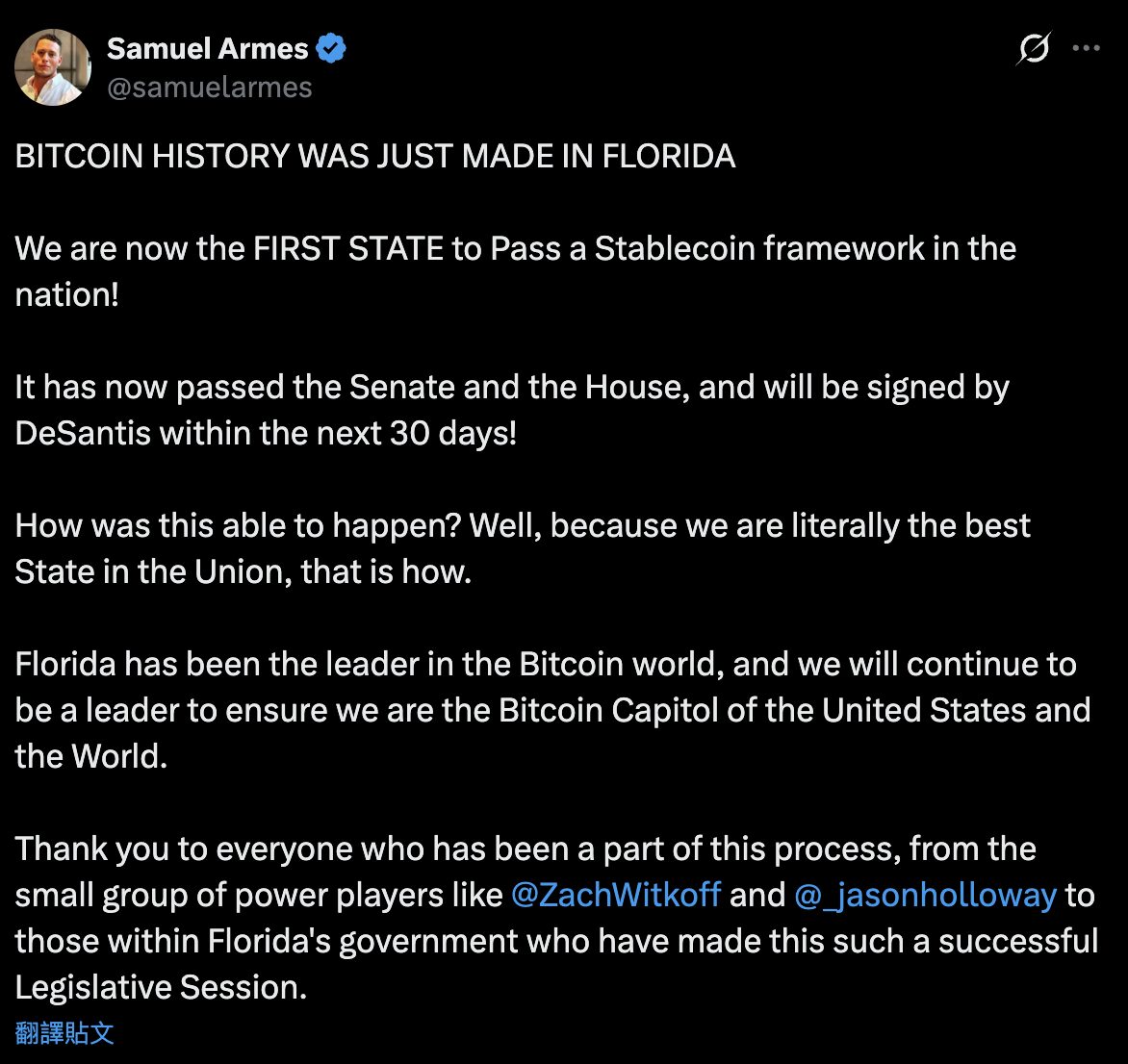
Image source: X/@samuelarmes | Samuel Armes, founder and president of the Florida Blockchain Business Association (FBBA), describes this as a historic milestone on social media.
Florida’s move reflects the current disconnect between local and federal regulators. While Washington D.C. continues to debate the definition of cryptocurrencies, Florida has chosen to proactively establish clear industry boundaries.
Samuel Armes emphasizes that Florida will continue to serve as a global leader in Bitcoin and blockchain innovation. This legal framework will attract more Web3 companies to set up shop. It’s not just a regulatory update but a concrete endorsement of digital assets’ future development, aiming to build a solid foundation for the digital economy.
Integrating Stablecoins into the Money Services Regulatory System
The core of SB 314 involves amending the existing Florida Money Services Business Anti-Money Laundering Act. The new law explicitly defines stablecoins as a form of “Monetary Value,” which is a significant legal development. This means stablecoin issuers must comply with standards equivalent to those for traditional money service providers.
Under the bill, stablecoin issuers operating within Florida must obtain relevant licenses and implement strict consumer protection and AML procedures. Additionally, the bill complements the House’s HB 175, which clarifies that certain payment stablecoins meeting specific criteria are not considered securities. This clarification provides issuers with valuable legal certainty. In the context of ongoing conflicts between federal regulators and the crypto industry over securities classification, Florida’s stance offers a safe harbor for businesses.
The bill also sets clear thresholds for interstate operations. Qualified issuers based outside Florida must submit written notice to the Florida Office of Financial Regulation (OFR) before conducting business, ensuring effective local oversight. Furthermore, transactions involving stablecoins over $10,000 must be fully recorded, aligning with traditional banking regulatory standards. By incorporating digital assets into the existing monetary regulatory framework, Florida effectively reduces compliance risks associated with innovative technologies and provides a legislative template for other states.
Federal Framework Alignment: Revenue-Generating Stablecoin Regulation
This legislation demonstrates Florida’s strategic foresight by linking with the federal GENIUS Act, which takes effect in July 2025. The bill establishes a dual oversight system: some issuers will be fully regulated by the Florida Office of Financial Regulation, while others will be jointly overseen by state and federal agencies such as the OCC.
A particularly notable aspect is how the bill addresses interest payments on stablecoins. According to the regulation, if federal law prohibits stablecoin issuers from paying yields or interest to holders, qualified Florida issuers must comply with this restriction. This design directly responds to the most heated debates in the U.S. financial sector.
Traditional banks view interest-bearing stablecoins as a threat to deposit bases and systemic financial stability. In fact, federal legislation like the Clarity Act remains stalled in the Senate due to strong opposition from the banking industry. Florida’s conservative stance on revenue-generating products aims to balance innovation with financial stability, reducing institutional resistance during implementation. This pragmatic approach reflects the attitude of Florida lawmakers, prioritizing the legitimacy of stablecoins as a means of payment over unrestricted feature expansion.
From Government Pilot Programs to Data Protection Measures
Beyond the core regulatory framework, Florida’s SB 314 also reveals ambitions to incorporate blockchain technology into public administration. The bill authorizes the state’s Department of Financial Services to launch a pilot program exploring the acceptance of approved stablecoins for paying licensing fees, taxes, and other government services.
This signifies official recognition of digital assets as legitimate payment methods. To further enhance the investment environment, Florida also passed CS/CS/SB 1440, which significantly strengthens confidentiality protections for data related to digital asset service providers.
These protections apply to crypto companies, trust companies acting as issuers, and qualified stablecoin issuers, aiming to safeguard trade secrets and sensitive operational data from regulatory scrutiny. Supporters argue that robust confidentiality measures are key to attracting top-tier companies, as businesses need assurance that their core technologies and trade secrets are legally protected while complying with regulations.
Despite ongoing disagreements at the federal level over regulatory rulings, Florida has chosen to solidify its position as a global hub for digital asset innovation through prudent local legislation. In the future, the integration of government services and digital assets in Florida will serve as a critical case study for blockchain application practices.
Disclaimer: The information on this page may come from third parties and does not represent the views or opinions of Gate. The content displayed on this page is for reference only and does not constitute any financial, investment, or legal advice. Gate does not guarantee the accuracy or completeness of the information and shall not be liable for any losses arising from the use of this information. Virtual asset investments carry high risks and are subject to significant price volatility. You may lose all of your invested principal. Please fully understand the relevant risks and make prudent decisions based on your own financial situation and risk tolerance. For details, please refer to
Disclaimer.
Related Articles
Pakistan Lifts an Eight-Year Ban: Central Bank Allows Banks to Serve Crypto Businesses, and the Virtual Assets Law Takes Effect
On April 14, 2026, the State Bank of Pakistan lifted its crypto-assets banking ban that has been in place since 2018, officially kicking off the Virtual Assets Act 2026. Banks may open accounts for licensed virtual asset service providers, but must establish a segregation-of-funds mechanism to ensure that customers’ funds are not affected. This policy change responds to domestic demand and demonstrates Pakistan’s growing role on the international stage.
ChainNewsAbmedia4h ago
U.S. Has Not Agreed to Extend Ceasefire Agreement
Gate News message, April 15 — The United States has not agreed to extend the ceasefire agreement, according to Axios.
GateNews7h ago
Oil Prices Rise on Geopolitical Tensions; WTI Up 1.97%, Brent Up 2.00%
International oil prices rose significantly due to heightened geopolitical tensions in the Middle East, with WTI crude up 1.97% and Brent crude up 2.00% amid Iranian threats to U.S. maritime actions.
GateNews9h ago
Trump Says Iran Conflict's 'Final Outcome' Could Come Soon
In a Fox Business News interview, President Trump expressed optimism about resolving the Iran conflict soon, emphasizing that the U.S. will not agree to terms if Iran seeks nuclear weapons development.
GateNews9h ago
Zelenskyy Says Middle East Conflict Significantly Impacting Weapons Supply to Ukraine
Ukrainian President Zelenskyy warned that the ongoing Middle East conflict is affecting weapons supplies to Ukraine, particularly for air defense. He emphasized the critical shortage of the Patriot missile system, which has reached a concerning level.
GateNews10h ago
IMF Cuts Global Growth to 3.1%, Warns of Recession Risk as Bitcoin Slides to $74K
The IMF has downgraded its 2026 global growth forecast to 3.1%, citing risks of recession from rising oil prices and US-Iran tensions. Bitcoin has also dropped significantly amid poor macroeconomic conditions and rising global debt.
GateNews12h ago


