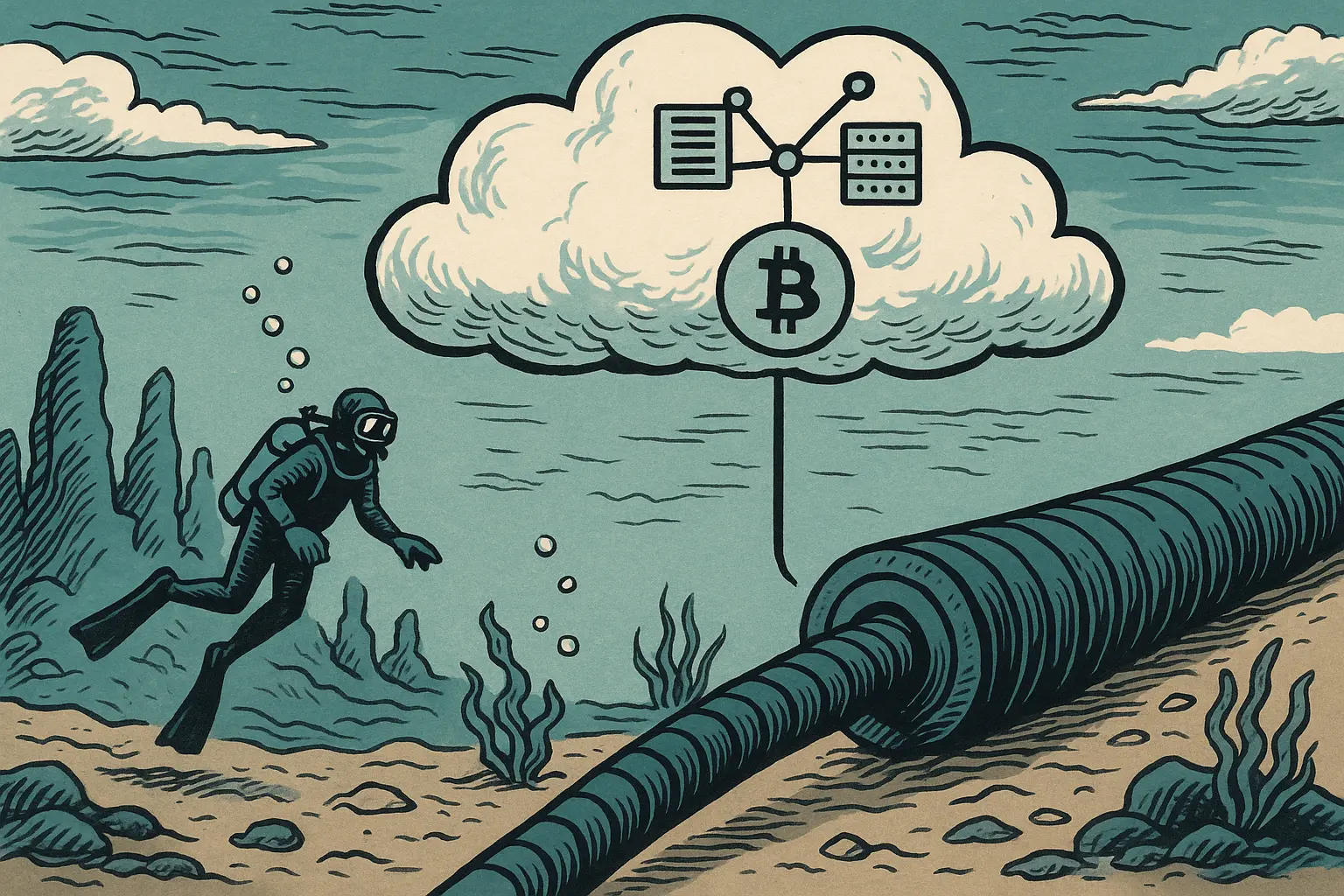
In 2024, submarine disturbances near Ivory Coast simultaneously severed seven undersea cables, but for the Bitcoin network, this event left almost no trace: prices remained stable, consensus was unaffected. Cambridge researchers Wenbin Wu and Alexander Neumueller used this as a basis to analyze cable failure events from 2014 to 2025, concluding that “the real bottleneck is not underwater but in the cloud.”
Historical Record of Undersea Cables: 11 Years of Data Say It All
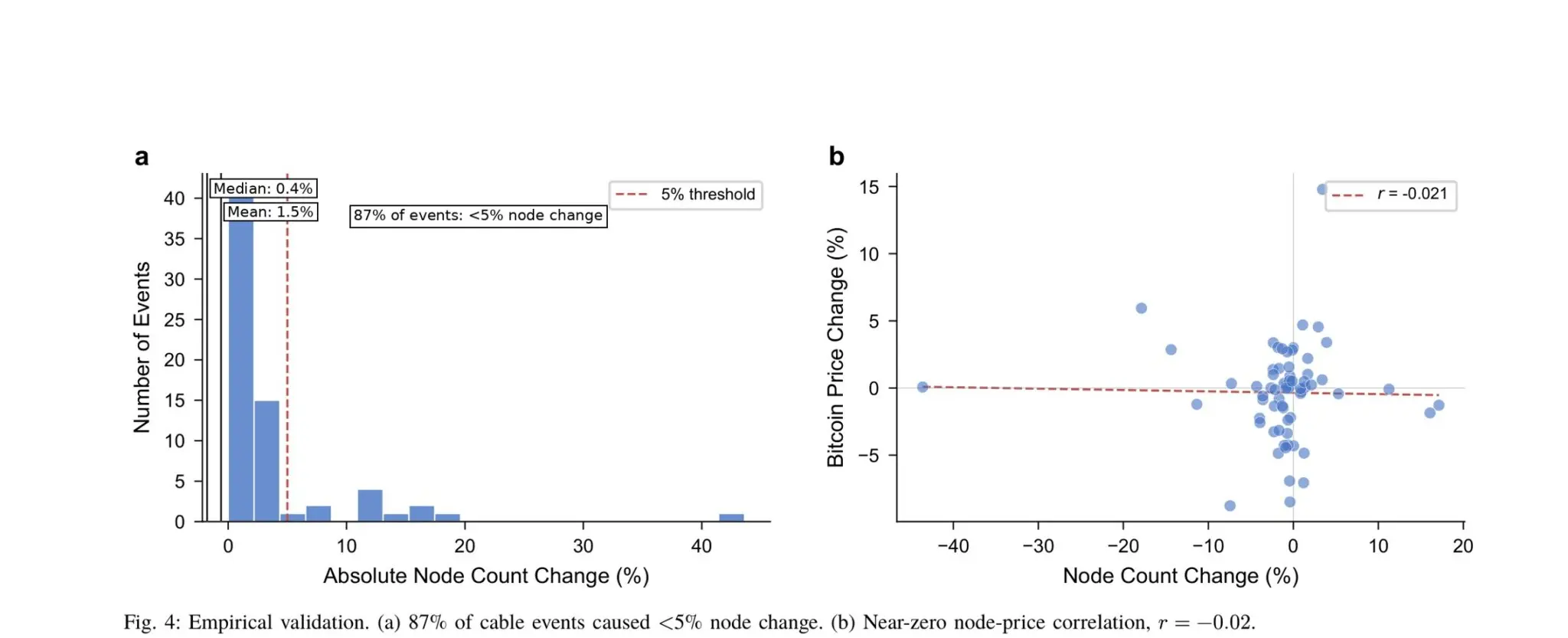
(Source: Cambridge Research)
Cambridge’s dataset covers 11 years of Bitcoin network activity. Among 68 verified cable failure events, 87% caused node changes of less than 5%, with an average impact of -1.5%, and a median of only -0.4%. The correlation coefficient between node disruptions and Bitcoin prices is close to zero (r = -0.02), indicating almost no linear relationship.
Further simulation experiments quantify the actual threat of cable cuts: in scenarios where cables are randomly removed, over 72% to 92% of all cables must be cut to disconnect more than 10% of nodes—meaning an almost global-scale coordinated disruption of transoceanic fiber optic cables would be needed to significantly impact the Bitcoin network.
The True Bottleneck: 5% Threshold in Cloud ASN
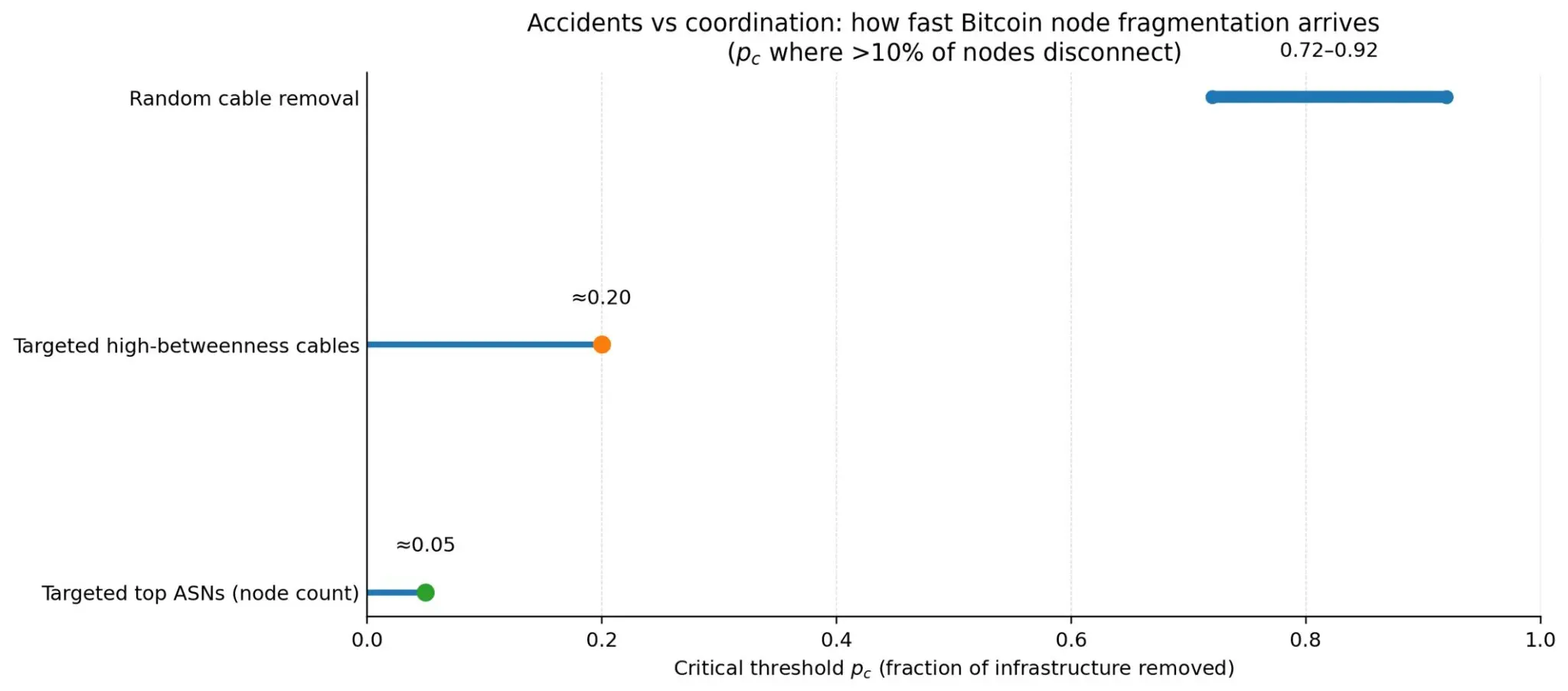
(Source: Cambridge Research)
However, when researchers shifted focus from physical cables to Autonomous System Numbers (ASNs), the figures changed dramatically. Precise attacks on high-centrality cable nodes can lower the critical threshold from 72-92% to just 20%; targeting the cloud service providers with the most nodes, removing only 5% of routing capacity can cause noticeable disruptions to reachable nodes on the public network.
According to a March 2026 Bitnodes snapshot, the hosting concentration of 23,150 reachable nodes is as follows:
Hetzner: 869 nodes (3.8%)
OVHcloud: 348 nodes (1.5%)
Comcast: 348 nodes (1.5%)
Amazon AWS: 336 nodes (1.5%)
Google Cloud: 313 nodes (1.4%)
The researchers explicitly state that this ASN scenario refers to “hosting providers’ shutdowns or coordinated regulatory actions, not physical cable cuts”—in other words, policy-level coordinated pressure rather than battlefield sabotage. Recent outages in Amazon and AWS Middle East regions, while not causing substantial impact on Bitcoin, confirm that such hosting failures are real risks, not just theoretical speculation.
Tor’s Invisible Defense: Structural Resilience of 63% of Nodes
Even with the above ASN risks, Bitcoin holds a widely underestimated trump card—Tor. Data from March 2026 shows that out of 23,150 reachable nodes, 14,602 (63%) operate over the Tor network, making it a major component of Bitcoin node infrastructure.
The surge in Tor usage was not planned but a collective response to a series of censorship events: Iran’s internet shutdown in 2019, Myanmar’s network disruptions after the 2021 coup, and China’s 2021 mining ban. Node operators independently migrated to censorship-resistant infrastructure without centralized coordination, demonstrating typical decentralized self-organizing adaptability.
Cambridge’s four-layer model (covering Tor relay infrastructure) shows that adding a Tor layer consistently raises the critical failure threshold by 0.02 to 0.10. Even if the clear net is completely removed, Tor nodes can still operate because their relay infrastructure is mainly concentrated in Germany, France, and the Netherlands—countries with extensive submarine cable connections, less affected by peripheral cable failures.
Frequently Asked Questions
Why does the severing of seven submarine cables hardly affect Bitcoin?
Because Bitcoin nodes are distributed worldwide, and most run over Tor (accounting for 63%), cable cuts typically only impact a small number of nodes in specific regions. Cambridge research shows that in 68 verified cable failure events, 87% caused node changes of less than 5%, far below the threshold needed to impact network consensus. Random cable cuts would need to simultaneously damage 72-92% of transoceanic cables globally to significantly affect Bitcoin.
Are cloud service providers a bigger threat to Bitcoin than undersea cables?
According to Cambridge’s model, coordinated suppression targeting cloud providers (ASN-directed attacks) can cause noticeable disruptions by removing only 5% of routing capacity, far more efficient than physical cable cuts. The researchers emphasize that this scenario involves policy-level coordinated regulation or service provider shutdowns, not battlefield destruction.
What role does Tor play in protecting the Bitcoin network?
Tor usage grew from nearly zero in 2014 to 63% in 2026, becoming a major part of Bitcoin node infrastructure. It not only provides privacy but also creates an independent structural resilience layer separate from the clear net. Even if clear net nodes are compromised by cloud outages or regulatory actions, Tor nodes can sustain most network operations, greatly enhancing Bitcoin’s overall resilience in extreme scenarios.
Disclaimer: The information on this page may come from third parties and does not represent the views or opinions of Gate. The content displayed on this page is for reference only and does not constitute any financial, investment, or legal advice. Gate does not guarantee the accuracy or completeness of the information and shall not be liable for any losses arising from the use of this information. Virtual asset investments carry high risks and are subject to significant price volatility. You may lose all of your invested principal. Please fully understand the relevant risks and make prudent decisions based on your own financial situation and risk tolerance. For details, please refer to
Disclaimer.
Related Articles
Bernstein: The Bitcoin market has already priced in the risk from quantum computing, and developers have 3 to 5 years to push forward with a post-quantum upgrade
Bernstein’s research report states that the Bitcoin pullback reflects market concerns about the risks of quantum computing, and argues that the quantum threat is manageable and does not constitute a systemic risk. Current technological progress provides a cushion for Bitcoin, giving developers 3 to 5 years to push forward a post-quantum upgrade. Institutional investors will help drive consensus formation, but user migration remains the main challenge.
GateNews6h ago
WisdomTree saw net inflows of $98 million of digital assets in Q1, with assets under management reaching $867 million
Gate News news, April 13, asset management company WisdomTree released a March monthly performance report showing that in the first quarter of 2026 its digital-asset net inflows totaled $98 million, and as of March 31 its digital-asset assets under management reached a record $867 million. The report noted that although the overall cryptocurrency market has been lackluster, WisdomTree’s digital-asset business saw significant growth thanks to the launch of tokenized money market funds. (Businesswire)
GateNews7h ago
Saudi Arabia’s Crypto Market Projected to Reach $47.8 Billion by 2034
The Saudi Arabian cryptocurrency market is projected to grow from $24.9 billion in 2025 to $47.8 billion by 2034.
Key Takeaways:
SAMA is backing projects like mBridge to grow the market to $47.8 billion by 2034.
High youth interest in DeFi and gaming is fueling a 7.51% annual growth rate for
Coinpedia7h ago
CoinShares: Net inflows of $1.1 billion into digital asset investment products last week, the highest single-week level this year
According to CoinShares’ research report, digital asset investment products recorded a net inflow of $1.1 billion last week, the highest in the year to date. Bitcoin saw inflows of $871 million, Ethereum inflows of $196.5 million, and XRP inflows of $19.3 million, with the U.S. driving the dominant inflows. Overall market risk appetite rebounded, reflecting investor demand.
GateNews10h ago
VC professionals: There may be fewer than 20 institutions in the industry that are truly still investing in the seed round.
Varys Capital venture investment chief Tom Dunleavy noted that in the past six months, the crypto VC funding environment has changed significantly: well-funded projects are proactively coming to them, while most VC capital has run out or shifted to late-stage investments, extending the fundraising cycle to 2–3 months. Only a few institutions are still making early-stage investments, and in the future they may see investment opportunities on a historic scale.
GateNews12h ago
Stablecoins Eye $1.5 Quadrillion Future as Payments Shift On-Chain, Chainalysis Reports
_Stablecoins processed $28T in 2025 and could scale to $1.5 quadrillion as adoption and wealth shifts accelerate._
Stablecoins are moving beyond crypto trading into real economic activity at a rapid pace. Payments, remittances, and settlements now form a growing share of on-chain volume. New
LiveBTCNews13h ago


