Key Takeaways
-
February 15, 2026 is the mandatory upgrade deadline for all Pi Mainnet node operators.
-
Nodes that fail to update will be disconnected from the network.
-
The upgrade moves Pi toward Stellar Protocol v23 and future ecosystem expansion, including the Pi DEX launch.
The Pi Network Core Team has issued an important reminder to all Mainnet node operators as the project’s blockchain protocol undergoes a multi-step upgrade process. Node operators are urged to act swiftly to maintain their connectivity to the network.
According to the official announcement from the Pi Core Team, shared via their verified channels including telegram and X (formerly Twitter), the Pi Mainnet blockchain protocol is currently in the midst of a series of upgrades designed to enhance network stability, performance, and scalability. This phased upgrade path is a critical step in preparing the infrastructure for future ecosystem developments, including greater decentralization and potential expansions in functionality.
The first upgrade step requires all Mainnet nodes to complete the necessary updates by **February 15, **2026. Failure to do so will result in nodes being disconnected from the network, preventing them from participating in consensus, validation, or other core operations.
“All Mainnet nodes must complete this step to remain connected to the network,” the Core Team emphasized in their statement.
A Mandatory Multi-Stage Transition
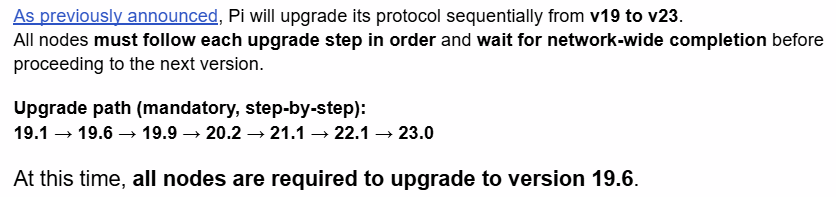
The current protocol shift moves the network sequentially from version 19 toward the advanced Stellar-based Protocol v23. Unlike routine maintenance, this series of upgrades requires node operators to follow a specific, non-skippable path (v19.1 → v19.6 → v19.9 → v20.2, and beyond).
Source: minepi
The Core Team has emphasized that the deadline for the first critical step is February 15, 2026. All Mainnet nodes must complete this initial upgrade to ensure they remain synchronized and connected to the blockchain. Nodes that fail to comply by this date risk being disconnected from the network, potentially losing their ability to participate in consensus and earn associated rewards.
Why the Upgrade Matters
The technical enhancements included in this protocol wave are vital for several key reasons:
-
Infrastructure Security: Strengthened protection layers reduce vulnerabilities and ensure long-term stability for the over 16 million Pioneers already migrated to the Mainnet.
-
Performance Scaling: Increased transaction throughput and improved node responsiveness are necessary to support the growing volume of decentralized applications (dApps) within the Pi App Studio.
-
Stellar Protocol Integration: Aligning with Stellar Protocol v23 introduces smarter contract capabilities and more robust consensus mechanisms, bringing Pi closer to a production-ready Open Network environment.
Strategic Roadmap for 2026
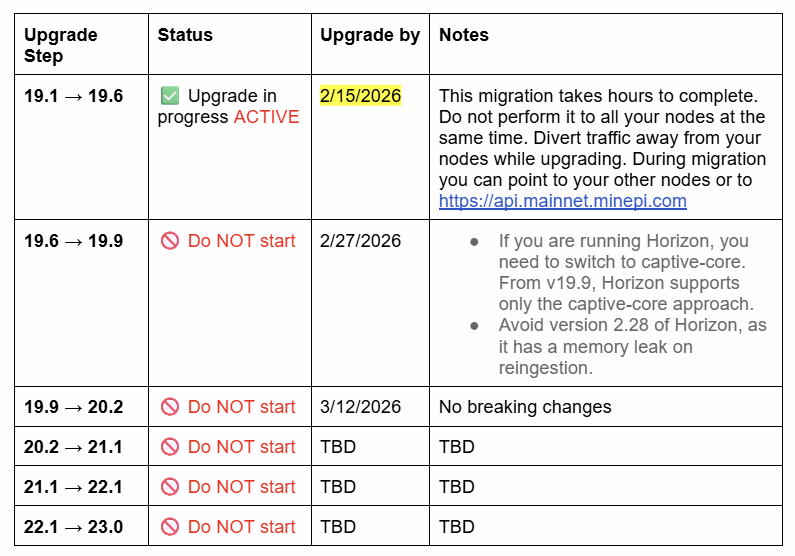
This February 15 deadline is the first of several milestones scheduled for the first quarter of the year. Following this initial step, subsequent upgrades are expected on February 27 (v19.9) and March 12 (v20.2). The culmination of this process is set to coincide with the launch of the Pi DEX, a decentralized exchange that will allow peer-to-peer asset trading directly on the Pi blockchain.
Source: minepi
“These upgrades reflect our disciplined approach to building a sustainable Web3 ecosystem,” a community analyst noted. “By prioritizing infrastructure integrity before full open trading, Pi Network is positioning itself to avoid the congestion and security pitfalls seen in other major blockchain launches.”
Action Required for Node Operators
All individuals running a Pi Node are advised to visit the official Pi Node technical portal immediately to download the necessary software updates and follow the step-by-step configuration guide.
For detailed instructions and to download the latest software, node operators should visit the official page: Pi Node Technical Guide.
Disclaimer: The views and analysis presented in this article are for informational purposes only and reflect the author’s perspective, not financial advice. Technical patterns and indicators discussed are subject to market volatility and may or may not yield the anticipated results. Investors are advised to exercise caution, conduct independent research, and make decisions aligned with their individual risk tolerance.
About Author: Nilesh Hembade is the Founder and Lead Author of Coinsprobe, with over 5 years of experience in the cryptocurrency and blockchain industry. Since launching Coinsprobe in 2023, he has been providing daily, research-driven insights through in-depth market analysis, on-chain data, and technical research.
Disclaimer: The information on this page may come from third parties and does not represent the views or opinions of Gate. The content displayed on this page is for reference only and does not constitute any financial, investment, or legal advice. Gate does not guarantee the accuracy or completeness of the information and shall not be liable for any losses arising from the use of this information. Virtual asset investments carry high risks and are subject to significant price volatility. You may lose all of your invested principal. Please fully understand the relevant risks and make prudent decisions based on your own financial situation and risk tolerance. For details, please refer to
Disclaimer.
Related Articles
Pi Network 18 million users complete KYC, and 26.5 million PI are issued to verifiers
Pi Network distributes 26.5 million PI tokens to more than 1 million community members who have completed KYC verification, to accelerate user identity verification and strengthen the decentralized model. 18 million already-verified users have laid the groundwork for the ecosystem’s development, but the key lies in how to convert these users into active participants. With the protocol upgrade, Pi Network is moving toward the open network phase, and smart contract support signals richer application scenarios.
MarketWhisper4h ago
Pi Network price hits a new 7-week low as a wave of 60 million token unlocks comes in
Pi Network's native token PI fell to $0.165 in April, hitting a 7-week low and leaving market sentiment weak. The unlock peak will release more than 60 million PI, adding downward pressure. Despite the core team recently publishing technical updates, it failed to improve market confidence and instead drew community criticism due to KYC access issues and the ongoing slide in price. Increased future supply could further drive prices lower.
MarketWhisper6h ago
Pi Network Distributes 26.5M PI to 1M KYC Validators
Pi Network has taken another step forward in building its ecosystem. The project recently distributed 26.5 million PI tokens to more than 1 million KYC validators.
These rewards were given to users who helped verify identities on the network. This process is important. Because it ensures that
Coinfomania20h ago
Pi Network PIRC baseline protection mechanism sparks controversy, implying a “quasi-stablecoin” logic
Pi Network member Daniel F raised a logical contradiction in the PIRC token design, noting that if it has a 23.8% floor protection, it would need to behave like a stablecoin, which conflicts with its high volatility on CEX. This floor is based on Pi’s price calculations; if Pi itself fluctuates significantly, it will be unable to effectively protect holders. Daniel emphasized the importance of transparency, but the project team did not respond to it, leading the community to continue speculating about the reasons for its silence.
MarketWhisper04-13 02:23
Pi Network Major Transformation: 210 Ecosystem Applications Deployed, 23k Developers Ready
The Pi Network ecosystem is accelerating its transition, with more than 210 active applications and 23,000 developers actively participating in Pi Studio, spanning multiple areas such as payments, community engagement, education, and gaming. The ecosystem’s diversity shows indicators of healthy development, and developers’ engagement is driving ongoing application optimization. In the future, improving the usefulness of the mainnet will be a key challenge, including issues that need to be urgently addressed such as scalability, security, and user adoption rates.
MarketWhisper04-13 02:06


