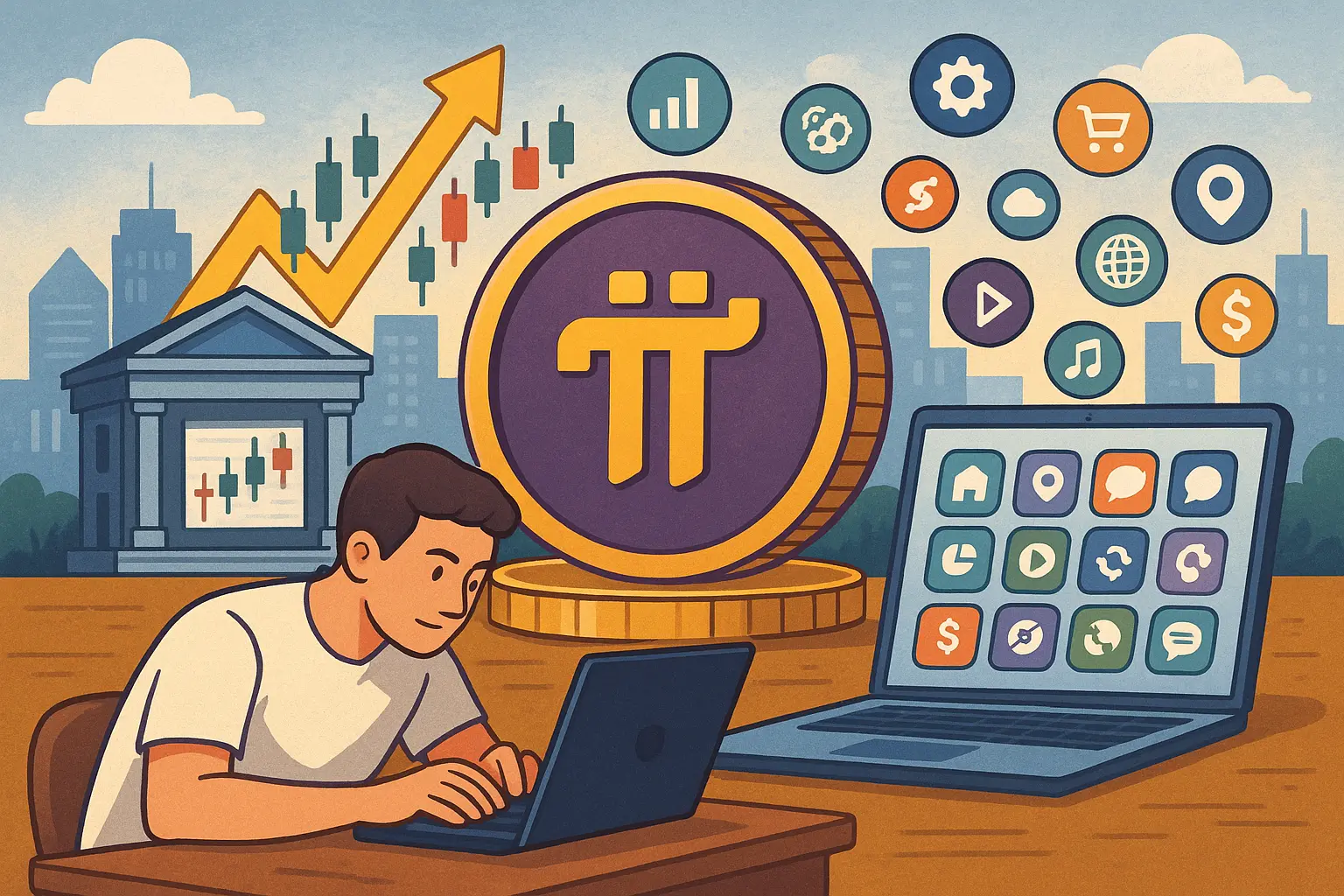
Pi Network focuses on digital payments and application development, temporarily delaying listing on mainstream exchanges. Currently, it has 35 million users and 215 applications, rapidly expanding in emerging markets such as Nigeria, Brazil, and Vietnam. On January 22, a community voting was launched, emphasizing practicality over price speculation.
Practicality-First Anti-Mainstream Approach
Pi Network has been committed to promoting its vision of building a digital interconnected economy, with the core team emphasizing usability for everyday users. Pi starts from local markets and gradually expands to global platforms, aiming to enable convenient digital payments. Therefore, the project prioritizes ease of use; any user with a smartphone can join without expensive mining hardware or complex technical knowledge.
Pi places greater importance on user experience rather than price trends. The system supports payments, application development, and peer-to-peer transactions, with the goal of facilitating real economic activity. Developers are dedicated to creating everyday tools, and Pi is being tested among local merchants, allowing its ecosystem to grow naturally. This “use first, then value” logic is in stark contrast to most crypto projects that “speculate first, then find applications.”
Last year’s strategic announcement by the core team shocked the community. They clearly stated that they would prioritize developing decentralized finance and practical applications rather than seeking to list on mainstream crypto exchanges. This decision broke the traditional path of crypto projects “listing equals success,” instead pursuing the long-term value of the ecosystem. The team believes that listing too early would lead to prices dominated by speculators rather than actual utility, harming the project’s long-term development.
Three Reasons Pi Network Rejects Listing
Avoid Speculation Dominance: Listing often leads to prices controlled by short-term speculators, disconnecting from the project’s long-term value
Reduce Early Sell Pressure: Delaying listing prevents large early users from cashing out, protecting ecosystem growth
Focus on Ecosystem Building: Resources are invested in application development rather than paying high listing fees (often millions of dollars)
This strategy has polarized reactions within the community. Supporters see it as demonstrating the team’s long-term vision and commitment to practicality, while critics question whether it’s just delaying or shows a lack of confidence in competing in open markets. Regardless, this anti-mainstream approach has become a distinctive feature of Pi Network.
215 dApps Building a Digital Economy Closed Loop
According to the team, the ecosystem of 100 decentralized applications (dApps) that Pi Network plans to build is still under development. Currently, over 215 applications are online or in testing, exceeding the initial goal. These dApps cover areas such as payments, lending, NFTs, gaming, and social networking, aiming to create a self-sufficient crypto economy.
The core team promotes its YouTube channel, offering tutorials on how to build applications and implement payment functions. New users follow these tutorials step-by-step, accelerating knowledge dissemination. Higher education levels boost user confidence, which directly promotes long-term engagement. This “education first” strategy is uncommon in the crypto industry, where most projects focus on marketing and price speculation; Pi invests in user capability building instead.
Testing of practical applications is accelerating. From cafes and restaurants to grocery stores, more local merchants are accepting Pi as a payment method. Although these merchants are mainly in developing countries like the Philippines, Nigeria, and Vietnam, this aligns with Pi’s strategic focus. In these regions, traditional financial services are insufficient, but smartphone penetration is high. Pi’s zero-threshold participation makes it an ideal digital payment tool.
However, the scale and quality of actual applications remain to be verified. While 215 dApps sound impressive, if most are in “testing” or “zombie” states, they won’t generate sufficient network effects. The key is how many applications have real daily active users and transaction volume. Pi Network has not yet disclosed detailed usage data for each dApp, and this lack of transparency has raised some doubts.
Action-First Strategy to Capture Emerging Markets
Pi adopts an action-first strategy, utilizing low-power design and removing hardware barriers. As a result, users in emerging markets can join easily. Users in Nigeria, Brazil, and Vietnam are very active, and Pi positions itself as an inclusive platform. This geographic focus is not accidental but based on deep market insights.
In developed countries, users already have mature banking systems and convenient digital payment tools (like credit cards, Apple Pay, Alipay). Compared to these, Pi’s advantages are less obvious. But in emerging markets, hundreds of millions of people lack bank accounts (unbanked) but own smartphones. Pi’s zero-cost participation model (no need to buy specialized mining rigs or pay electricity bills) makes it an ideal digital currency entry point in these regions.
Nigeria is a prime example. As Africa’s most populous country with over 200 million people, its banking coverage is less than 50%, and traditional bank fees are high. Pi’s user base in Nigeria has exceeded 5 million, making it one of the most popular crypto projects locally. Many small merchants are beginning to accept Pi payments, forming an initial payment network. Similar stories are unfolding in Brazil, Vietnam, the Philippines, and other countries.
This “rural encircles the city” strategy demonstrates strategic wisdom. Building a user base and payment network in less competitive emerging markets, then expanding to developed markets after accumulating network effects. This is similar to Alipay’s early expansion into third- and fourth-tier cities in China, eventually moving into first-tier cities and going global.
Community Voting Launches on January 22 to Open a New Chapter in Governance
On January 22, 2026, Pi introduced a community voting mechanism aimed at promoting decentralized governance. Although progress has been criticized as slow, improvements are underway. The organization is moving toward transparency and openness, gradually rebuilding user trust. This is an important step for Pi Network to respond to long-term criticism.
Since its founding in 2019 by Stanford graduates, Pi Network has been criticized for being overly centralized. The core team controls all key decisions, including token issuance, mainnet launch schedule, and ecosystem strategy, which contradicts the decentralization spirit of blockchain. The introduction of the voting mechanism marks a shift of power toward users, although initial voting may be limited to minor decisions. It’s a first step toward full decentralized governance.
Details of the voting process are not fully disclosed, but known frameworks include: Pioneers holding verified identities can participate, voting weight may be linked to holdings or activity, initial issues may include ecosystem fund allocation, dApp review standards, etc. As governance matures, it may expand to protocol upgrades, tokenomics adjustments, and other core decisions.
This governance evolution is crucial for Pi Network’s long-term value. Decentralization is not just a technical feature but a source of trust. When users know they can participate in decision-making, their loyalty and willingness to hold long-term will significantly increase.


