BitMine Immersion Technologies surpasses 2 million ETH staked, with a total holding of 4.24 million ETH, accounting for 3.5% of circulating supply. Based on a combined staking rate of 2.81%, the annualized return is $164 million. If all staked assets generate daily revenue exceeding $1 million, the company plans to launch its own validators in 2026 to internalize operations.
The Rise of BitMine Staking Empire: 2 Million ETH Milestone
The world’s largest publicly traded Ethereum treasury, BitMine, added 40,302 ETH in the past week, bringing its total holdings to 4,243,338 ETH. More notably, its staked ETH balance surged by 171,264 ETH during the same period, pushing the total staked amount to 2,009,267 ETH, officially surpassing the 2 million mark. This figure indicates that BitMine has staked over 47% of its Ethereum holdings, far above the industry average.
According to the Ethereum comprehensive staking rate (CESR) of 2.81%, which estimates annualized returns for validators, BitMine’s current staking position, based on an ETH price of $2,917 at the time of writing, yields an annualized return of $164 million. This translates to about $13.7 million per month or approximately $450,000 daily in passive income, without incurring traditional mining electricity or hardware depreciation costs.
Chairman Tom Lee revealed a broader vision in a recent statement. If the company stakes all 4.24 million ETH, based on the same CESR benchmark, it could generate approximately $374 million annually, or “over $1 million daily.” Such staking scale is nearly unmatched in the crypto industry, demonstrating that BitMine is building an Ethereum empire centered on revenue.
It’s worth noting that BitMine’s staking strategy was not built overnight. The staking balance increased by 171,264 ETH over the past week, averaging about 24,466 ETH added daily. This sustained and large-scale staking behavior reflects the company’s strong confidence in Ethereum’s long-term value. Meanwhile, this gradual staking approach also avoids market liquidity shocks from large, one-time staking.
Strategic Ambition Behind 3.5% Market Share
Based on an estimated circulating supply of 120,700,000 ETH, BitMine currently holds 3.52% of the token’s circulating supply. This ratio is unprecedented among publicly traded companies, indicating that BitMine has become a key player influencing Ethereum’s market supply and demand dynamics. More importantly, the company publicly aims to acquire 5% of the total ETH supply.
What does a 5% target mean? With the current circulating supply, BitMine needs to hold about 6,035,000 ETH, leaving roughly 1.79 million ETH to reach that goal. At the recent weekly addition rate of 40,302 ETH, achieving this would take about 44 weeks, less than a year. However, this simple extrapolation is not entirely accurate, as BitMine’s acquisition speed is accelerating, with recent weekly increases already surpassing previous averages.
Holding 5% of the circulating supply would give BitMine significant market influence. Under proof-of-stake, large-scale staking not only generates revenue but also grants influence over network governance. While the Ethereum community remains cautious about centralization risks, BitMine’s status as a publicly traded company, with transparent holdings and regulatory oversight, somewhat alleviates these concerns.
In addition to Ethereum holdings, BitMine reports holding $682 million in cash, 193 Bitcoin, and minority equity investments, bringing total crypto and cash holdings to $12.8 billion. This diversified asset allocation shows that, although Ethereum remains core to its strategy, the company maintains ample liquidity and risk hedging. The $682 million cash reserve provides strong backing for future ETH accumulation.
Building Validator Infrastructure for Internalized Staking by 2026
BitMine is currently collaborating with multiple staking providers but plans to launch its own validator infrastructure in the U.S. by 2026. This strategic shift will enable internalization of staking operations, offering multiple advantages. First, self-built validators can eliminate third-party staking service fees, which typically range from 5% to 15% of staking rewards. Based on the current annualized return of $164 million, internalization could save between $8.2 million and $24.6 million annually.
Second, building its own infrastructure provides higher security and control. While third-party staking providers are professional, they still pose risks such as smart contract vulnerabilities, private key mismanagement, or service outages. Multiple incidents of staking service hacks in 2023 resulted in losses of hundreds of millions of dollars, prompting large holders to consider self-built solutions. Constructing validators in the U.S. also aligns with regulatory compliance for a publicly traded company.
Third, self-built validators allow BitMine to participate in MEV (Maximal Extractable Value) profits. Professional validators can optimize transaction ordering and block construction to earn additional revenue beyond basic staking rewards. Industry data suggests MEV can boost total validator income by 20% to 50%. If successful in capturing MEV opportunities, BitMine’s annualized earnings could rise from $164 million to over $200 million.
However, building validators also presents challenges. Ethereum validators must operate 24/7; any downtime results in penalties. BitMine will need to invest in redundant hardware, a professional operations team, and disaster recovery plans. Initial investments are expected to reach tens of millions of dollars, but for a company holding $12.8 billion in assets, this is a manageable and strategic investment.
Intensified Competition in Ethereum Treasury Space
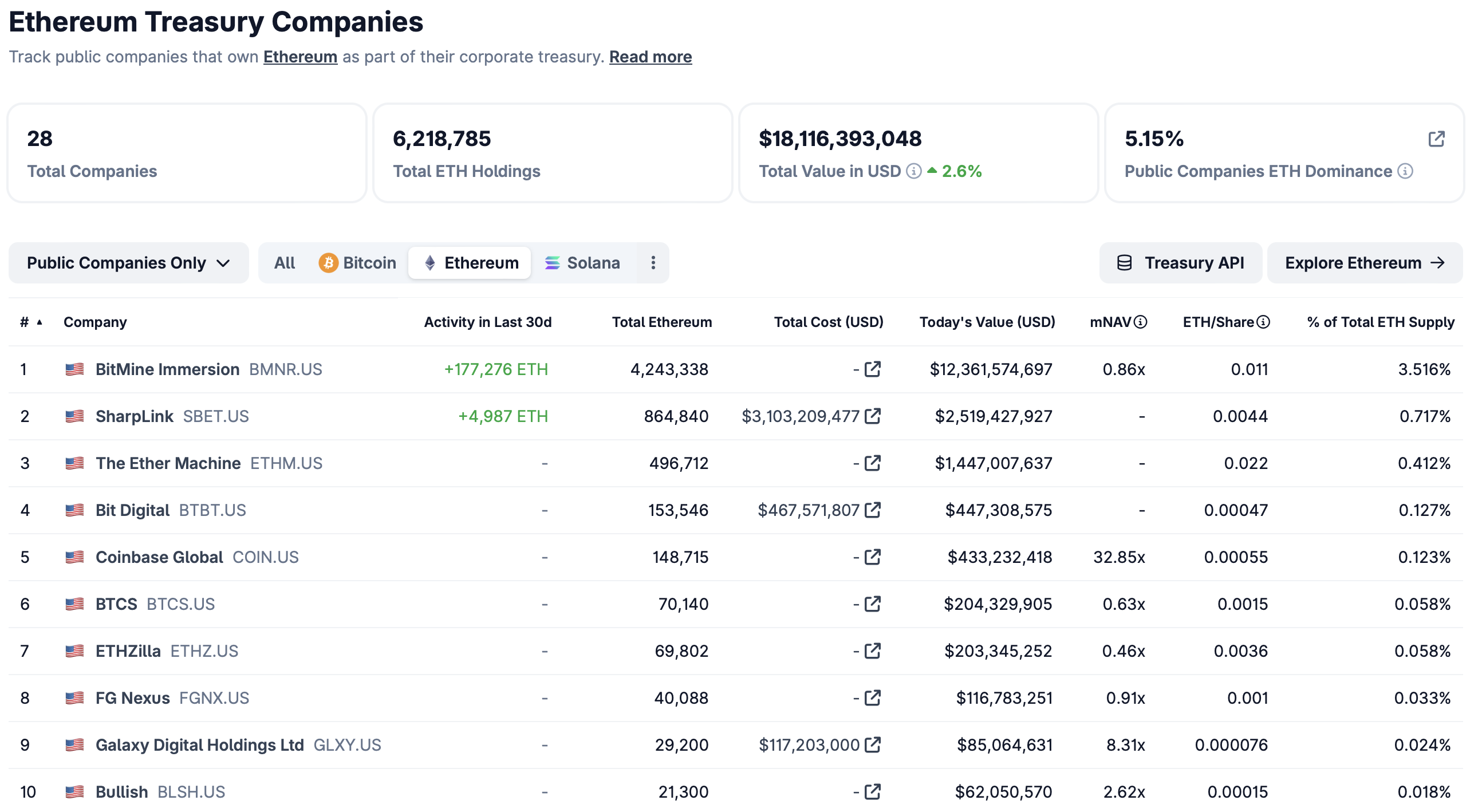
(Source: CoinGecko)
BitMine is not the only digital asset manager staking large holdings to earn protocol rewards. According to CoinGecko data, SharpLink Gaming is the second-largest Ethereum treasury, holding 864,840 ETH. On January 9, SharpLink Gaming disclosed that over the past seven months, it earned 10,657 ETH from staking rewards, worth about $33 million. This indicates that staking has become a core profit model for Ethereum treasury companies.
The third-largest treasury, Ether Machine, holds 496,712 ETH. Last year, the company announced plans to launch a publicly traded, yield-oriented Ethereum tool targeting institutional investors. Bit Digital holds 153,546 ETH; in June this year, it announced plans to gradually cease or sell its Bitcoin mining operations and use the proceeds to increase its Ethereum holdings.
This industry trend is driven by explosive growth in Ethereum staking demand. Data from January 17 shows that the ETH withdrawal queue has dropped to zero, while over 2,600,000 ETH remain waiting to be staked— the largest backlog since mid-2023. This supply-demand imbalance could push up staking yields further, encouraging more institutional participation.
Related Articles
Trader Maji Closes HYPE Long Position; Current BTC and ETH Longs Exceed $80M
Gate News message, April 23 — Trader Maji closed his entire HYPE long position 3 hours ago, according to Hyperbot data. He currently maintains a 25x leveraged Ethereum long position holding 18,000 ETH
GateNews7m ago
Kevin O'Leary Says Only Bitcoin and Ethereum Are "Worth Owning" Among Cryptocurrencies
Gate News message, April 23 — Renowned investor Kevin O'Leary stated that only Bitcoin and Ethereum deserve a place in investment portfolios, according to remarks made on the Varney & Co. program. The President of O'Leary Ventures said he has restructured his crypto holdings after years of
GateNews14m ago
Dormant Whale Returns After 1.6 Years, Purchases 3,000 ETH Worth $7M
Gate News message, April 23 — According to Onchain Lens, a whale address dormant for 1.6 years has purchased 3,000 ETH at $2,333 per token, totaling approximately $7 million.
The address currently holds 3 million USDC in its wallet, suggesting it may continue accumulating ETH.
GateNews53m ago
ETH Liquidation Cascade: $1.056B Short Squeeze at $2,426, $365M Long Liquidations at $2,218
Gate News message, April 23 — According to Coinglass data, if Ethereum (ETH) breaks above $2,426, short liquidations across major centralized exchanges would accumulate to $1.056 billion.
Conversely, if ETH drops below $2,218, long liquidations would reach $365
GateNews1h ago
Whale Opens 7,000 ETH Long Position With 20x Leverage, Worth $16.34M
Gate News message, April 23 — A whale address starting with 0xa875 opened a 20x leveraged long position on Ethereum an hour ago, according to Onchain Lens. The position comprises 7,000 ETH valued at approximately $16.34 million at an average entry price of $2,350. The position is currently underwate
GateNews2h ago
Whale Opens 25x Leveraged ETH Short Position Worth $5.15M, Plans Liquidation Between $2,343 and $2,280
Gate News message, April 23 — A whale address starting with 0x3bc opened a 25x leveraged short position on ETH over the past three hours, worth $5.15 million with an average entry price of $2,343, according to Hyperinsight monitoring.
After the position moved into a 10% loss, the address placed a t
GateNews4h ago


