
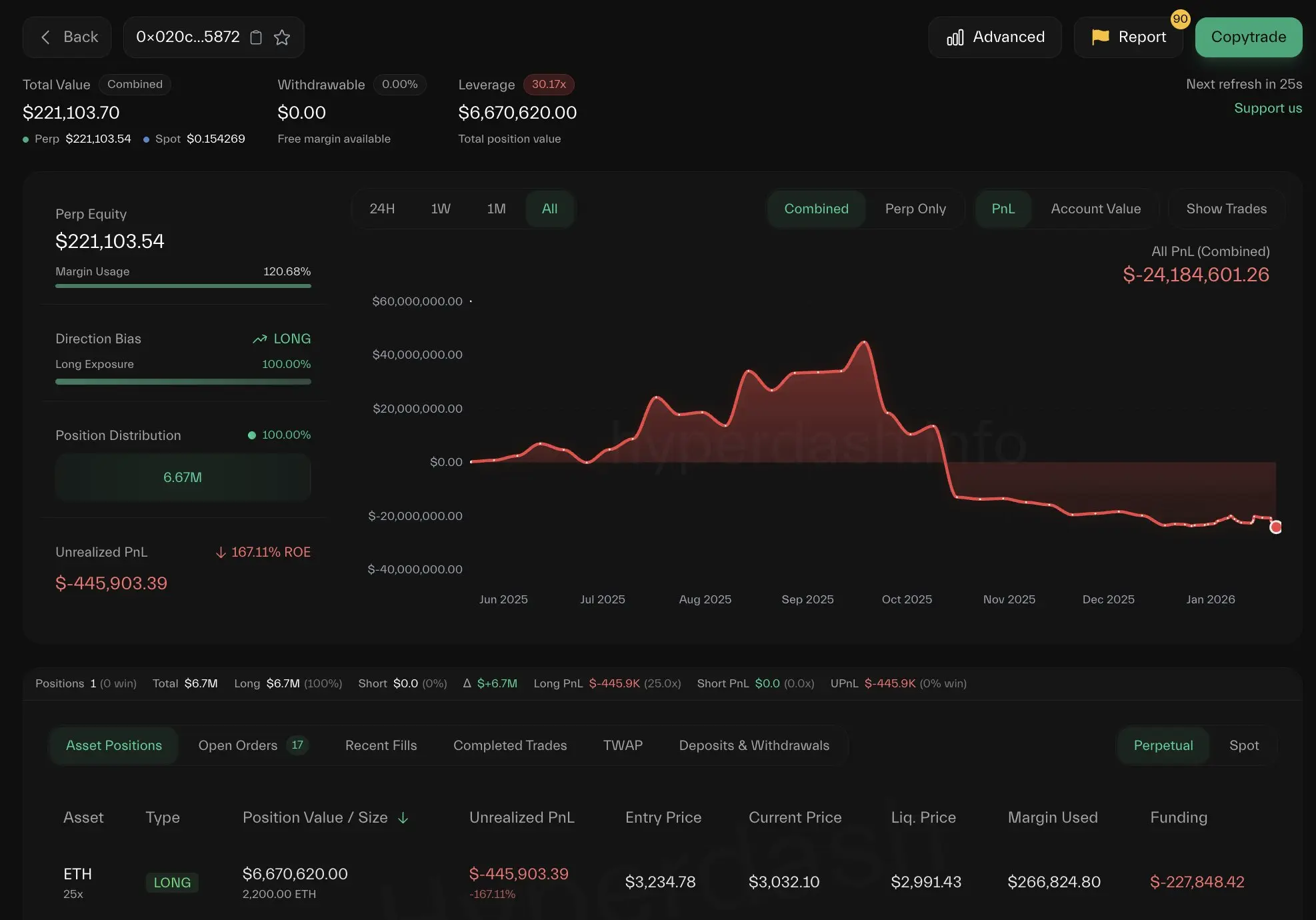
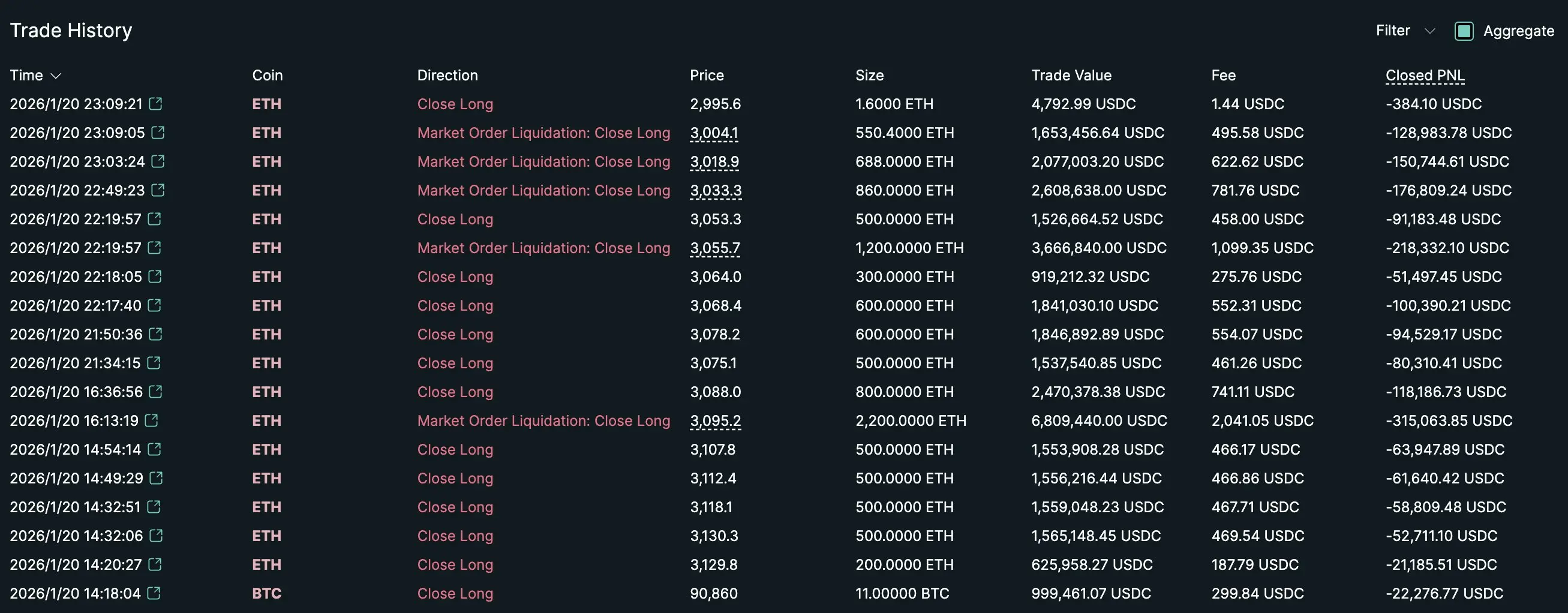
Celebrity “Maji Brother” Huang Licheng was liquidated 5 more times on January 20th. He currently holds 2,200 ETH (worth $6.67 million), with total losses expanding to $24.18 million. Having been liquidated 151 times, he ranks as the “Liquidation King” on Hyperliquid, yet calmly responded “The process was interesting,” sparking widespread discussion.
From a floating profit of 44 million to a total loss of 24.18 million, a rollercoaster ride
(Source: Hyperdash)
In recent years, Huang Licheng has invested in the crypto space, becoming a market focus. In June this year, he earned $6.5 million from HYPE tokens, once hailed as a “Crypto Legend.” However, in September, the market suddenly crashed, causing him to lose $18.5 million overnight. Since then, the market recovered; on September 19, his account’s floating profit once reached $44 million (about NT$1.37 billion). But good times didn’t last, and just 22 days later, on October 10, he experienced a major liquidation, with losses reaching a new high of $54.5 million.
Data platform Arkham on X (formerly Twitter) publicly disclosed Huang Licheng’s losses over the past 20+ days, showing he went from a profit of $44.5 million to a loss of $10 million, totaling a net loss of $54.5 million. In response, Huang Licheng reposted the platform’s post, calmly saying “Was fun while it lasted,” a composed attitude that surprised many.
On January 12th at 3 a.m., Huang Licheng reposted a message on X, showing that within just 24 hours, Ethereum and Bitcoin prices surged back to $2.28, a 150% increase. He captioned it “Crypto Rules Everything Around Me.” However, the good times didn’t last; on January 20th, the market declined again, and he faced 5 more liquidations today, with total gains and losses expanding to negative $24.18 million.
151 Liquidations, crowned Hyperliquid’s Liquidation King
(Source: Hyperdash)
According to on-chain data analysts, Maji Brother has been liquidated 151 times on Hyperliquid, earning him the title of “Liquidation King” on that platform. Last month, when ETH rose, he held a large long position, with floating profits reaching as high as $3 million. But this decline led to a liquidation, turning into a $1 million loss, bringing his assets back to the lowest point, with total losses reaching a record high of $22.45 million (about NT$7.1 billion).
Currently, Huang Licheng holds 2,200 ETH, valued at $6.67 million at current prices. The key point is his liquidation price set at $2,991.43, meaning if ETH drops below this level, he faces the risk of forced liquidation of all positions. Given ETH’s current volatile price swings, this liquidation price isn’t far off, and a slight market misstep could trigger a new round of liquidations.
Maji Brother’s trading strategy has sparked market debate. His trading record shows a typical pattern of high leverage, large directional bets rather than hedging or risk management. Such aggressive trading can yield astonishing gains in a bull market, like the $6.5 million profit in June and the $44 million floating profit in September, but during volatile times, it can lead to catastrophic losses. His 151 liquidations clearly demonstrate a “averaging down” strategy—losing money, then adding to positions to lower the average cost, hoping for a market reversal.
Crypto analysts point out that Maji Brother’s approach is a real-world lesson: no matter how large your principal, averaging down ultimately leads to liquidation. From a $44 million floating profit to a total loss of $24.18 million, he has lost over $68 million in total, exemplifying the extreme volatility of high-leverage trading. For most investors, this approach is extremely risky and not a strategy to emulate.
Why is Maji Brother’s trading publicly tracked?
Many are curious why Huang Licheng’s trading activities are known to outsiders. Crypto analyst A Shui once explained that although blockchain wallet addresses are anonymous, as a public figure, Huang Licheng’s past public statements can link to his interacting wallets. These links are tagged. Plus, since blockchain has a transparent ledger, all transaction records are accessible, allowing on-chain data analysts to trace.
Specifically, when Huang Licheng publicly discusses a token or trading strategy on social media, analysts can cross-reference large transactions on the blockchain at the same time, narrowing down potential wallet addresses. Once a wallet is confirmed to belong to him, all subsequent operations can be continuously tracked. Platforms like Lookonchain and Arkham monitor these activities in real-time and publish analyses.
This transparency is a double-edged sword of blockchain technology. On one hand, it ensures tamper-proof transaction records and market fairness. On the other, for public figures, this transparency means all investment decisions are scrutinized, turning successes into legends and failures into jokes. Huang Licheng appears to accept this reality; his calm response to losses indicates he doesn’t mind being publicly tracked.
The calm attitude behind his asset strength
Seeing Huang Licheng’s calm demeanor, many netizens find it hard to believe, commenting “You need to have enough assets to play like that,” “He can always come back anytime,” “His account has NT$44 billion, more than what he lost, so he’s not afraid.” These comments highlight a key point: Huang Licheng’s ability to stay calm stems from his overall asset size far exceeding his current losses.
As a well-known celebrity and early crypto investor, his asset allocation spans multiple fields. Besides his current trading positions, he may hold large amounts of early investments in cryptocurrencies, NFT projects, and traditional assets. The $24.18 million loss, while staggering, might only be a small part of his total wealth. This scale of assets allows him to endure high-risk operations; even after 151 liquidations, he can continue trading.
However, is this calm attitude worth emulating? The answer is clearly no. For most investors, limited capital and inability to withstand such huge losses make this approach unfeasible. Maji Brother’s style resembles a high-risk game of the wealthy, not a rational investment strategy. His case serves as a cautionary tale: high leverage, averaging down, and large directional bets are shortcuts to liquidation. No matter how wealthy, persisting with such strategies long-term will lead to significant losses.
Related Articles
Bitcoin, Ethereum and Solana ETFs Record Positive Net Inflows on April 16
Gate News message, according to the April 16 update, Bitcoin ETFs recorded a 1-day net inflow of +2,855 BTC (+$209.95M) and a 7-day net inflow of +11,849 BTC (+$871.52M). Ethereum ETFs showed a 1-day net inflow of +15,477 ETH (+$35.44M) and a 7-day net inflow of +90,366 ETH (+$206.94M). Solana ETFs
GateNews8m ago
Ethereum Foundation Announces ETH Rangers Project Results: Over $5.8M in Recovered or Frozen Assets
The Ethereum Foundation's ETH Rangers project has successfully completed, funding 17 researchers to enhance public security in the ecosystem. Achievements include recovering $5.8M in assets, identifying over 785 vulnerabilities, and developing several security tools.
GateNews17m ago
ETH drops 1.23% in 15 minutes: Retail’s concentrated sell-off and amplified ETF fund outflows weigh on the spot order book
2026-04-16 13:45 to 14:00 (UTC), ETH spot prices fell by 1.23% in just 15 minutes. The candlestick price range covered 2291.2 to 2336.98 USDT, with a swing of 1.96%. Market volatility intensified, sell pressure on the board became concentrated, and the trading community’s focus clearly shifted toward changes in capital outflows.
The main driver behind this abnormal move is large-scale, concentrated selling from retail. In the spot market, net outflows in the first 5 minutes reached as high as -$95.57M. Although some lead/major funds attempted to accumulate at lower prices (net inflows of +$18.95M in large orders over 5 minutes), the overall scale was limited and unable to effectively hedge the overall short-term selling pressure. Meanwhile, the ETH futures market did not show extreme liquidations or large-scale position closures, indicating that the core of the abnormal move came from a spot supply-and-demand imbalance rather than leveraged liquidation cascades.
In addition, ETH spot ETF funds have continued to experience net outflows in early April. On April 1, the single-day net outflow was $7.1M. The overall trend in Q1 was bearish, directly reflecting weakening institutional capital allocation intent and further undermining market confidence. Some funds have shifted to on-chain staking and emerging DeFi protocols. It is also worth noting that large holders with holdings in the 100,000-ETH range have continued to reduce their positions since the end of March. Whale capital outflows have persisted, and retail has followed the above signals, leading to a multi-factor selloff resonance effect in the short term. Although both the number of active addresses on the ETH chain and daily trading volume have hit historical highs, network usage and liquidity are overall strong, but capital flow has not formed any substantive spot buy orders, making it difficult to drive a price reversal.
At present, short-term market risk remains significant. Investors should pay attention to the strength of subsequent retail selling, the direction of ETF fund flows, and changes in large-holder positions. If large holders and major funds do not form a strong follow-through/acceptance, the spot market may continue to be affected by the release of structural supply. It is recommended that investors monitor key support zones in real time, track large on-chain fund movements, and watch for macro news developments, in order to reasonably mitigate the risk of short-term price fluctuations and promptly obtain more market information.
GateNews46m ago
ETH falls below 2300 USDT
Gate News bot message, Gate quotes show that ETH has fallen below 2300 USDT, with the current price at 2296.29 USDT.
CryptoRadar54m ago
Charles Schwab Launches Schwab Crypto Spot Trading for Bitcoin and Ethereum
Charles Schwab launched Schwab Crypto on April 16, a spot cryptocurrency trading service for retail customers. It supports direct trading of Bitcoin and Ethereum and offers education and support, integrating with existing financial services.
GateNews1h ago
Ethereum Foundation Funds $1M Audit Program for Smart Contract Developers
The Ethereum Foundation has launched a $1 million subsidy program designed to help Ethereum mainnet builders pay for professional smart contract security audits.
Key Takeaways:
The Ethereum Foundation launched a $1 million audit subsidy program on April 14, 2026, to help builders cover security r
Coinpedia1h ago


