
Bitcoin long-term holders sell 1.4 million coins, ETF only attracts 26.9 billion USD in inflows, leaving a 95 billion USD gap causing Bitcoin to lag behind macro assets. Correlation with Nasdaq drops to -0.42, hitting a new low. By 2025, it will be proven that everything is a trade, with a very short exit window, and the HODL culture will die. The target price for 2026 is predicted to be $174,000.
The brutal math behind the 1.4 million coin sell-off and ETF defense line
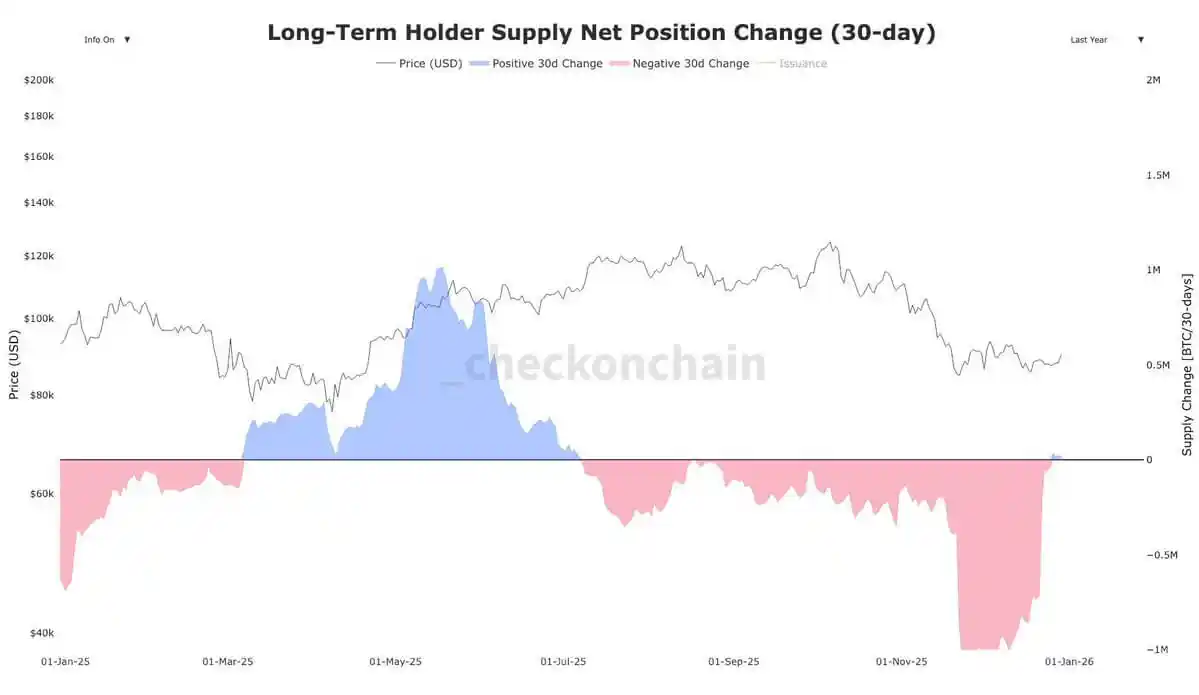
(Source: Checkonchain)
Since March 2024, long-term Bitcoin holders (OGs) have sold approximately 1.4 million BTC, worth about $121.17 billion. This figure is highly impactful, representing one of the largest profit-taking waves in crypto history. Most of these long-term holders accumulated Bitcoin in 2020-2021 or even earlier. Their sell-off indicates that even the most steadfast believers are choosing to cash out during this cycle.
Imagine if there were no ETF—what would the crypto market look like? Despite falling prices, capital inflows into BTC ETFs remain positive, totaling $26.9 billion. The roughly $95 billion gap is the reason Bitcoin has underperformed almost all macro assets. Bitcoin itself isn’t the problem; there’s no need to dig into unemployment rates or manufacturing data—this is just a large rotation by whales and “4-year cycle believers.”
This sell-off and buying imbalance reveal the true role of spot ETFs: they are a floor, not a ceiling. ETFs provide institutional-level buying support, preventing a collapse during large-scale sell-offs by long-term holders, but they do not generate enough incremental demand to push prices to new highs. The $26.9 billion inflow sounds substantial, but compared to the $121.17 billion sell-off, it’s just a drop in the bucket.
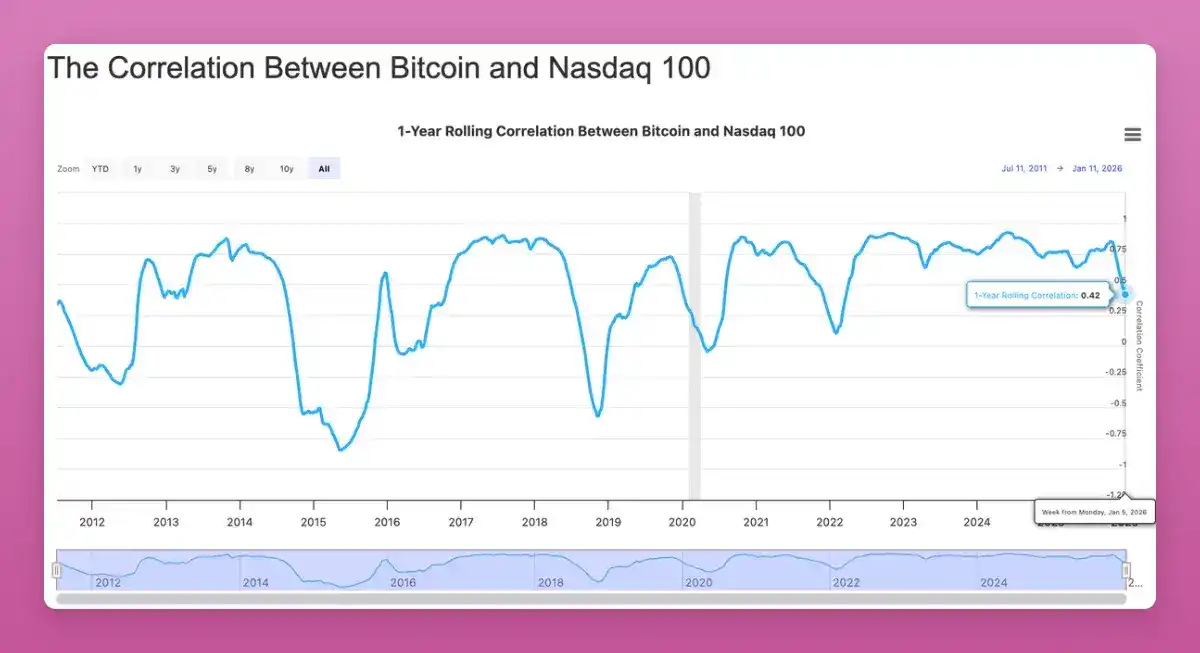
More importantly, Bitcoin’s correlation with traditional risk assets like Nasdaq has fallen to its lowest since 2022 (-0.42). While everyone hopes for correlation to break upward, in the long run, as an uncorrelated asset sought by institutions, this is actually a bullish signal. When Bitcoin no longer simply follows stock market fluctuations, its value as an independent asset class becomes more apparent.
Five truths about the crypto market in 2025
Spot ETFs are a floor, not a ceiling: $26.9 billion inflow blocks $121.17 billion sell-off, preventing collapse but not pushing prices higher
Airdrops continue but need focused effort: $4.5 billion distributed, but token fatigue worsens; strategic re-accumulation is necessary, not blind dumping
Fee switching sets a price floor: Buybacks prevent rises but only guard against crashes; UNI’s surge and retracement prove everything is a trade
Stablecoins go mainstream but trading is hard to profit from: Circle IPO surges then retraces; proxy assets perform poorly
DeFi is more decentralized than CeFi: Aave accounts for 60% market share; L2 multi-signature controls billions; conflicts of interest between equity and tokens
Signs indicate supply shocks have ended. Long-term holders’ sell-off gradually slowed in Q4 2025, possibly meaning most profit-taking has been completed. If in 2026 there is no such large sell pressure and ETF inflows continue or accelerate, the supply-demand balance could undergo a fundamental reversal.
Retail investors vanish and Meme coin supercycle fails
The prediction that “retail prefers Meme coins” has been proven wrong. In reality, retail investors do not favor cryptocurrencies; they buy gold, silver, AI stocks, and anything non-crypto. The Meme coin or AI proxy supercycle has not appeared. The harsh reality is: when Bitcoin surpasses $100,000, social media buzz drops to 2021 levels. YouTube crypto content views hit a five-year low, and X platform engagement collapses simultaneously.
In 2025, Bitcoin’s return is -7%, while palladium, rhodium, cobalt, silver, and gold outperform Bitcoin. People want returns, not stories about when they will get returns. When actual returns disappoint, even grand narratives cannot keep capital in the market. The “AI x Crypto remains strong” forecast is mixed; projects continue to deliver, standards evolve, and funding persists, but tokens fail to sustain any upward momentum.
The prediction that “NFTs are dead” is fully validated. In 2025, NFT market trading volume continues to shrink; apart from a few blue-chip projects maintaining minimal liquidity, most NFTs have become worthless or near worthless. This once-promising field, believed to revolutionize digital ownership, has now become a textbook case of a speculative bubble.
The logical reconstruction of $174,000 in 2026
2025 proved one thing: everything is a trade. Exit windows are extremely short, and no token has long-term conviction. As a result, 2025 marks the death of the HODL culture. However, after the supply shock ends, 2026 could see a turnaround. The forecast for 2026 is a Bitcoin price of $174,000, about 10% of gold’s market cap.
This target is not wishful thinking. Currently, gold’s total market cap is about $17.4 trillion. If Bitcoin reaches 10% of that, the price would be approximately $174,000. This ratio is logically plausible because the narrative of Bitcoin as “digital gold” has been accepted by institutions, and its non-correlated asset characteristics are being validated. If in 2026 long-term holders’ sell-off significantly decreases and ETF inflows sustain or accelerate, the improved supply-demand structure could push the price toward this target.
However, this requires investors to accept a new reality: Bitcoin is no longer a “buy and forget” asset but a trading instrument that requires active management.
Disclaimer: The information on this page may come from third parties and does not represent the views or opinions of Gate. The content displayed on this page is for reference only and does not constitute any financial, investment, or legal advice. Gate does not guarantee the accuracy or completeness of the information and shall not be liable for any losses arising from the use of this information. Virtual asset investments carry high risks and are subject to significant price volatility. You may lose all of your invested principal. Please fully understand the relevant risks and make prudent decisions based on your own financial situation and risk tolerance. For details, please refer to
Disclaimer.


