Uniswap Labs executed the largest token burn in history on December 27, permanently removing 100 million UNI tokens, with a market value at the time of approximately $600 million. This move implements the core mechanism of the UNIfication governance proposal, shifting the protocol from a fee accumulation model to a deflationary-driven framework. Protocol fees generated from Uniswap v2 and v3 will continue to be used for market buybacks and burning of UNI, gradually reducing circulating supply.
UNIfication Proposal Restructures Uniswap Economic Model
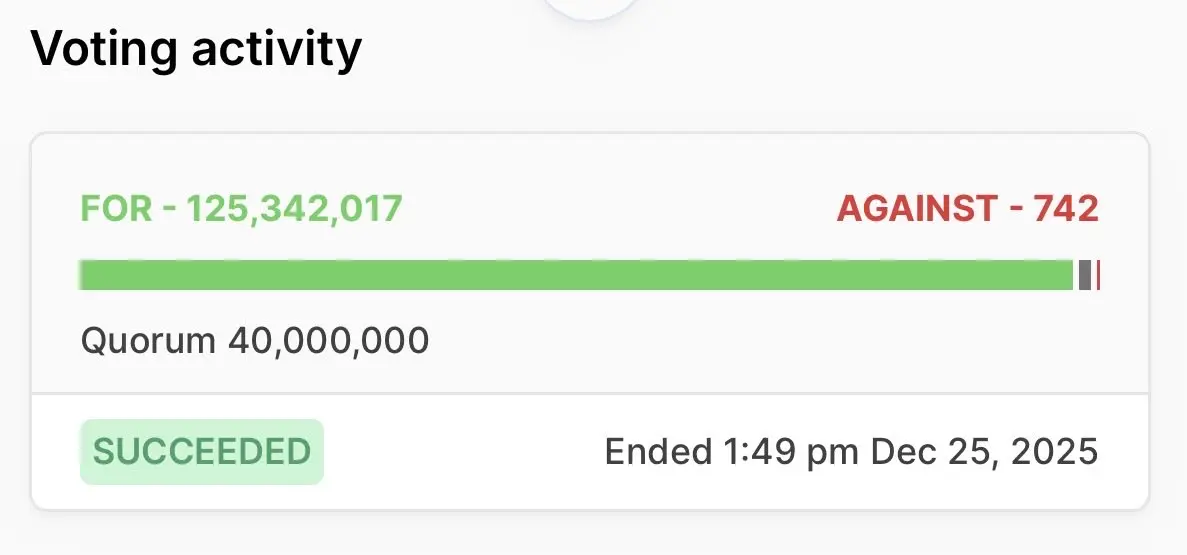
The UNIfication proposal was introduced in November 2025 and was overwhelmingly approved on December 25, marking the most significant economic model reform in Uniswap governance history. The core logic of the proposal is to establish a direct link between protocol revenue and token value. Previously, Uniswap’s protocol fees mainly accumulated in the treasury, lacking an immediate value transfer mechanism to UNI holders. The new model creates a closed loop of “fees → buyback → burn,” directly converting protocol operational results into token scarcity.
From a technical perspective, Uniswap v2 charges a 0.25% fee per trade, of which 0.05% is allocated to the protocol. V3 adopts a more flexible design, where liquidity providers route a quarter or a sixth of their earnings to the protocol based on fee tiers. These accumulated protocol fees were mainly stored in various tokens in the treasury, but now will be used periodically to buy UNI on the market and burn them permanently.
The 100 million UNI burn executed on December 27 is the first wave of this mechanism, reducing the circulating supply by about 10%. These tokens originally belonged to the Uniswap treasury reserve and were sent permanently to a black hole address via on-chain transactions, making them inaccessible to anyone. This irreversible burn mechanism establishes a clear market expectation of supply reduction. Supporters believe that as Uniswap’s trading volume continues to grow, ongoing buybacks and burns will gradually increase UNI’s scarcity, driving long-term value appreciation.
In addition to the token mechanism overhaul, UNIfication also reorganizes Uniswap’s organizational structure. Employees of the Uniswap Foundation will transition to Uniswap Labs, funded by the growth fund from the treasury. This integration aims to eliminate organizational barriers between development and operations, making protocol expansion decisions more efficient. Previously, the Foundation mainly handled community governance and ecosystem funding, while Labs focused on technical development. The merger signifies that Uniswap will operate with a more unified approach in facing the rapidly evolving DeFi competitive landscape.
How the Deflationary Mechanism Changes UNI’s Value Logic
Traditional DeFi protocol tokens often face a “value capture dilemma”: protocols can generate substantial trading fees, but this income is not effectively passed on to token holders. The deflationary shift in Uniswap directly addresses this issue by linking protocol profitability with token scarcity, establishing a value support mechanism for UNI similar to “stock buybacks.”
Three Major Value Transfer Paths of the Deflationary Model
Supply Contraction Creates Scarcity Premium: Each burn permanently reduces circulating supply. With demand unchanged, the unit token value theoretically increases.
Fee Growth Drives Buyback Scale: Uniswap’s monthly trading volume exceeds $60 billion across 40 blockchains. As protocol fee volume continues to expand, the burn rate accelerates.
Market Expectations Form a Positive Cycle: The transparency of the deflationary mechanism allows investors to forecast future supply curves, reducing uncertainty and attracting long-term holders.
Data from DefiLlama shows that Uniswap’s trading volume last month exceeded $60 billion. Even with a conservative estimate of a 0.05% protocol fee rate, this could generate approximately $30 million in protocol revenue per month. These funds will regularly be used to buy and burn UNI, creating ongoing buy-side support. Unlike one-time burns, this mechanism’s key lies in sustainability and predictability, allowing the market to forecast future burn scales based on Uniswap’s trading volume growth.
Market reactions to the initial burn confirmed the effectiveness of the deflationary logic. According to BeInCrypto data, UNI surged over 6% within 24 hours after the burn execution, reaching $6.38, a multi-week high. This price reaction was driven not only by the removal of 100 million tokens but also by market expectations of continued future burns. Technical analysis shows that UNI broke through multi-week descending trendlines, with increased trading volume, indicating a recovery of buying confidence.
However, the deflationary model also faces potential challenges. First, token burns reduce the circulating supply available for governance, potentially leading to further centralization of governance power. Second, if Uniswap’s market share declines due to competition, reduced fee income will weaken the burn efforts. Third, large-scale buybacks may temporarily inflate UNI’s price, creating unsustainable speculative bubbles. Therefore, the market needs to monitor whether protocol fee growth can sustain the long-term operation of the deflationary mechanism after initial excitement.
Future Revenue Expansion Plans
Uniswap Labs has explicitly stated that future revenue mechanisms may be proposed through separate governance processes. Potential future sources include layer-2 protocol fees, new features in Uniswap v4, revenue from UniswapX order flow, PFDA (Protocol Fee Distribution Agreement), and aggregator hooks. Once these new revenue streams are activated, they will significantly increase the funds available for burning, accelerating the deflation process.
Uniswap v4 introduces a “hooks” mechanism that allows developers to embed custom logic into liquidity pools, creating new revenue possibilities for the protocol. For example, certain hooks could impose additional fees on specific functions, with these fees routed to the burn mechanism. UniswapX, as an order flow auction protocol, can extract revenue from market maker bidding. Layer-2 protocol fees come from Uniswap’s deployments on various Layer 2 networks. As ecosystems like Optimism, Arbitrum, and Base grow, this revenue potential is substantial.
From a governance evolution perspective, UNIfication is only the beginning, not the end. Uniswap is transforming from a purely technical protocol into a decentralized organization with a complete economic closed loop. The activation of the deflationary mechanism sets a new standard in DeFi, and it is expected that other mainstream protocols will follow suit. For UNI holders, monitoring protocol fee growth, burn frequency, and market share changes will become key indicators for assessing investment value.
Disclaimer: The information on this page may come from third parties and does not represent the views or opinions of Gate. The content displayed on this page is for reference only and does not constitute any financial, investment, or legal advice. Gate does not guarantee the accuracy or completeness of the information and shall not be liable for any losses arising from the use of this information. Virtual asset investments carry high risks and are subject to significant price volatility. You may lose all of your invested principal. Please fully understand the relevant risks and make prudent decisions based on your own financial situation and risk tolerance. For details, please refer to
Disclaimer.


