Key Takeaways:
- Brazil approved a R$1.08 million ($197,000) tax-incentivized project that converts live Bitcoin price data into orchestral music.
- A custom algorithm will translate Bitcoin price movements and volatility into melody, rhythm, and tempo during a live performance in Brasília.
- The initiative highlights how crypto market data can power cultural experiences, not just financial products.
Brazil is bringing Bitcoin off the charts and onto the stage. A newly approved cultural project will use real-time Bitcoin market data to generate live orchestral music, blending crypto, mathematics, and art in a public performance in the nation’s capital.

Table of Contents
- Brazil Approves Bitcoin-Powered Orchestra Under Cultural Incentive Law
- How Bitcoin Price Data Becomes Live Music
- From Price Charts to Soundwaves
- A New Way to Experience Bitcoin Volatility
- Crypto Data as Artistic Material
Brazil Approves Bitcoin-Powered Orchestra Under Cultural Incentive Law
Brazil’s Ministry of Culture has cleared an experimental music project that will transform Bitcoin’s live price movements into sound. The approval allows organizers to raise up to R$1.08 million through Brazil’s cultural tax incentive framework, commonly known as the Rouanet Law.
In this system, the firms and individuals are allowed to fund acceptable cultural projects through tax-deductible contributions, which means that private funds constitute the major source of funds. The project falls under the category of the “Instrumental Music” and it is planned to raise funds up to December 31, 2025.
The concert will be held in Brasilia, which will further support the fact that the government wants to make the initiative more of a cultural experiment, but not a niche crypto event. Though the approval is concerned about funding, it also is a sign of official acknowledgement of Bitcoin being a legitimate source of creative data.
How Bitcoin Price Data Becomes Live Music
The main part of the project is an algorithm that will receive real-time signals of the Bitcoin market and transform them into the orchestra music instructions.
Read More: How Long Does It Take to Mine 1 Bitcoin in 2025?
From Price Charts to Soundwaves
The musicians will not use a predetermined musical score but will play according to the information in the data streamed by Bitcoin markets. As Bitcoin’s price changes, the system adjusts musical elements such as:
- Melody, driven by price direction and magnitude
- Rhythm and tempo, influenced by volatility and momentum
- Harmony and dynamics, shaped by broader market behavior
The final outcome is a performance that is in a continuous state of flux. With each change in price of Bitcoin, the soundscape is subject to changes, and every version cannot be repeated.
The organizers outline the aim as providing a sound that was audible as a representation of Bitcoin volatility where the audiences can audibly experience what the market is doing in real time. Instead of reducing the data, the system does not simplify the data and converts the numerical movement into a sound structure.
A New Way to Experience Bitcoin Volatility
Bitcoin can be discussed in terms of charts, indicators, and price alerts. This project is different since it transforms abstract data into a direct and emotional one. When the orchestra traces behavior of the market directly to music, it subjected them to the characteristic feature of Bitcoin, namely constant motion. Sudden tempo shifts can be caused by sharp price movements, whereas slower, steadier passages can be caused by low energy trading.
Read More: Bitcoin ‘After-Dark’ ETF Filing Targets Overnight Gains as Issuers Chase Fresh Alpha
Notably, trading and speculation are not encouraged in the project. It is not mentioned that on-chain infrastructure or blockchain transactions will be utilized when the performance happens. Bitcoin is not a payment rail or financial product but is solely utilized as a source of data. This distinction matters. It characterizes Bitcoin as an unrefined digital signal (like environmental or scientific data), not an investment pitch.
Crypto Data as Artistic Material
The project in Brazil is based on an increased tendency of artists to use crypto-native data as a source of creative input.
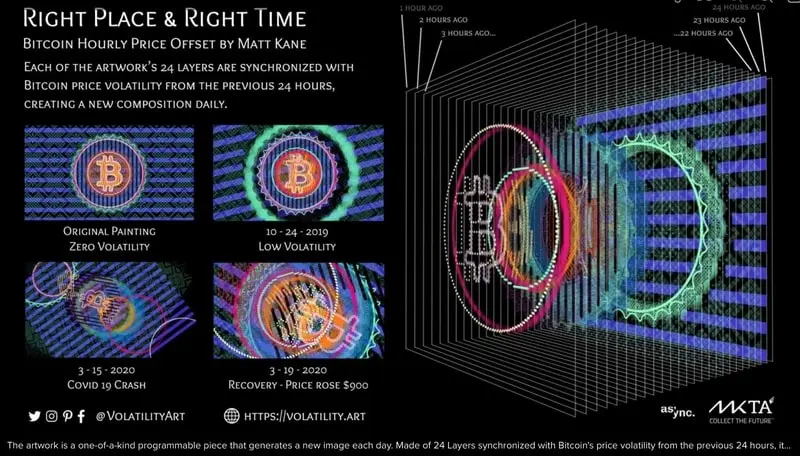
In 2020, digital artist Matt Kane published the programmable artwork, Right Place & Right Time, which visualizes itself in response to the price of Bitcoin. As the BTC grows or decreases, the art evolves form, colour, and composition becoming a part of the market statistics.
Another aspect of Bitcoin that has been exploited by musicians and performers is the culture. Other artists have used bitcoin symbolically, or released music directly on crypto networks in formats such as Bitcoin Ordinals, permanently embedding audio files on-chain.
The difference between the Brazilian orchestra and others is its live and analog performance. The traditional instruments react immediately to the digital signal, which is the interface between the millennia-old musical practice and contemporary financial technology.
Disclaimer: The information on this page may come from third parties and does not represent the views or opinions of Gate. The content displayed on this page is for reference only and does not constitute any financial, investment, or legal advice. Gate does not guarantee the accuracy or completeness of the information and shall not be liable for any losses arising from the use of this information. Virtual asset investments carry high risks and are subject to significant price volatility. You may lose all of your invested principal. Please fully understand the relevant risks and make prudent decisions based on your own financial situation and risk tolerance. For details, please refer to
Disclaimer.
Related Articles
BTC dips slightly by 0.53% in 15 minutes: whale transfers increase sell pressure and amplified liquidity widen the short-term drop
From 17:45 to 18:00 (UTC) on 2026-04-19, within 15 minutes BTC’s spot price fell -0.53%, with a price range of 74648.4 to 75212.8 USDT and a swing of 0.75%. During this period, market attention increased, volatility clearly accelerated, and the magnitude of the abnormal move exceeded typical levels for the same timeframe.
The main driver behind this abnormal move was that large-whale accounts concentrated transfers of BTC to a certain major exchange; the All Exchanges Whale Ratio (EMA14) rose to a near-ten-month high, and sell pressure increased significantly in a short time, becoming a direct cause of the spot price decline.
GateNews1h ago
BTC falls below 75,000 USDT
Gate News bot message, Gate quotes show that BTC has fallen below 75,000 USDT, with a current price of 74,985.2 USDT.
CryptoRadar1h ago
BTC breaks through 76000 USDT
Gate News bot message, Gate market shows, BTC breaks through 76000 USDT, current price is 76071.4 USDT.
CryptoRadar5h ago
Bitcoin ETFs Add $664 Million as Assets Top $100 Billion Again
Crypto exchange-traded funds (ETFs) capped the week with a powerful surge, led by bitcoin’s massive inflow that pushed assets back above $100 billion. Ether extended its streak, while XRP and solana continued their steady climb.
Key Takeaways:
Bitcoin ETFs drew $663.91 million, pushing net asset
Coinpedia6h ago
Whale Deposits 3M USDC to HyperLiquid, Increases 30x BTC Short Position to $52.89M
A whale deposited 3 million USDC to HyperLiquid, boosting its 30x leveraged Bitcoin short to 700 BTC, valued at $52.89 million. The short was opened at $75,919, with a liquidation price of $80,839.93.
GateNews6h ago


