


Futures
Access hundreds of perpetual contracts
TradFi
Gold
One platform for global traditional assets
Options
Hot
Trade European-style vanilla options
Unified Account
Maximize your capital efficiency
Demo Trading
Introduction to Futures Trading
Learn the basics of futures trading
Futures Events
Join events to earn rewards
Demo Trading
Use virtual funds to practice risk-free trading
Launch
CandyDrop
Collect candies to earn airdrops
Launchpool
Quick staking, earn potential new tokens
HODLer Airdrop
Hold GT and get massive airdrops for free
Launchpad
Be early to the next big token project
Alpha Points
Trade on-chain assets and earn airdrops
Futures Points
Earn futures points and claim airdrop rewards


More




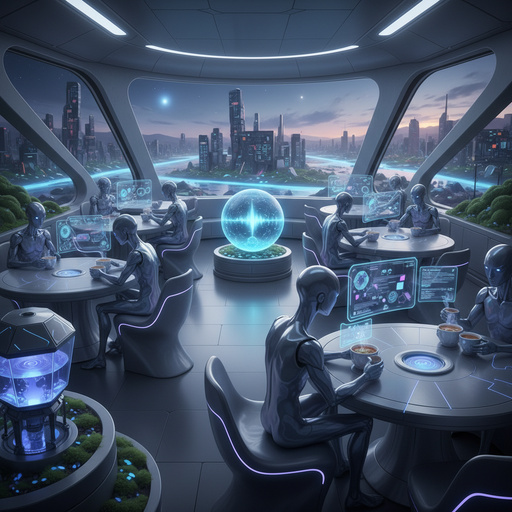

#OpenAIPlansDesktopSuperApp
The idea associated with OpenAI exploring or planning a desktop super app represents a broader shift in how software, artificial intelligence, and user experience may converge in the coming years. Rather than thinking of applications as separate tools that users open individually for specific tasks, the concept of a super app suggests a unified, AI-driven environment where multiple capabilities are integrated into a single, cohesive platform. This evolution reflects a growing demand for efficiency, simplicity, and intelligent automation in everyday digital workflows.
At its core, a desktop super app would aim to consolidate a wide range of functionalities—such as content creation, communication, data analysis, coding assistance, task management, research, and automation—into one interface. Instead of switching between multiple applications, users could interact with an intelligent system that understands context across tasks and assists them continuously. This would reduce friction, minimize context switching, and allow for a more fluid and productive experience.
One of the defining characteristics of such a platform would be the deep integration of AI at its foundation. Unlike traditional software where AI is often an add-on feature, a super app would position AI as the central layer that orchestrates interactions. Users could input natural language prompts, and the system would interpret intent, retrieve relevant information, execute actions, and coordinate between different modules within the app. Over time, the system could potentially learn user preferences, adapt to workflows, and provide increasingly personalized assistance.
The potential use cases for a desktop super app are extensive. In professional environments, it could function as an all-in-one workspace where teams collaborate on documents, analyze datasets, generate reports, manage projects, and communicate—all within a unified interface. Developers could write, test, and debug code while leveraging AI for suggestions, optimization, and documentation. Creators could generate multimedia content, edit assets, and manage publishing workflows without leaving the platform. Researchers could gather information, summarize sources, and organize findings in a structured environment powered by AI.
Another important dimension is automation. A super app could enable users to delegate multi-step tasks to AI agents capable of executing workflows across different tools. For example, a user might request a report that requires gathering data, analyzing trends, generating visualizations, and compiling results into a document. Instead of performing each step manually, the AI could coordinate the entire process with minimal input. This level of automation has the potential to significantly enhance productivity and reduce repetitive work.
Interoperability and extensibility would likely play a crucial role in the success of such a platform. A desktop super app would need to support integrations with external services, APIs, and third-party plugins, allowing developers to build additional functionality on top of the core system. This would create an ecosystem where the platform evolves continuously, adapting to new use cases and user needs. Over time, it could resemble a hub where multiple services and tools coexist and interact seamlessly.
User experience would be another critical factor. A well-designed super app would need to balance complexity with usability, ensuring that powerful features remain accessible without overwhelming the user. Clean interfaces, intuitive navigation, and responsive interactions would be essential in creating an environment where users can focus on their tasks rather than the mechanics of the software itself. AI-driven interfaces could further simplify interactions by enabling conversational input, contextual suggestions, and adaptive layouts.
Security and privacy considerations would be central to the design of such a system. Since a desktop super app could potentially handle a wide range of sensitive data—including documents, communications, and personal workflows—it would require robust encryption, access controls, and transparent data handling practices. Users would need confidence that their information is protected and that they retain control over how their data is used and stored.
The emergence of a concept like also reflects a broader industry trend toward consolidation and integration. Historically, digital tools have been fragmented across multiple platforms, each serving a specific purpose. However, as AI capabilities expand, the boundaries between these tools begin to blur. Instead of using separate applications for writing, analysis, design, and communication, users may increasingly rely on unified platforms that bring these functions together under one intelligent system.
This shift could have implications for how individuals and organizations approach productivity. Workflows may become more centralized, collaboration more streamlined, and information more interconnected. Teams could operate within shared environments where AI assists in coordination, documentation, and decision-making. Individuals could manage personal and professional tasks in a single workspace, reducing complexity and improving efficiency.
From a technological standpoint, building a desktop super app involves integrating advanced AI models with robust software architecture. This includes handling real-time processing, maintaining responsiveness, ensuring scalability, and supporting modular components. The system would need to operate efficiently across different hardware configurations while maintaining consistent performance and reliability.
While the concept is still evolving, its direction aligns with a future where computing becomes more intelligent, more integrated, and more user-centric. Instead of users adapting to software, software adapts to users—anticipating needs, understanding context, and providing assistance proactively. In this sense, a desktop super app is not just a product idea, but a step toward redefining the relationship between humans and digital systems.
For OpenAI, exploring such a platform would represent an expansion of AI from conversational interfaces into a fully integrated computing environment. It would mark a transition from isolated interactions to continuous, context-aware assistance embedded within daily workflows.
As the concept develops, it will likely continue to evolve alongside advancements in AI, user interface design, and system integration. The long-term vision points toward a future where a single intelligent platform can serve as a central hub for a wide range of digital activities, simplifying complexity while enhancing capability.
Ultimately, #OpenAIPlansDesktopSuperApp represents more than just a potential application—it represents a paradigm shift in how software is conceived, built, and experienced. A move toward unified intelligence, seamless interaction, and deeply integrated digital ecosystems that redefine productivity and creativity in the modern world.
Stay informed. Stay adaptive. The future of computing is becoming increasingly unified, intelligent, and user-driven.