Humanoid Robot Half Marathon Returns with Record Participation
On April 19, 2026, the 2026 Beijing Yizhuang Half Marathon featuring humanoid robots will take place, attracting over 100 teams—nearly a 5-fold increase from the previous year. According to the source, approximately 40% of participating teams will use autonomous navigation, and the competition will feature comprehensive upgrades in technical standards and rule systems.
Featured Robot Teams and Hardware Upgrades
Beijing Humanoid Robot Innovation Center
Beijing Humanoid Robot Innovation Center (“Beijing Humanoid”) will return with its Tiangong Ultra robot, the only team from the previous year’s competition that did not replace its machine. This year, three Tiangong Ultra units will compete in fully autonomous mode. According to Beijing Humanoid, participation aims not only to compete for the championship but also to accumulate experience for deploying general-purpose robots across diverse industry scenarios through extreme stress testing.
To meet the half-marathon challenge, Tiangong Ultra has undergone comprehensive hardware upgrades, including self-developed high-torque integrated joints and a new liquid cooling heat dissipation system to address heat generation during high-speed movement.
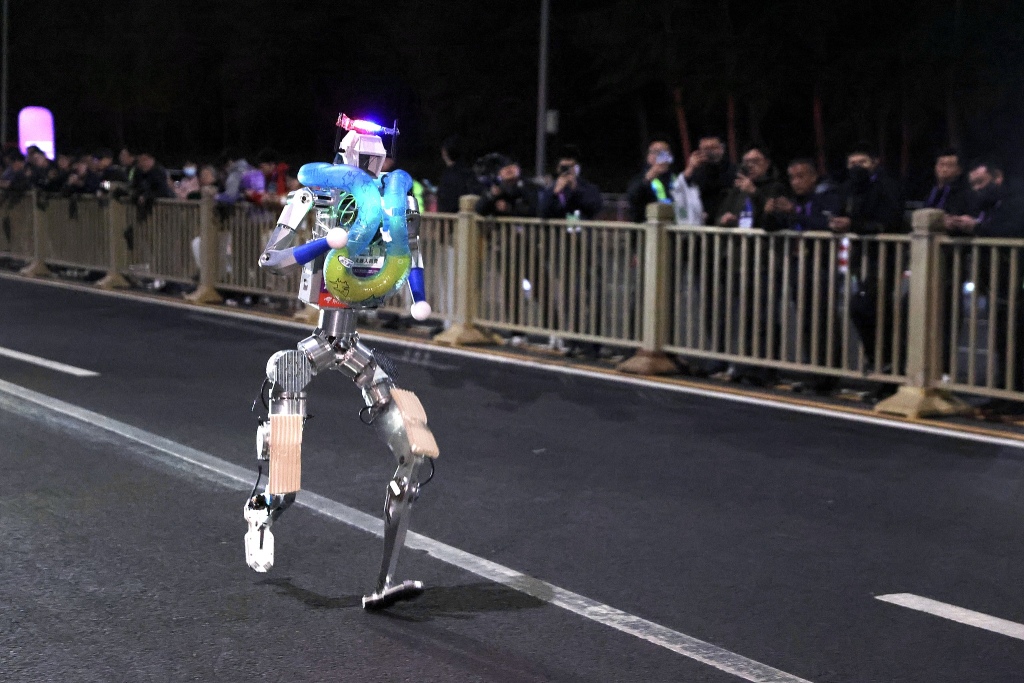
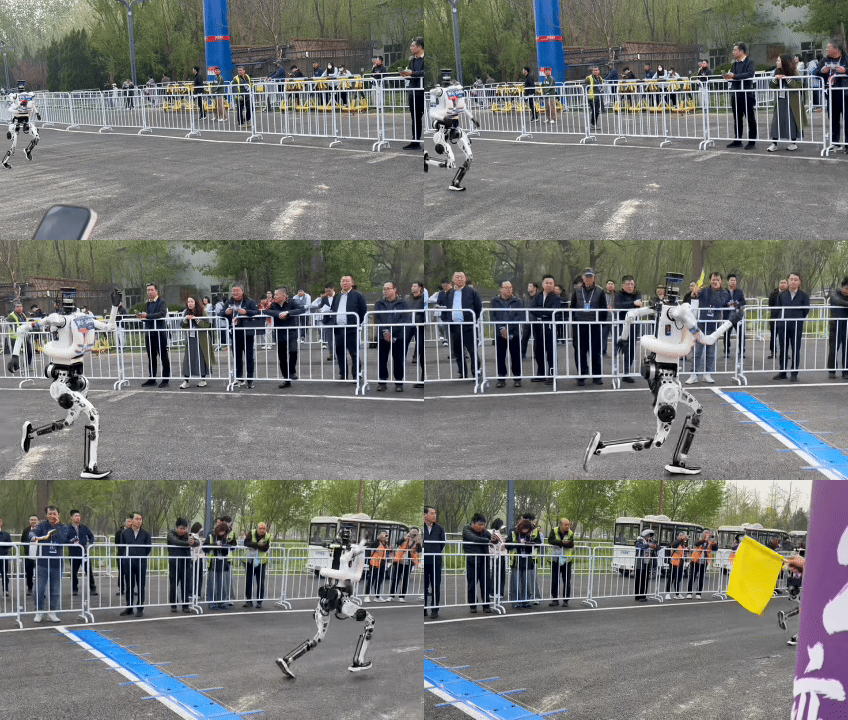 Beijing Humanoid’s competing robot at the qualifying race
Shanghai National-Local Humanoid Robot Innovation Center
The National-Local Humanoid Robot Innovation Center (“National-Local Center”) from Shanghai will participate for the first time, fielding three teams: National-Local Leap Team, National-Local Explorer Team, and National-Local Expedition Team. Their competition model is Linglong 2.0, designed for general-purpose lightweight scenarios, featuring outstanding dynamic balance and full-body coordinated control capabilities, as well as high-performance computing modules supporting motion control verification and embodied intelligence algorithm research in complex environments.
According to the source, the three teams will focus respectively on high-dynamic motion capability and stability, robot stability in complex environments, and complex environment adaptation with long-distance autonomous operation capability.
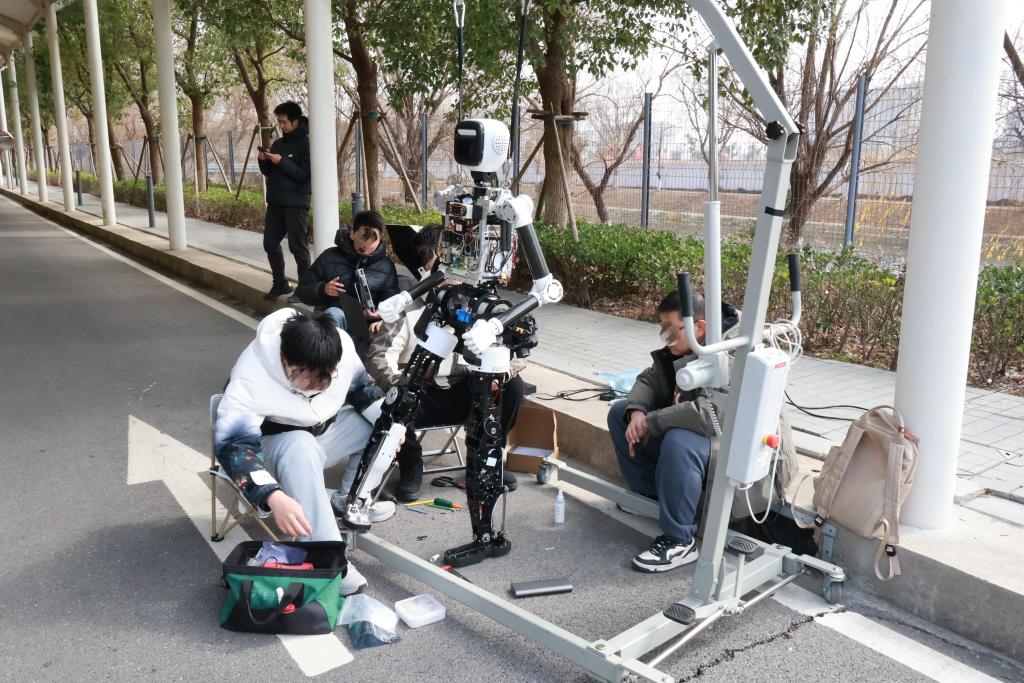 National-Local Leap Team testing their humanoid robot
Unitree Robotics
Unitree Robotics will participate for the first time with an official team, deploying a fine-tuned version of its H1 humanoid robot. According to the competition roster, Unitree has three official teams based in Beijing, Shanghai, and Hangzhou.
Unitree’s market manager Chu Yang previously stated in media interviews that H1 achieved a best internal test time of over 50 minutes for the half marathon. To address long-distance running, the team conducted deep optimization, with key upgrades to the battery endurance system, improved foot structure and grip design to enhance balance and adaptability on slopes and curves. According to Unitree’s recent H1 video, its maximum running speed exceeds 10 m/s.
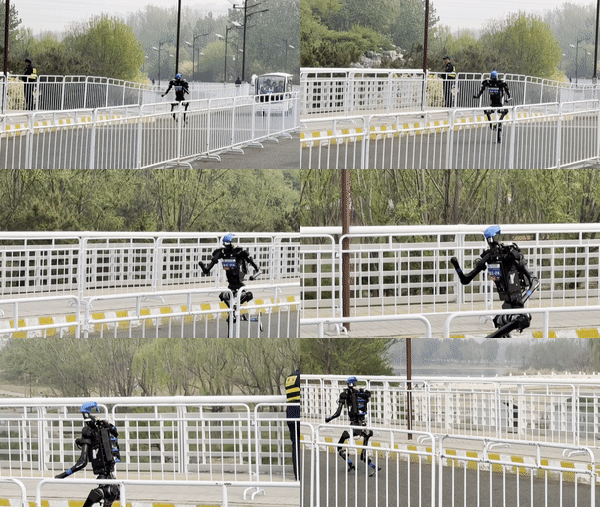 Unitree’s H1 humanoid robot running at the qualifying race. Photo by Sun Jiarui
Unitree stated that due to time and resource constraints, only the H1 model participates officially, while numerous independent teams will participate based on Unitree products after independent development.
Unitree founder and chairman Wang Xingxing previously stated that in this robot half marathon, many robots may run faster than humans, and the “ChatGPT moment” for embodied intelligence technology maturity and large-scale application deployment may arrive within the next two to three years.
Honor
Smartphone manufacturer Honor will participate for the first time, fielding two robot models: “Lightning” and “Yuanqi.” According to media reports, “Lightning” performed well in the April 11 test race, securing first place. To address the challenge of motor overheating during extended operation, this robot is equipped with a high-power liquid pump on its back, capable of achieving heat exchange flow exceeding 4 liters per minute.
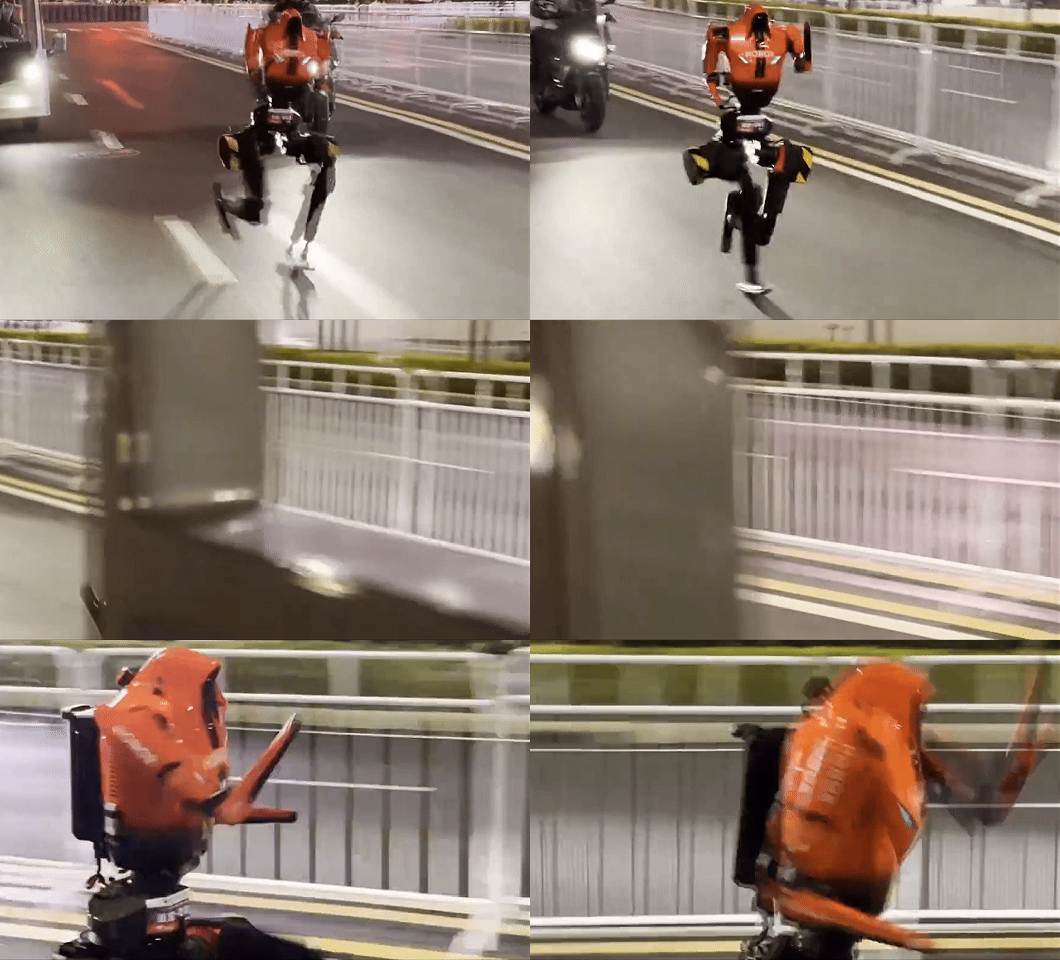 Honor’s “Lightning” robot accelerating at the test race. Source: CCTV News
Other Notable Competitors
Other robot competitors include last year’s runner-up Songyan Power’s “Little Troublemaker” N2, Zhishen Technology’s uniquely designed “Wind Breaker,” and Booster K1.
Autonomous Navigation as Key Innovation
The most significant highlight of this year’s event is the large-scale application of autonomous navigation mode. Unlike last year’s competition where most teams relied on manual remote control, approximately 40% of teams this year will allow robots to “run on their own.”
According to Li Quan, member of Beijing Economic-Technological Development Area Committee and deputy director of the Management Committee, all robot competitors will be equipped with specialized shoulder badges integrating Beidou spatial-temporal intelligent technology, enabling centimeter-level high-precision positioning and real-time trajectory transmission.
“Full autonomy” means robots have no navigator, no track, and no external guidance signals. They must rely entirely on their onboard multi-sensor fusion systems—including visual cameras, laser radar, and inertial measurement units—to perceive the surrounding environment in real-time and independently complete localization, mapping, path planning, and dynamic obstacle avoidance. This places extremely high demands on the robot’s environmental perception, real-time decision-making, and sustained stable motion capabilities.
To encourage autonomous navigation technology development and application, the competition committee innovated the scoring rules. Competing robots are divided into autonomous navigation and remote control groups, using mixed timing and unified ranking. Remote-controlled robots’ times are multiplied by a 1.2 weighting coefficient. This means that even if a remote-controlled robot crosses the finish line first, its final score may fall behind an autonomous navigation robot due to the coefficient adjustment.
 April 11, Beijing: The 2026 Humanoid Robot Half Marathon held full-process, full-element testing activities in Beijing Yizhuang. Photo by Wang Zirou, China News Service
Additional Upgrades and Safety Measures
Compared to the inaugural event, this year’s robot half marathon implements systematic upgrades in rule systems, safety measures, and award categories, further enhancing competition professionalism and fairness.
The race distance is 21.0975 kilometers. The track has been specially optimized for humanoid robot gait characteristics. For the first time, park ecology segments have been incorporated, combined with slopes, curves, and uneven surfaces to precisely test balance control and joint torque response. The GT professional track section balances speed and stability, accommodating human runner rhythm while providing standardized gait testing environments for robots.
Start procedures use staggered single-robot releases at 30-second intervals. Unlike last year where staff “ran alongside,” this year each robot will be followed by a golf cart carrying judges and staff to monitor the competition and handle emergencies. The track establishes clear “keep right, pass left” principles, with robots maintaining at least 5 meters safety distance from each other.
This year’s penalty rules are stricter: battery changes at designated stations incur no time penalty but the duration counts toward total time; battery changes outside stations are limited to emergencies only, with first offense penalized 5 minutes and second offense 10 minutes, accumulating thereafter. Robot replacements are limited to maximum 2 times, with first replacement penalized 15 minutes and second replacement 20 minutes. Additionally, autonomous navigation teams exceeding 3 cumulative violations of manual intervention rules will automatically be reclassified to remote control scoring.
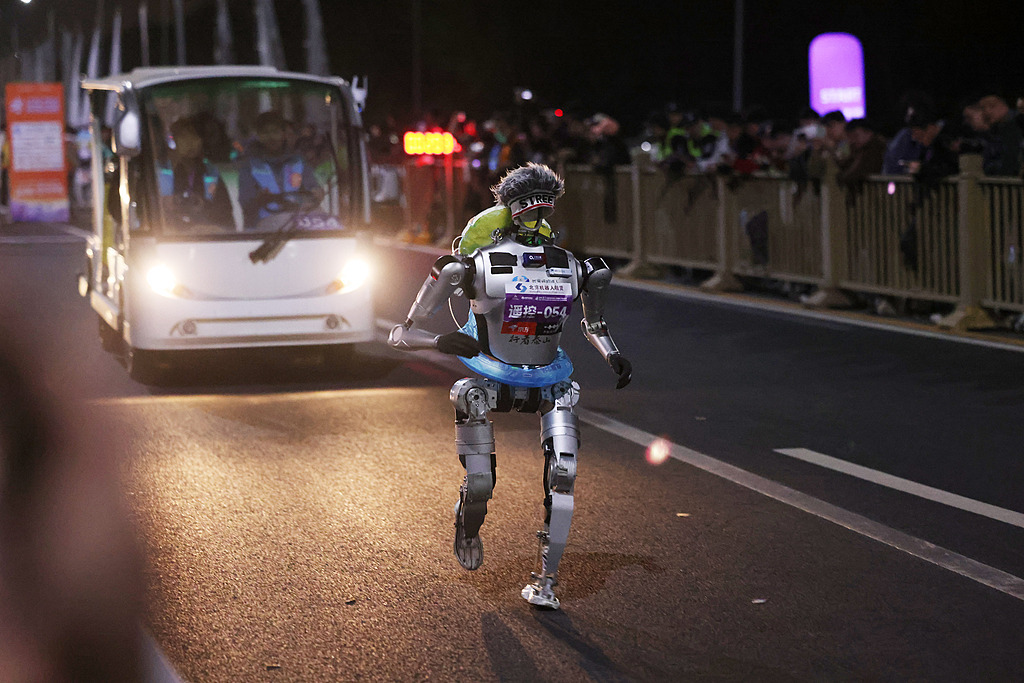 April 11, 2026, Beijing Yizhuang: During the 2026 Humanoid Robot Half Marathon’s full-process, full-element testing activities, a humanoid robot wearing a wig runs on the track. Photo by Visual China
The competition features a “robot ambulance” for support, and seven standardized supply and emergency response stations are positioned along the track, capable of battery replacement, equipment repair, and emergency reset operations.
Beyond speed-based championships (first, second, third place), the event includes completion awards and multiple technical awards: Best Endurance Award, Best Gait Control Award, and Best Design Award. The Best Endurance Award prioritizes completing the full distance without battery or robot replacement with the best time. The Best Gait Control Award will be selected through online voting on the official website, choosing the team with the most beautiful and anthropomorphic running posture. The Best Design Award is determined by expert review, evaluating technical innovation and structural rationality.
Significance Beyond Competition
Many may question the purpose of humanoid robots running a half marathon. The answer clearly extends beyond competition itself. This is not merely a speed contest or simple demonstration of results, but rather an extreme stress test and a trial ground for verifying technology maturity. Through this extreme challenge, China’s humanoid robots will move toward real-world scenarios and large-scale application more effectively and rapidly.


