A draft proposal circulating among Bitcoin developers would give holders roughly five years to move their coins to quantum-resistant addresses or watch them become permanently unspendable on the network.
Key Takeaways:
- BIP-361, co-authored by Casa CTO Jameson Lopp, proposes freezing Bitcoin in legacy addresses within 5 years of activation.
- Over 34% of all Bitcoin has an exposed public key onchain, with quantum attacks potentially viable by 2027-2030, per McKinsey.
- BIP-360 entered testnet via BTQ Technologies in early 2026, setting the foundation BIP-361 requires before its phased timeline begins.
BIP-361 Would Give Bitcoin Holders Five Years to Move Funds or Face Permanent Freeze
The proposal is Bitcoin Improvement Proposal (BIP)-361, titled “Post Quantum Migration and Legacy Signature Sunset.” It was formally assigned on Feb. 11, 2026, and lists six co-authors, including Casa CTO Jameson Lopp. The draft is currently in informational status and requires no immediate action from anyone holding bitcoin.
The core concern is straightforward. Bitcoin’s existing cryptography relies on elliptic curve math. A quantum computer running Shor’s algorithm could, in theory, work backward from a public key to derive a private key. Addresses that have already broadcast a public key onchain are the most exposed. As of March 1, 2026, that category reportedly covers more than 34% of all bitcoin in circulation.
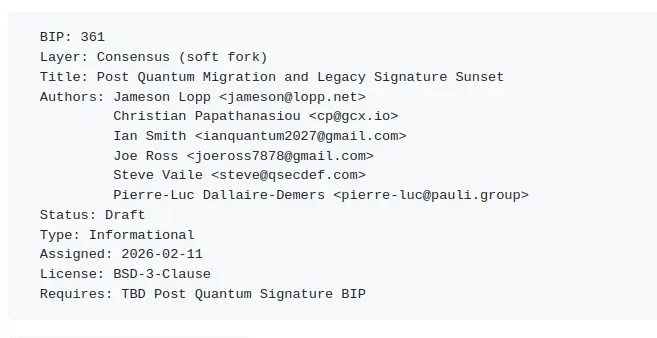
BIP-361 lays out a three-phase soft fork plan. Phase A would begin approximately three years after a companion quantum-resistant address proposal, likely BIP-360, is activated. During Phase A, wallets would be blocked from sending funds to legacy address types, pushing users toward newer quantum-safe formats. Phase B would kick in two years after that, rendering all legacy signatures invalid at the consensus layer. Coins that did not migrate would become frozen, and would be unable to move.
A third phase, still under research, would allow holders of frozen coins to prove ownership through a zero-knowledge proof tied to a BIP-39 seed phrase and recover their funds. In addition to Lopp, BIP-361 co-authors include Christian Papathanasiou, Ian Smith, Joe Ross, Steve Vaile, and Pierre-Luc Dallaire-Demers. Moreover, this is not the first time Lopp has floated this idea. In a blog post published in mid-March 2025, Lopp said burning vulnerable coins may be the least-worst option.
In the blog post, Lopp argues that allowing quantum computers to “recover” bitcoin from vulnerable addresses would effectively legitimize theft and concentrate wealth in the hands of a few technologically advanced actors, undermining Bitcoin’s core security model. He contends that a better outcome is to “burn” those vulnerable coins.
This would make them permanently unspendable in order to prevent large-scale economic disruption, protect user confidence, and preserve fairness across the network. While this approach may harm inattentive users who fail to upgrade, he sees it as the lesser of two evils compared to widespread redistribution and loss of trust. Ultimately, Lopp frames the issue as a game theory problem, concluding that incentivizing users to migrate to quantum-safe systems strengthens Bitcoin long term.
At the time, the post was controversial on the Reddit forum r/ cryptocurrency with the top comment saying, “ BTC ceases to be BTC if you fork it to mute wallets you think are a risk to your investment.” Others commented that people with vulnerable addresses should deal with the possibililty that a quantum attacker could take their coins. “Let them get hacked and crash the price for a month. We’ll buy the dip, just like last time there was an existential crisis,” the Redditor wrote.
The BIP-361 authors cite accelerating quantum hardware and algorithm improvements as the reason for urgency. McKinsey and academic road maps referenced in the proposal place a cryptographically relevant quantum computer as early as 2027 to 2030. Researchers also flag the possibility of a covert attack, where a quantum actor drains addresses quietly over weeks or months without triggering any onchain alerts.
The proposal would directly affect coins long attributed to Bitcoin’s pseudonymous creator, Satoshi Nakamoto. Early pay-to-public-key outputs, the format used in Bitcoin’s first year or two, have fully exposed public keys and would be covered under the freeze. Estimates place roughly 1.1 million BTC in those early addresses. The authors argue that leaving those coins spendable creates a future attack surface large enough to destabilize bitcoin‘s price and miner incentives simultaneously.
Critics of the plan see it differently. Freezing coins that a holder never chose to move touches the third rail of Bitcoin philosophy: the network does not change the rules on existing outputs. Supporters counter that waiting for a confirmed quantum breach before acting leaves no time to coordinate wallets, exchanges, miners and custodians, a process that has historically taken years even under favorable conditions. Others called it downright authoritarian.
“This quantum proposal is highly authoritarian and confiscatory, but of course, it’s from Lopp. There is no good rationale for forcing the upgrade and rendering old spends invalid. Upgrade should be 100% voluntary,” the X account Cato the Elder wrote. Another offered a dry aside, quipping, “We have to steal people’s money to prevent their money from being stolen.” The X post, sharing BIP-361, had a significant amount of negative comments against the proposal.
We enlisted Grok to analyze the X thread, aiming to gauge whether the overall sentiment leaned positive or negative. “The comments to this post are ~95% negative (overwhelmingly mostly negative),” Grok replied. “Out of the 74 total replies (and the large sample of top/high-engagement ones visible in the thread), virtually all express strong disapproval,” the artificial intelligence (AI) chatbot wrote.
Grok added:
“No replies show clear support or enthusiasm for the proposal. The sentiment is extremely one-sided against it.”
The proposal frames the freeze as defensive rather than punitive. Holders who migrate in time lose nothing. Those who do not lose access to funds they may no longer control anyway once quantum computing matures. The authors note that abandoned keys left frozen would reduce circulating supply, a dynamic Satoshi once described as a donation to the rest of the network.
BIP-360, which introduces the quantum-resistant address types that BIP-361 depends on, moved into testnet implementation through BTQ Technologies in early 2026. That progress gives the migration timeline a concrete starting point to build from.
No activation has occurred. Bitcoin Core and the broader developer community remain cautious. Alternative proposals in circulation include rate-limited spending from vulnerable outputs and voluntary migration paired with supply burns. A failed consensus process carries its own risk: a potential chain split.
The proposal asks a question Bitcoin has not had to answer before. How much rule-change is acceptable to prevent a cryptographic threat that may not become real for years, but whose damage, once it arrives, could not be undone?
Disclaimer: The information on this page may come from third parties and does not represent the views or opinions of Gate. The content displayed on this page is for reference only and does not constitute any financial, investment, or legal advice. Gate does not guarantee the accuracy or completeness of the information and shall not be liable for any losses arising from the use of this information. Virtual asset investments carry high risks and are subject to significant price volatility. You may lose all of your invested principal. Please fully understand the relevant risks and make prudent decisions based on your own financial situation and risk tolerance. For details, please refer to
Disclaimer.
Related Articles
NYSE Welcomes Morgan Stanley’s MSBT Launch as First Spot Bitcoin ETF Issued by a Major US Bank
Bank-backed bitcoin ETFs are accelerating institutional adoption and strengthening market credibility. The NYSE marked a new milestone as Morgan Stanley Investment Management rang the closing bell and celebrated the launch of MSBT, which the NYSE described as the first spot bitcoin ETF by a major
Coinpedia1h ago
BTC falls 0.49% in 15 minutes: fragile long leverage and active sell-off pressure resonate to weigh on the short term
From 18:00 to 18:15 (UTC) on 2026-04-17, the BTC price fluctuated and trended downward within the 77097.4 to 77573.2 USDT range. Over these 15 minutes, the return rate recorded -0.49%, and the amplitude reached 0.61%. During this period, market trading was active; short-term volatility was amplified, and trading attention increased significantly. The main driver behind this abnormal move is that the overall leverage structure is bearish and long positions are fragile. At present, the BTC perpetual contract funding rate has remained negative for 11 consecutive days, indicating that the bears have the upper hand in the market. In addition, futures open interest (OI) is about 628.3 billion USDT, which is at a historical high. During the anomaly window, trading volume increased noticeably. On-chain data shows large amounts of BTC flowing from long-term holder addresses to exchanges, suggesting that active sell orders may have triggered longs to passively reduce positions, amplifying downward price pressure. Moreover, institutional positioning enthusiasm in the mainstream contract market has cooled off; liquidity boundaries have tightened, causing large-trade activity to have an amplified effect on market volatility. In the options market, implied volatility rose to 39.81%, increasing demand for downside protection and reflecting a defensive posture among market participants. Macro-environment volatility and some capital flowing into safe-haven assets, together with the recent regulatory uncertainty-related historical events, reinforced the move, pushing overall market risk appetite lower. Current BTC leverage risks still remain. If, in the future, there are concentrated sell-offs, volatility may be further amplified. It is recommended to continue monitoring sustained high OI levels, the persistence of negative funding rates, and on-chain transfers of large amounts of funds, and to stay alert for whale behavior and any disruptions to market sentiment caused by macro-policy developments. For subsequent price action, please watch key support levels, institutional and whale on-chain moves, and relevant global market news, and guard against short-term risks.
GateNews3h ago
Bitcoin Liquidations Hit $815M as BTC Surges Above $78K Amid Iran Strait Opening
Over $815 million in leveraged cryptocurrency positions were liquidated recently, mainly due to short positions against Bitcoin. Markets improved as Iran reopened the Strait of Hormuz and Trump hinted at a deal with Iran, boosting Bitcoin prices significantly.
GateNews3h ago
Cardano Founder Hoskinson Warns BIP-361 Could Freeze 1.7M Bitcoin
Charles Hoskinson warned that Bitcoin's BIP-361 upgrade, meant to address quantum threats, is wrongly classified as a soft fork. It could freeze 1.7 million BTC, including 1 million from Satoshi Nakamoto, as early coin owners can't prove ownership.
GateNews4h ago
BTC drops 0.45% in 15 minutes: Whale concentrated transfers into exchanges stack up sell pressure while leverage withdrawals amplify the pullback
From 17:00 to 17:15 (UTC) on 2026-04-17, BTC saw a brief drop. The return rate recorded was -0.45%, with the price ranging from 77354.3 to 77916.9 USDT and a swing of 0.72%. During the event, market attention warmed up, volatility intensified, and spot market liquidity changed significantly.
The main driver of this price anomaly was that whale wallets concentrated transfers to exchanges. In a single 15-minute period, the exchange inflow surged to 11,000 BTC, reaching a new high since December 2025. The average amount deposited per transaction was as high as 2.25 BTC, indicating that large holders chose key price levels to concentrate and release their positions, clearly lifting sell pressure. At the same time, BTC futures open interest fell to a 14-month low of $841 million, as leverage funds exited sharply. The spot market’s pull on price fluctuations became the main factor, further magnifying the impact of whale trading.
In addition, although ETF funds had a net inflow with a hedging effect—bringing the April cumulative inflow to $5.651 billion—within this anomaly window they were not able to fully absorb large sell orders. The spot market mainly relied on institutional buying to digest the selling pressure, and overall risk appetite contracted. On-chain data shows that 41% of the BTC supply is in a loss-making range, and some holders who bought at lower prices face take-profit and stop-loss pressure. With multiple factors converging, short-term tension formed among exchange inflows, leverage withdrawal, profit realization, and institutions’ ability to absorb, increasing the magnitude of spot volatility.
Short-term risks are worth watching closely. Users should closely monitor core indicators such as the subsequent exchange inflow volume, the pace of ETF net inflows, and futures open interest. If whale sell orders still have not eased and ETF inflows cannot accelerate in step, the BTC price may remain under sustained pressure. Users should focus on on-chain transfers and changes in major holders’ positions, watch the spot market’s key support ranges and trading structure, obtain more market information in a timely manner, and stay alert to risks brought by sharp volatility.
GateNews4h ago


