South Korea’s Fair Trade Commission released its 2025 franchise business status report on April 15, revealing a significant structural gap in the coffee franchise market: the brand with the most stores does not generate the highest average sales per location. Mega Coffee leads with 3,325 franchised units, but Twosome Place ranks among the top performers in average revenue per store, despite operating only 1,510 locations. This disparity reflects fundamental differences in store format, location strategy, and business model between budget-focused and premium coffee brands.
Coffee Franchise Market Snapshot
According to the FTC report, Mega Coffee’s 3,325 stores place it first in store count, followed by Compose Coffee (2,649 units), Ediya Coffee (2,562 units), Bae-dda-bang (1,712 units), and Twosome Place (1,510 units). However, when ranked by average revenue per franchised location, the hierarchy shifts dramatically. Twosome Place appears in the top tier, alongside About Coffee and Pascucci, while Mega Coffee, Compose Coffee, and Bae-dda-bang—the three store-count leaders—do not rank among the highest-performing brands by per-store sales metrics.
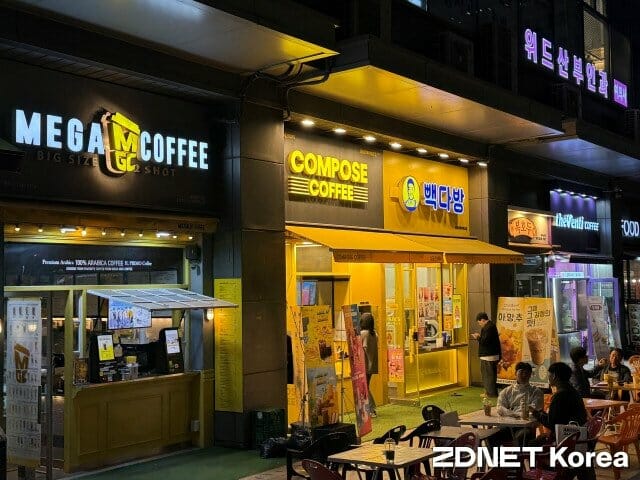
Franchise brands in Seoul operate across diverse store formats and locations, reflecting their distinct market positioning strategies.
Store Format and Location Strategy Differences
Industry analysts attribute the store-count-to-sales disparity to fundamental differences in franchise operating models. Premium brands such as Starbucks and Twosome Place operate larger-format locations designed to encourage “dwell consumption”—customers spending extended time in-store for seating, ambiance, and social purposes. In contrast, budget-focused coffee brands prioritize rapid store expansion through small-format takeout-oriented locations. These structural differences directly impact revenue generation: dwell-based models accumulate revenue through extended customer visits, while takeout models rely on transaction volume and speed.
A franchise industry insider explained: “Revenue is calculated on total sales, not profit, so differences emerge based on store size and sales structure. When additional revenue elements like desserts and larger store footprints are factored in, average revenue per location changes significantly.”
Menu Composition and Customer Spending Impact
Menu strategy reinforces the revenue gap between franchise tiers. Twosome Place derives substantial revenue from high-margin products beyond coffee—including cakes, desserts, and pastries—which increase average customer spending per transaction. Budget-focused brands such as Mega Coffee and Compose Coffee concentrate on single-category, coffee-centric menus, resulting in lower average transaction values. This menu composition difference is structural: premium formats can justify larger venues and seating through diversified offerings, while budget formats optimize for rapid coffee sales with minimal overhead.
The franchise insider noted: “Budget coffee brands operate primarily small takeout locations with relatively lower average customer spending. Revenue gaps emerge based on store location, local market conditions, and operational approach.”
Private Equity Expansion and Store Growth Strategy
A second layer of analysis concerns the capital structures driving franchise expansion. Mega Coffee and Compose Coffee are both held or backed by private equity firms—capital structures that fundamentally reshape expansion incentives. Private equity ownership prioritizes rapid asset growth and corporate valuation increases, often measured by store count expansion. Compose Coffee was acquired by Philippine-based Jollibee and Korean private equity firm Elevation PE; Mega Coffee is held by private equity investors.

Compose Coffee’s rapid expansion is visible through advertising in Seoul’s commercial districts, reflecting the accelerated store growth typical of private equity-backed franchise models.
Under private equity ownership, the expansion model shifts incentives: new store openings become a direct revenue stream for the parent company through franchisee fees, logistics sales, and supply agreements. As a result, store count expansion itself becomes a financial metric tied directly to corporate performance and investor returns. This creates structural pressure to maximize new openings regardless of local market saturation or franchisee profitability. Industry sources note that “private equity-backed franchises like Mega Coffee and Compose Coffee tend to prioritize rapid store expansion based on their capital structure, accelerating the pace of new openings to drive corporate valuation growth.”
Location Validation Concerns and Franchisee Income Disparity
Industry analysts express concern that rapid expansion may outpace rigorous location analysis. One franchise insider cautioned: “In some cases, store expansion takes priority over location and market analysis. While rapid growth appears impressive externally, per-store revenue variance can be substantial.” This creates a structural misalignment: as the parent company expands store count and secures corresponding franchise fees and logistics revenue, individual franchisees may operate locations with lower-than-average sales performance.
The result is a growing income gap among franchisees. As one industry observer explained: “As store count increases, the parent company secures revenue through franchisee fees and logistics sales. However, lower-performing store locations may generate insufficient revenue for franchisees. A gap emerges between corporate store-count expansion and actual franchisee profitability.”
This structural tension—rapid corporate expansion versus franchisee financial performance—reflects a fundamental misalignment in the franchise model when driven by private equity capital seeking rapid returns. Store count becomes the primary growth metric for corporate valuation, while individual franchisees bear the risk of operating in inadequately validated locations.
Frequently Asked Questions
Q: Why does the coffee franchise with the most stores not generate the highest average sales per location?
Store count and per-store revenue are driven by different business models. Budget-focused brands like Mega Coffee expand rapidly through small takeout locations with lower per-transaction spending, while premium brands like Twosome Place operate larger formats with menu diversity and dwell-time revenue, generating higher average sales per store despite fewer total locations.
Q: How does private equity ownership affect franchise expansion strategy?
Private equity firms prioritize rapid store expansion to increase corporate valuation and investor returns. New store openings generate direct revenue through franchisee fees and logistics sales, creating structural incentives to maximize store count regardless of individual franchisee profitability. This differs from traditionally-owned franchises, which may prioritize per-store profitability over expansion speed.
Q: What risks do franchisees face in rapidly expanding budget coffee brands?
Rapid expansion without rigorous location analysis can result in oversaturation and underperforming stores. While parent companies secure revenue through franchise fees regardless of store performance, franchisees operating in inadequately validated locations may face insufficient sales to cover operating costs, creating income disparity across the franchise network.
Disclaimer: The information on this page may come from third parties and does not represent the views or opinions of Gate. The content displayed on this page is for reference only and does not constitute any financial, investment, or legal advice. Gate does not guarantee the accuracy or completeness of the information and shall not be liable for any losses arising from the use of this information. Virtual asset investments carry high risks and are subject to significant price volatility. You may lose all of your invested principal. Please fully understand the relevant risks and make prudent decisions based on your own financial situation and risk tolerance. For details, please refer to
Disclaimer.


