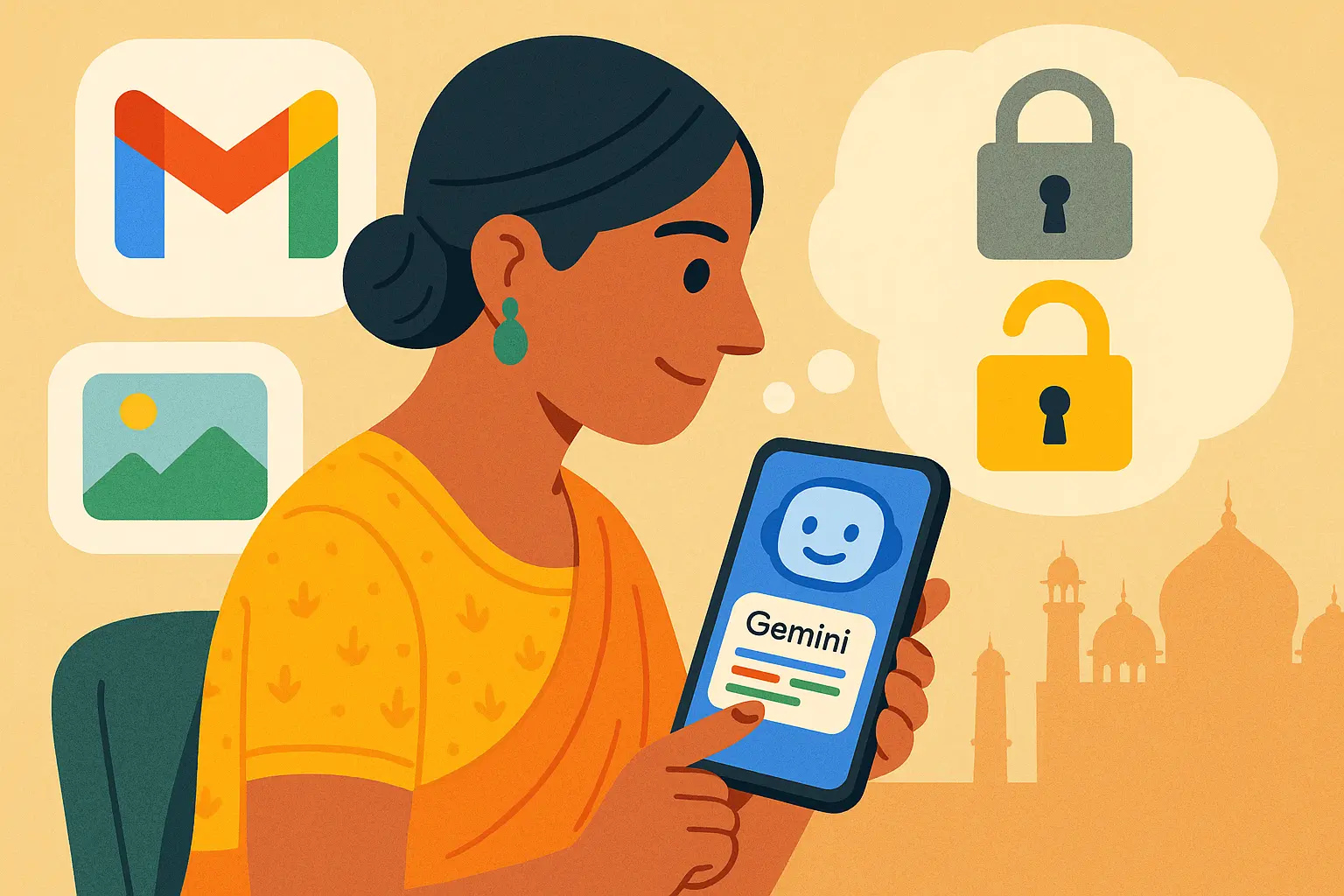
Google has launched AI Gemini Personal Intelligence in India, connecting Gmail, Google Photos, and YouTube history to deliver personalized responses. India becomes the third market after the US and Japan, with access initially limited to AI Pro and AI Ultra subscribers before expanding to free users in the coming weeks.
What AI Gemini’s Personal Intelligence Actually Does
The core idea is a departure from traditional search: instead of asking AI Gemini a general question and receiving generic information, users connect their Google accounts and ask questions grounded in their own life. A user could type “What are my travel plans for Jaipur?” — and rather than returning travel guides, AI Gemini searches their Gmail for booking confirmations, hotel reservations, and itinerary emails.
The feature also references recent YouTube viewing history to surface recommendations and contextual suggestions. Every response includes source attribution — Gemini identifies where it found each piece of information — so users can verify details independently before acting on them. If AI Gemini gets something wrong, users can correct it directly through natural conversation.
Core Capabilities Included at Launch
Gmail integration: Retrieves trip plans, appointments, receipts, and personal records from email history
Google Photos access: Identifies places visited, activities, and people based on image history
YouTube reference: Draws on viewing history to inform recommendations and contextual answers
Source attribution: Labels where information was sourced, supporting independent verification
Natural language correction: Users can instantly correct any inaccurate inferences directly in conversation
The Honest Limitations Google Is Openly Acknowledging
Google is one of the few AI companies that has been unusually candid about where its system fails, and AI Gemini Personal Intelligence is no exception.
In its official blog post, Google explained that Gemini may struggle with “timing or nuance, particularly regarding relationship changes, like divorces, or your various interests.” The clearest example provided: if a user’s Google Photos contains hundreds of images at a golf course, AI Gemini may conclude they love golf — even if the user is only there because their child is playing, not out of personal interest.
The fix is simple — tell Gemini “I don’t like golf” and it will adjust. But the underlying limitation matters: AI reasoning based on data patterns can miss human meaning and context entirely. For users trusting Personal Intelligence with sensitive personal information, this is worth understanding before relying on its outputs.
India as a Priority Market for AI Gemini
The Personal Intelligence launch is part of a deliberately accelerated AI Gemini rollout in India, which Google is treating as one of its highest-priority deployment markets. The pace has been rapid: in March 2026, Google launched Gemini in Chrome for Indian users, and just last week, the company enabled agentic restaurant booking through AI mode in India — partnering with Zomato, Swiggy, and EazyDiner to let users search and book restaurants through conversational AI without leaving Google’s interface.
The overall pattern suggests a strategic calculation: India’s scale, growing digital user base, and competitive AI landscape make it a market where Google is choosing to deploy advanced AI Gemini capabilities faster than most international markets.
FAQ
What is AI Gemini’s Personal Intelligence feature?
Personal Intelligence connects AI Gemini to a user’s Google accounts — Gmail, Google Photos, and YouTube history — to deliver personalized responses instead of generic search results. It retrieves information from the user’s actual data to answer questions about their plans, history, and preferences, while attributing sources for verification.
Who can access AI Gemini Personal Intelligence in India today?
As of the April 14 announcement, the feature is live for AI Pro and AI Ultra subscribers in India. Google has stated its plan to expand access to free users in the coming weeks, following the same phased rollout model used when the feature launched in the US in January 2026.
How accurate is AI Gemini’s interpretation of personal data?
Google has publicly disclosed that AI Gemini can make incorrect inferences from pattern-based reasoning — potentially misreading the context behind photos, emails, or viewing history. Users can correct errors conversationally, and source attribution helps identify where potentially inaccurate conclusions originated. Google recommends treating the feature as a starting point for personal retrieval, not an authoritative source.
Disclaimer: The information on this page may come from third parties and does not represent the views or opinions of Gate. The content displayed on this page is for reference only and does not constitute any financial, investment, or legal advice. Gate does not guarantee the accuracy or completeness of the information and shall not be liable for any losses arising from the use of this information. Virtual asset investments carry high risks and are subject to significant price volatility. You may lose all of your invested principal. Please fully understand the relevant risks and make prudent decisions based on your own financial situation and risk tolerance. For details, please refer to
Disclaimer.


