South Korea’s Ministry of Culture, Sports and Tourism (MCST) has elevated artificial intelligence to a core pillar of national cultural policy, moving from strategic planning to active implementation in February 2024 through April 2024. The ministry published copyright guidelines for generative AI training, established a dedicated AI policy division in March 2024, and held a public policy seminar on April 9, 2024, to define principles and frameworks for AI adoption in the culture sector.
Policy Framework and Timeline
The MCST’s AI policy initiative formally began in late February 2024 with the release of a comprehensive “Copyright Guidelines for Generative AI Training Under Copyright Law,” followed by the official establishment of a dedicated Cultural AI Policy Division in March 2024. The rapid sequence of guideline publication, institutional setup, and public consultation within a single month signals that the MCST views AI not as a one-time technology trend but as a structural pillar of long-term cultural strategy. This positioning represents a significant shift in how South Korea’s cultural sector is approaching AI integration at the policy level.

The ministry’s broader policy direction is becoming clearer through official announcements. The MCST’s 2026 budget allocation for content technology innovation and R&D has been expanded substantially, reflecting institutional commitment to AI-driven cultural development. Policy experts generally agree that the ministry has articulated a coherent strategic vision combining copyright interpretation standards, R&D investment, and direct industry support as three interconnected pillars.
R&D Investment and Budget Expansion
The MCST has announced a significant increase in research and development funding dedicated to cultural technology innovation. The 2025 R&D budget of 106.2 billion Korean won will expand to 151.5 billion won in 2026, representing a 42% year-over-year increase. This expanded budget will support the “K-Culture AI Oxygen Supply Project,” a flagship initiative designed to accelerate AI adoption across South Korea’s culture and content industries.
For 2026, the MCST has confirmed 14 new R&D projects with a total of 62 sub-tasks, focusing on AI-driven innovation in content creation, translation, distribution, marketing, and production processes. The ministry has established a timeline for implementation, with R&D institution selection and formal agreements to be completed between April and July 2026. This structured rollout indicates that the policy framework is transitioning from the design phase into active resource allocation and project execution.
Copyright Guidelines and Legal Foundation
The copyright guidelines published by the MCST address a critical gap in the regulatory landscape: how copyright law applies to the training processes of generative AI systems. The guidelines clarify the application of copyright law’s fair use doctrine to AI training workflows, establishing interpretive standards intended to reduce legal ambiguity for creators, production companies, platforms, and copyright holders.
However, industry stakeholders emphasize that the publication of guidelines represents a foundational step rather than a complete solution. The guidelines provide interpretive clarity, but their translation into actual dispute prevention, transaction order, and enforceable standards remains a work in progress. For creators, the predictability of rights protection is paramount; for industry participants, clarity on permissible use ranges is equally critical. These two concerns have not yet been fully reconciled through detailed implementation rules.
Implementation Challenges and Industry Expectations
While the MCST’s policy framework and direction-setting efforts have generated cautious optimism, significant implementation gaps remain. The current policy outputs—copyright guidelines, policy seminars, and R&D budget expansion—represent institutional design and directional signaling rather than actionable support mechanisms and execution standards that creators, production companies, and platforms can immediately apply in daily operations.
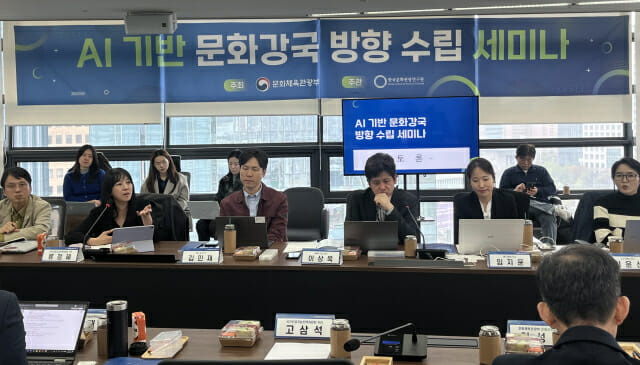
The April 9, 2024 policy seminar titled “Moving Toward an AI-Based Cultural Powerhouse: Policy Direction Discussion” opened public debate on how AI should be adopted in the culture sector. Yet the practical gap persists: AI-driven innovation in content creation, translation, distribution, marketing, and production workflows is already occurring in industry operations, but the criteria for supporting these activities and the scope of institutional acceptance remain underdeveloped. Industry observers note that creators and production companies require not only policy frameworks but also concrete support models, detailed application standards, and clear guidance on which AI use cases align with copyright and cultural policy objectives.
An industry official quoted in policy discussions stated: “Now that the MCST has positioned AI as a new axis of cultural powerhouse strategy, the next critical phase will be measured by how quickly the ministry can move beyond declarations and discussions to deliver executable support models and clear application standards. The speed and specificity of these implementation details will ultimately determine whether this policy achieves its intended impact.”
Success Metrics and Next Steps
The MCST’s ability to translate policy framework into measurable industry outcomes will depend on several factors: the clarity and enforceability of copyright standards in real-world disputes; the effectiveness of the R&D project selection process in identifying high-impact AI applications; and the speed at which detailed support mechanisms can be deployed to creators and production companies. The April–July 2026 timeline for R&D institution selection and agreement execution represents a critical juncture; delays or vague project criteria could signal that the policy framework remains primarily aspirational rather than operationally grounded.
Industry participants are watching closely to see whether the MCST’s AI policy will evolve from its current phase—characterized by guideline publication, institutional setup, and budget allocation—into a phase of active implementation support and measurable industry impact.
Frequently Asked Questions
Q: What are South Korea’s copyright guidelines for generative AI training?
A: The MCST published “Copyright Guidelines for Generative AI Training Under Copyright Law” in February 2024, which clarifies how copyright law’s fair use doctrine applies to AI training processes. The guidelines establish interpretive standards intended to reduce legal ambiguity for creators, production companies, platforms, and copyright holders, though detailed implementation rules are still being developed.
Q: When will South Korea’s AI policy framework take effect in the culture industry?
A: The policy framework is currently in the implementation phase. R&D institution selection and formal agreements are scheduled to occur between April and July 2026. However, detailed support mechanisms and execution standards that creators and production companies can directly apply are still being developed and have not yet been fully specified.
Q: How much is South Korea investing in AI for cultural innovation?
A: South Korea’s Ministry of Culture, Sports and Tourism expanded its R&D budget for content technology innovation from 106.2 billion Korean won in 2025 to 151.5 billion won in 2026, a 42% increase. The 2026 budget will support 14 new R&D projects with 62 sub-tasks through the “K-Culture AI Oxygen Supply Project.”
Disclaimer: The information on this page may come from third parties and does not represent the views or opinions of Gate. The content displayed on this page is for reference only and does not constitute any financial, investment, or legal advice. Gate does not guarantee the accuracy or completeness of the information and shall not be liable for any losses arising from the use of this information. Virtual asset investments carry high risks and are subject to significant price volatility. You may lose all of your invested principal. Please fully understand the relevant risks and make prudent decisions based on your own financial situation and risk tolerance. For details, please refer to
Disclaimer.


