The 6th China International Consumer Products Expo (April 13–18, 2024, Hainan) showcased AI glasses from leading Chinese brands and announced the imminent production launch of a modular flying car, signaling a shift in consumer technology from niche innovation to mainstream commercialization. The expo’s Science and Technology Consumer Zone featured AI glasses from iFLYTEK, Huawei, Rokid, China Mobile, and Alibaba’s Taobao Group, alongside Huitian Aerospace’s first-generation modular flying car, collectively demonstrating advances in spatial computing, edge AI models, lightweight wearables, and multi-scenario intelligent interaction.
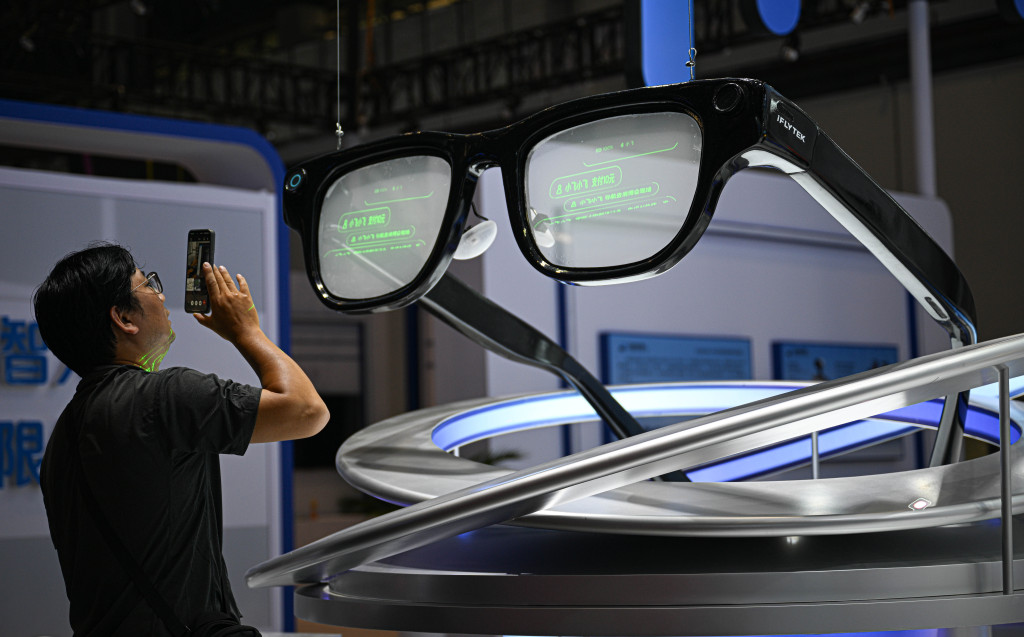 Various AI glasses models showcased at the expo’s main venue. Source: Xinhua News Agency
AI Glasses Market Maturation and Pricing Trajectory
AI glasses represent a new form of intelligent wearable technology that combines multiple computing platforms and is currently considered the near-eye terminal with the highest potential for mass adoption compared to AR, VR, and XR alternatives. According to research firm Omdia, global AI glasses shipments are projected to reach 8.7 million units in 2025, representing 322% year-over-year growth. China’s Saidian Intelligence research institute noted in a February 2024 report that AI glasses will be included in government subsidy programs starting in 2026, with industry consensus identifying AI glasses as the most certain product category for AI commercialization.
Despite high visitor engagement at expo booths—Rokid’s AI glasses were even relocated to the media center for journalist use—industry representatives acknowledged that the market remains in a cultivation phase. Both Rokid and iFLYTEK staff told reporters that current pricing concentrates in the mid-to-high range (several thousand yuan), limiting penetration among ordinary consumers. However, both companies expressed confidence that prices will decline as supply chain technology matures. An iFLYTEK representative compared the current situation to early mobile phones: “Just as mobile phones were initially large, expensive devices costing 20,000–30,000 yuan but became ubiquitous, AI glasses will follow a similar adoption curve.”
Rokid staff reported that their products currently capture 34% of the global market share for display-equipped AI glasses, and projected that consumer penetration will increase with time.
AI Glasses Technical Features and Design Differentiation
Rokid’s AI glasses weigh only 49 grams and feature diffractive optical waveguide technology paired with Qualcomm’s AR1 chipset, allowing users to invoke multiple AI language models and breaking free from single-algorithm constraints. The company emphasized that the modular design—including swappable battery configurations and charging cases—addresses battery life concerns, while acknowledging that current technical limitations require trade-offs in component optimization.
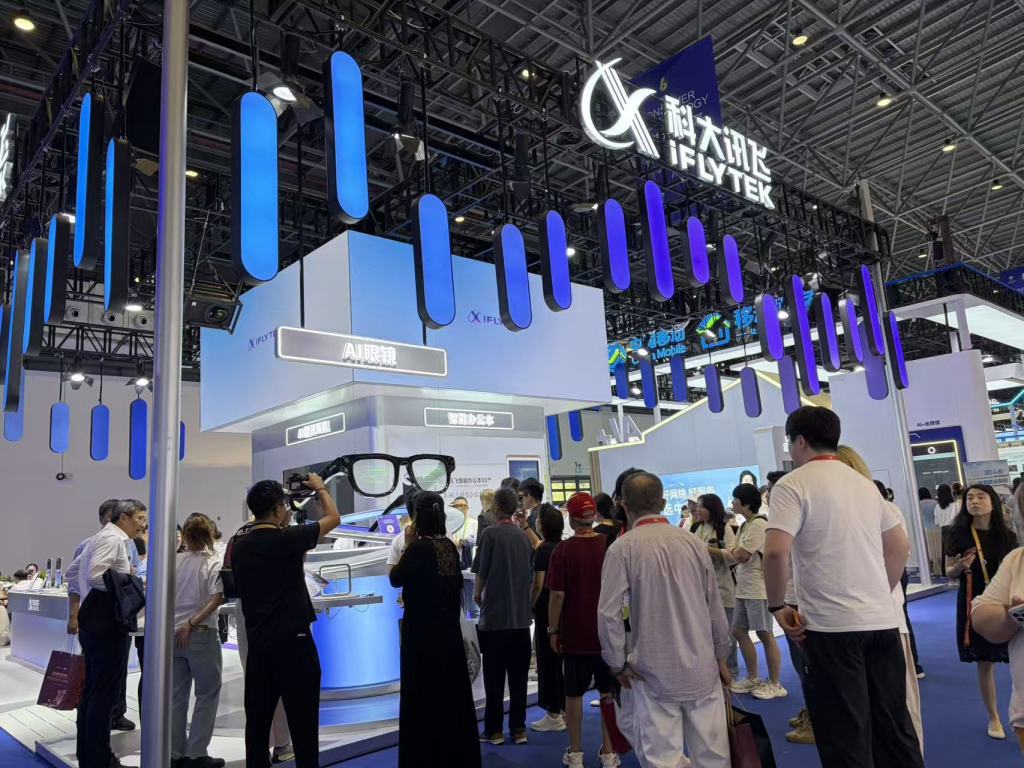 iFLYTEK’s AI glasses demonstration at the expo. Photo: Peng Pai News
iFLYTEK differentiated its offering through cross-language translation capabilities, simulating real-world scenarios such as expo negotiations and business interactions in noisy environments. An iFLYTEK representative identified two primary adoption barriers: first, the challenge of integrating AI glasses with prescription eyewear for users with existing vision correction needs; second, consumer price sensitivity, with most current products priced in the thousands of yuan range, which many consumers find prohibitively expensive. The company noted that lightweight design and battery management solutions are now mature across manufacturers, with the remaining hurdles being user experience integration and market price accessibility.
Modular Flying Car Enters Production Phase
Huitian Aerospace, a five-year repeat exhibitor at the Consumer Expo, announced that its modular flying car—branded the “Ground Carrier” (陆地航母)—will enter production. The company recently completed a new funding round of approximately 200 million USD, bringing its total equity financing to approximately 1 billion USD. Investors include top-tier venture capital firms such as Hillhouse Capital, Sequoia Capital China, Gaorong Venture Capital, and Dazen Capital.
The Ground Carrier is the world’s first modular air-ground amphibious flying car, featuring a globally unique vehicle-mounted automatic separation mechanism. Users can separate or recombine the ground vehicle and flight unit within five minutes via one-button operation. The design addresses two critical pain points of traditional aircraft: mobility and storage. The ground vehicle serves as both a daily transportation platform and as a storage and power replenishment base for the flight unit, enabling adaptation to complex terrain and weather conditions while supporting use cases ranging from daily commuting to off-road adventure, low-altitude tourism, and emergency services.
As of the expo date, the Ground Carrier has accumulated over 7,000 pre-orders. In March 2024, Huitian’s production facility in Guangzhou’s Huangpu District completed the production and multi-aircraft flight testing of five Ground Carrier units in a single day, marking the transition from research and development validation to commercial production preparation.
Broader Consumer Technology Showcase
Beyond AI glasses and flying cars, the expo featured additional breakthrough consumer technologies. Zhejiang Fubao Intelligent Technology unveiled its fifth-generation “Xiaobao” AI companion robot for health and wellness; Aosheng presented a flagship massage product integrating advanced AI biosensors; and Qunhe Technology debuted “Xiaoku,” China’s first deployed AI robot designer for home renovation applications.
Frequently Asked Questions
Q: What distinguishes AI glasses from other wearable technologies like AR or VR headsets?
AI glasses are lighter and more practical for daily wear compared to bulkier AR/VR devices. They focus on voice interaction, translation, and visual recognition rather than immersive environments, making them suitable for everyday consumer use. According to Omdia research, AI glasses are projected to ship 8.7 million units globally in 2025, reflecting their emergence as the most commercially viable near-eye wearable category.
Q: When will the Huitian Ground Carrier flying car be available for purchase?
Huitian Aerospace completed production of five units in March 2024 and has accumulated over 7,000 pre-orders. The company is currently in the commercial production preparation phase, though a specific consumer launch date has not been publicly announced. The modular design allows the ground vehicle to operate independently while the flight unit is stored or being serviced.
Q: Why are AI glasses still expensive despite technological maturity?
Current pricing reflects early market positioning and limited production scale. Industry representatives indicated that prices will decline as supply chain technology matures and production volumes increase, similar to the historical trajectory of mobile phones. Additionally, integration challenges with prescription eyewear and the need for custom fitting contribute to current cost structures.
Disclaimer: The information on this page may come from third parties and does not represent the views or opinions of Gate. The content displayed on this page is for reference only and does not constitute any financial, investment, or legal advice. Gate does not guarantee the accuracy or completeness of the information and shall not be liable for any losses arising from the use of this information. Virtual asset investments carry high risks and are subject to significant price volatility. You may lose all of your invested principal. Please fully understand the relevant risks and make prudent decisions based on your own financial situation and risk tolerance. For details, please refer to
Disclaimer.


