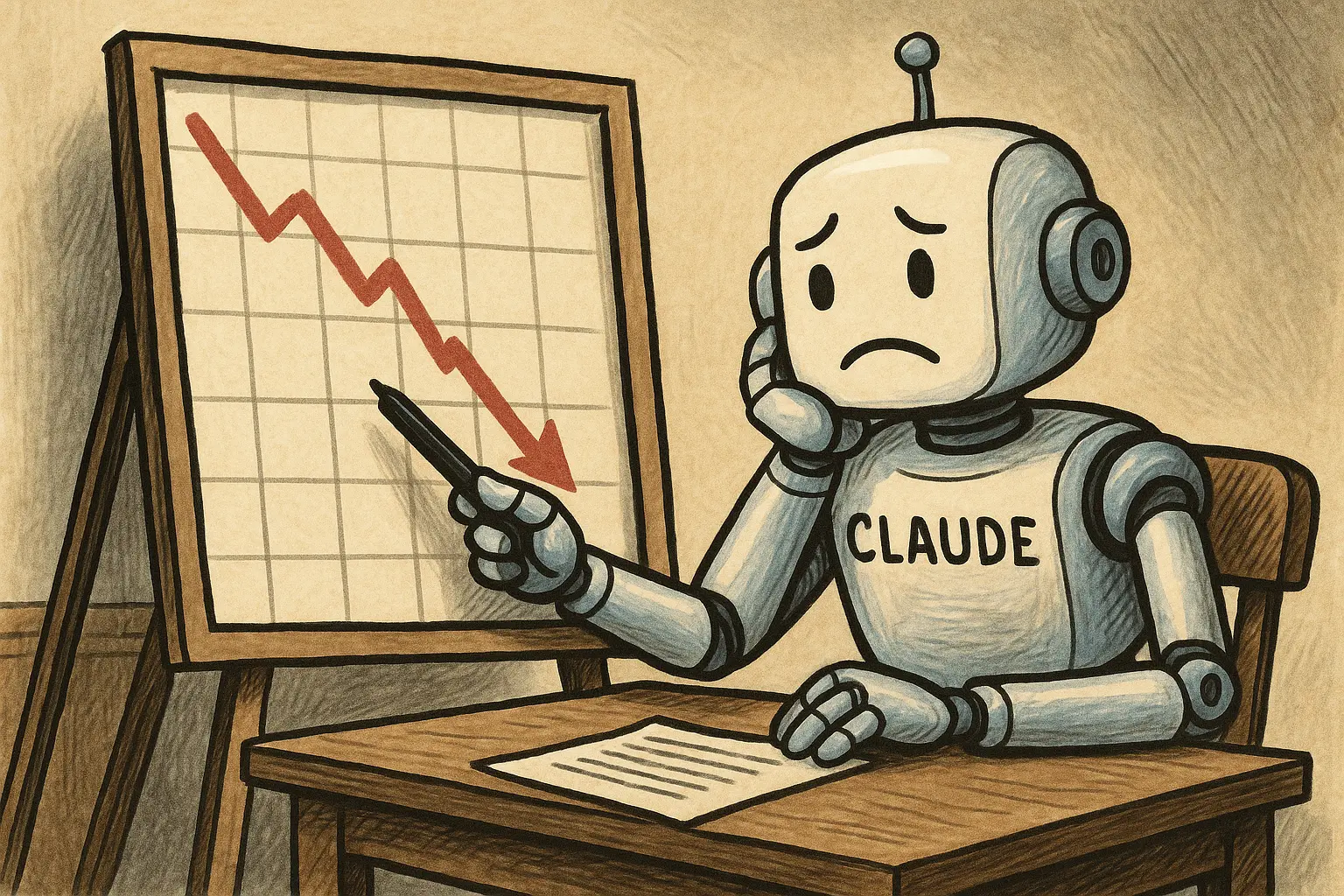
Anthropic’s Claude AI is facing an unusual credibility problem: mounting quality complaints on GitHub, a major April 13 outage, and a self-assessment from the model itself concluding concerns have “escalated sharply” since January — with April on pace to surpass March’s complaint volume, already a 3.5× jump over baseline.
The Experiment: Asking Claude to Evaluate Claude
The key test was straightforward. Journalists pointed Claude AI at the Claude Code GitHub repository, filtered for open issues mentioning quality, and asked: have complaints increased lately?
Claude’s response was unambiguous: “Yes, quality complaints have escalated sharply — and the data tells a pretty clear story.”
A follow-up query added more precision: “The velocity is notable: April is already at 20+ quality issues in 13 days, putting it on pace to exceed March’s 18 — which was itself a 3.5× jump over the January–February baseline.”
The central irony holds throughout — Claude AI is not a reliable narrator about its own performance. It is a pattern-matching system, and asking it to analyze complaint volume does not mean it correctly interprets whether those complaints are valid, inflated by AI-generated issue submissions, or obscured by Anthropic’s GitHub Actions script, which automatically closes issues after a period of inactivity.
But the general trend — growing reports about quality — is visible in the data it is citing, whatever the underlying cause.
The GitHub Issues Claude Is Citing
Claude AI’s conclusion was not abstract. The model pointed to specific open issues to support its analysis:
#42796: “Claude Code is unusable for complex engineering tasks with the Feb updates” — addressed directly by Boris Cherny, head of Claude Code, indicating Anthropic is engaged with at least some reported regressions
#46212: “Claude Code’s prediction-first behavior is dangerous on capital-at-risk projects” — flagging concerns about the model completing code actions before adequately scoping risk
#46949: “Artificial degradation, Acquisition Bias, and unacceptable compute throttling for paid users” — one of the more pointed complaints, alleging deliberate quality reduction for capacity management
#46099: “Opus 4.6: Severe quality degradation on iterative coding tasks” — targeting the latest Opus model specifically
A separate, more alarming claim — that Claude AI autonomously deleted over 35,000 production customer records and billing transactions — has not been independently verified. The post came from an account with no other activity, and the company named has not responded to press inquiries. Developer reports of data loss from Claude Code exist, but user error has not been ruled out in those cases.
What Benchmarks Say — And Why That Gap Matters
The story complicates when benchmark data enters the picture. Margin Lab’s assessments show Claude Opus 4.6 has maintained its score on SWE-Bench-Pro since February, with variation but no substantive decline.
This is the credibility gap at the center of the debate. Benchmarks measure specific, controlled tasks. Claude AI is most commonly deployed in complex, multi-step engineering workflows — exactly the context where throttling, behavioral changes from model updates, and prompt sensitivity are most visible.
Several structural factors may be amplifying perceived quality decline beyond actual model changes:
Anthropic has acknowledged taking steps to reduce usage during peak hours to manage capacity and demand — throttling that users may experience directly as degraded quality
The auto-closure of GitHub issues after inactivity may be masking the true volume of unresolved reports
A growing proportion of GitHub issues are themselves AI-generated, a widely noted concern in open source development
AMD AI director Stella Laurenzo publicly stated that Claude’s responses have been getting worse — a credible outside signal given the enterprise context.
The Outage Context
Claude.ai and Claude Code experienced a major outage on April 13, 2026, running from 15:31 to 16:19 UTC with elevated error rates across both products. It was brief, but its timing amplified developer discontent that was already accumulating. Routine outages tend to land differently when users have been logging quality concerns for weeks — they read as confirmation rather than coincidence.
FAQ
Is Claude AI actually getting worse, or is this user perception?
Probably both — and they are difficult to separate. GitHub complaint volume has genuinely increased 3.5× above the January–February baseline by March, and April is trending higher. But Margin Lab’s benchmark data shows Opus 4.6 holding its SWE-Bench-Pro score. The most defensible explanation is that capacity throttling during peak hours and February model updates have degraded real-world developer experience in ways that structured evaluations do not capture.
What are the most substantiated complaints about Claude AI quality?
The most credible concerns target Claude Code on complex, multi-step engineering tasks — specifically post-February update behavior. Issue #42796 was addressed by Claude Code head Boris Cherny, confirming Anthropic is actively engaging with at least some reported regressions. The throttling complaints are also credible, given that Anthropic has publicly acknowledged capacity management steps.
Can Claude AI reliably assess its own quality problems?
No — and this is the story’s central irony. Claude AI can synthesize patterns in the data it is shown, but it cannot distinguish valid complaints from AI-generated noise, assess its own calibration errors, or determine whether issue volume reflects real degradation or structural artifacts in how GitHub issues are filed and closed. The self-assessment is suggestive, not authoritative.
Disclaimer: The information on this page may come from third parties and does not represent the views or opinions of Gate. The content displayed on this page is for reference only and does not constitute any financial, investment, or legal advice. Gate does not guarantee the accuracy or completeness of the information and shall not be liable for any losses arising from the use of this information. Virtual asset investments carry high risks and are subject to significant price volatility. You may lose all of your invested principal. Please fully understand the relevant risks and make prudent decisions based on your own financial situation and risk tolerance. For details, please refer to
Disclaimer.


