
April 13 weekly data shows that Bitcoin spot ETFs recorded approximately $786 million in weekly capital inflows. BlackRock’s iShares Bitcoin Trust (IBIT) leads with $612 million in single-week inflows, with buy volume exceeding the combined totals of all other ETF issuers, accounting for roughly 78% of total weekly inflows across the entire market. Despite many IBIT investors facing unrealized losses, the data shows they have not withdrawn—instead, they keep adding.
This Week’s Inflow Structure: BlackRock Dominates Buys by an Overwhelming Margin
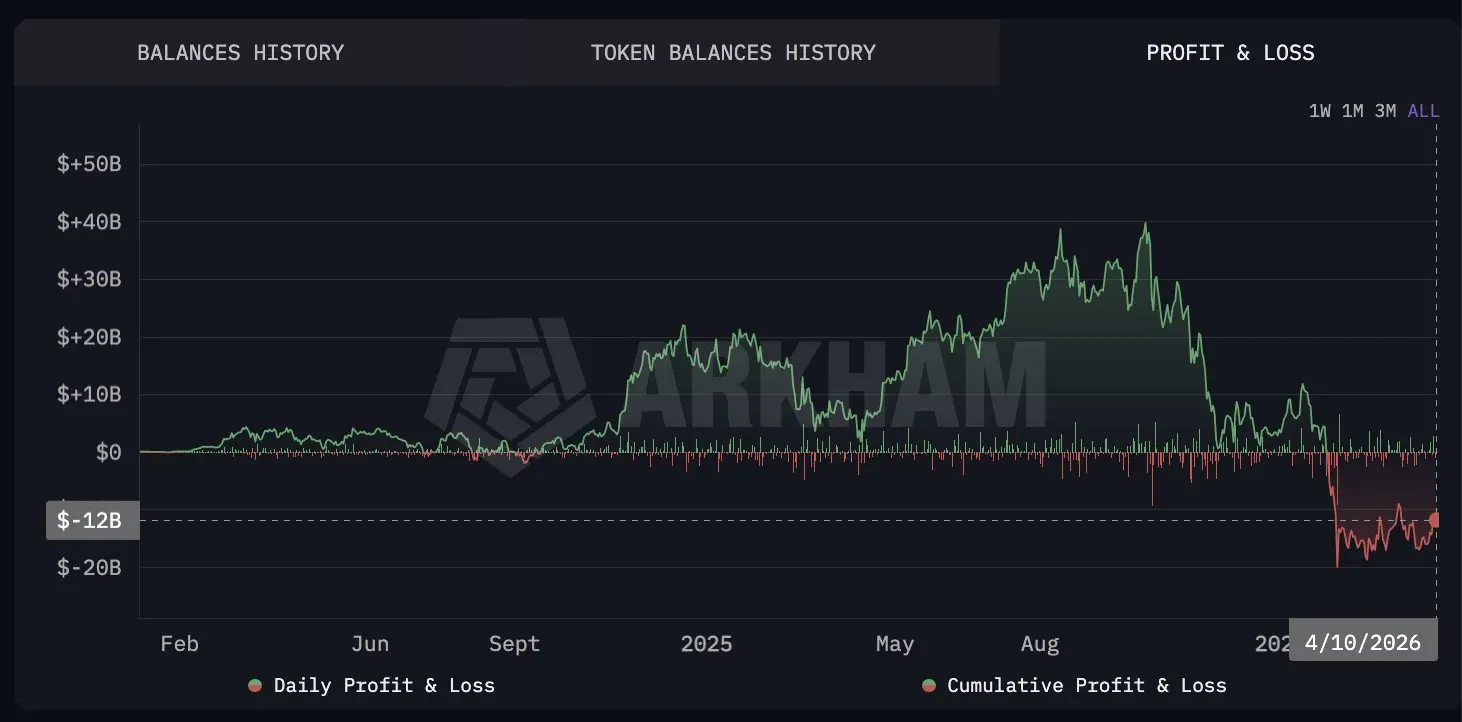 (Source: Arkham)
Of the total $786 million inflows, BlackRock’s IBIT alone accounts for $612 million. Fidelity and other smaller-scale ETFs also saw inflows, but their scale is far behind BlackRock’s, revealing a clearly concentrated market pattern.
So far, the total amount of Bitcoin held by IBIT has reached 790,808 BTC (about $57.2 billion), making it the largest Bitcoin ETF holding worldwide. Notably, BlackRock’s first-quarter ETF portfolio value fell by 25%, but the pace of buying has not slowed down. This “adding positions against the tide” posture has been interpreted by the market as a strategic confirmation of BlackRock’s long-term Bitcoin holdings.
Continued Accumulation Under Unrealized Losses: A Collective Simulation of a Cost-Averaging Strategy
Estimated data suggests the average buy cost for IBIT investors is about $89k per Bitcoin. Based on the current market price of around $70k, most IBIT holders face an unrealized loss of over 20%. However, capital flow data shows that investors have not chosen to cut losses and exit—they continue to add. This is the collective manifestation of a Dollar-Cost Averaging strategy.
This behavior reflects the fundamental differences between institutional investors and retail investors: institutional capital operates on a quarterly or annual scheduling cycle, and its tolerance for short-term volatility is far higher than that of individual investors. The continued accumulation by large institutions also has an inherently reinforcing market signaling effect.
Comprehensive Overview of This Week’s Crypto ETF Capital Flows
Weekly Capital Flows by Category of Crypto ETFs (April 7–13)
Total Bitcoin ETFs: Weekly inflows of $786 million (BlackRock IBIT accounts for $612 million; Fidelity and other small ETFs together make up the remainder)
Total Ethereum ETFs: Weekly inflows of $187 million, led by BlackRock ETHA and ETHB trust funds
XRP funds: Weekly inflows of $12 million, with demand staying relatively steady
Solana-related products: Weekly outflows of $6 million, with capital pulling back this week
The $187 million inflow data for Ethereum ETFs indicates that institutional capital this week mainly focused on the two major mainstream assets—Bitcoin and Ethereum—while institutional demand for other assets such as Solana appeared relatively weak.
Frequently Asked Questions
Why can BlackRock’s IBIT keep dominating capital inflows even amid market uncertainty?
IBIT has become one of the most important compliant channels for institutional investors to enter the Bitcoin market. Institutional capital is scheduled over a longer time horizon, so short-term market volatility has limited impact on decision-making. BlackRock’s brand credibility and the depth of IBIT’s liquidity give it a significant competitive advantage when institutions choose ETF tools.
Why do IBIT investors keep adding despite being in unrealized losses?
Most IBIT investors’ average buy cost is about $89k, which is higher than the current market price, leaving a clear unrealized loss. However, institutional investors typically respond with a cost-averaging strategy—adding during pullbacks to lower the overall cost of holdings, rather than admitting mistakes and exiting. This reflects institutional strategic confidence in Bitcoin’s long-term value, not a logic of short-term trading.
How did Ethereum ETFs and other crypto asset ETFs perform this week?
Ethereum ETFs recorded $187 million in net inflows this week, led by BlackRock ETHA and ETHB trust funds, indicating that institutional demand for Ethereum is also steady. XRP funds saw inflows of $12 million; Solana-related products recorded outflows of $6 million. Overall, this week’s capital is clearly concentrated in the two major mainstream assets—Bitcoin and Ethereum.
Disclaimer: The information on this page may come from third parties and does not represent the views or opinions of Gate. The content displayed on this page is for reference only and does not constitute any financial, investment, or legal advice. Gate does not guarantee the accuracy or completeness of the information and shall not be liable for any losses arising from the use of this information. Virtual asset investments carry high risks and are subject to significant price volatility. You may lose all of your invested principal. Please fully understand the relevant risks and make prudent decisions based on your own financial situation and risk tolerance. For details, please refer to
Disclaimer.
Related Articles
22,000 BTC Options and 100,000 ETH Options Expire Today; BTC Max Pain at $72,000
On April 17, 22,000 BTC options are expiring with a 1.05 Put/Call ratio and a $72,000 maximum pain point, totaling $1.65 billion. Additionally, 100,000 ETH options are expiring with a 0.95 Put/Call ratio and a $2,250 maximum pain point, valued at $460 million.
GateNews14m ago
Ethereum Q1 2026 Base Layer Transactions Hit Record 200.4 Million, Surpassing 200M for First Time
Ethereum achieved a record high of 200.4 million transactions in Q1 2026, driven by Layer 2 activity and stablecoin growth, despite ETH prices being over 50% lower than their August 2025 peak.
GateNews29m ago
Ethereum Foundation: Ketman project identifies 100 North Korean agents within six months
According to an ETH Rangers project recap report published by the Ethereum Foundation on April 17, 2026 (Thursday), within its six-month funding period the Ketman project funded by the Ethereum Foundation identified 100 North Korean IT workers using false identities to infiltrate Web3 organizations, and contacted roughly 53 crypto projects to warn them they may have hired active North Korean agents.
MarketWhisper2h ago
NFT platform Foundation announces shutdown; Snowden’s auction site becomes a thing of the past
NFT platform Foundation co-founder Kayvon Tehranian announced on the X platform on April 15 that the platform will officially cease operations. Earlier this year, Foundation had signed a sale agreement with a buyer, but the buyer backed out before the transaction was completed. After Tehranian reassumed control, he assessed the market situation and announced, "There are no other buyers worth pursuing," officially initiating the wind-down process.
MarketWhisper2h ago
Ethereum Foundation core researcher Josh Stark resigns, without disclosing specific reasons
Ethereum Foundation core researcher and project manager Josh Stark (Josh Stark) announced on the X platform on April 17, 2026 (Thursday) that he will leave the Ethereum Foundation after five years in the role. According to Cointelegraph, Stark did not disclose the specific reasons for his departure. In his X post, he said that there are currently “no plans for the future,” and that he intends to temporarily spend time with his family and friends.
MarketWhisper5h ago
Arthur Hayes-Linked Address Deposits 3,000 ETH to Major CEXs Worth $6.93M
An address linked to Arthur Hayes deposited 3,000 ETH, worth around $6.93 million, to major exchanges. The address now holds 5,278 ETH, valued at approximately $12.33 million, as on-chain actions attract market attention.
GateNews5h ago


