
On April 9, the on-chain research firm TKResearch Trading published an analysis on the X platform, pointing to signs that the “Binance Life” token’s circulating supply may be quietly controlled by an alleged insider. Data shows that the project’s officially disclosed circulating supply is 1 billion coins, but 816 million of them are currently held in exchanges. After subtracting this amount, only about 184 million tokens are truly freely circulating in the market.
Supply Structure Breakdown: 1 Billion on the Surface, Only 184 Million Actually Usable
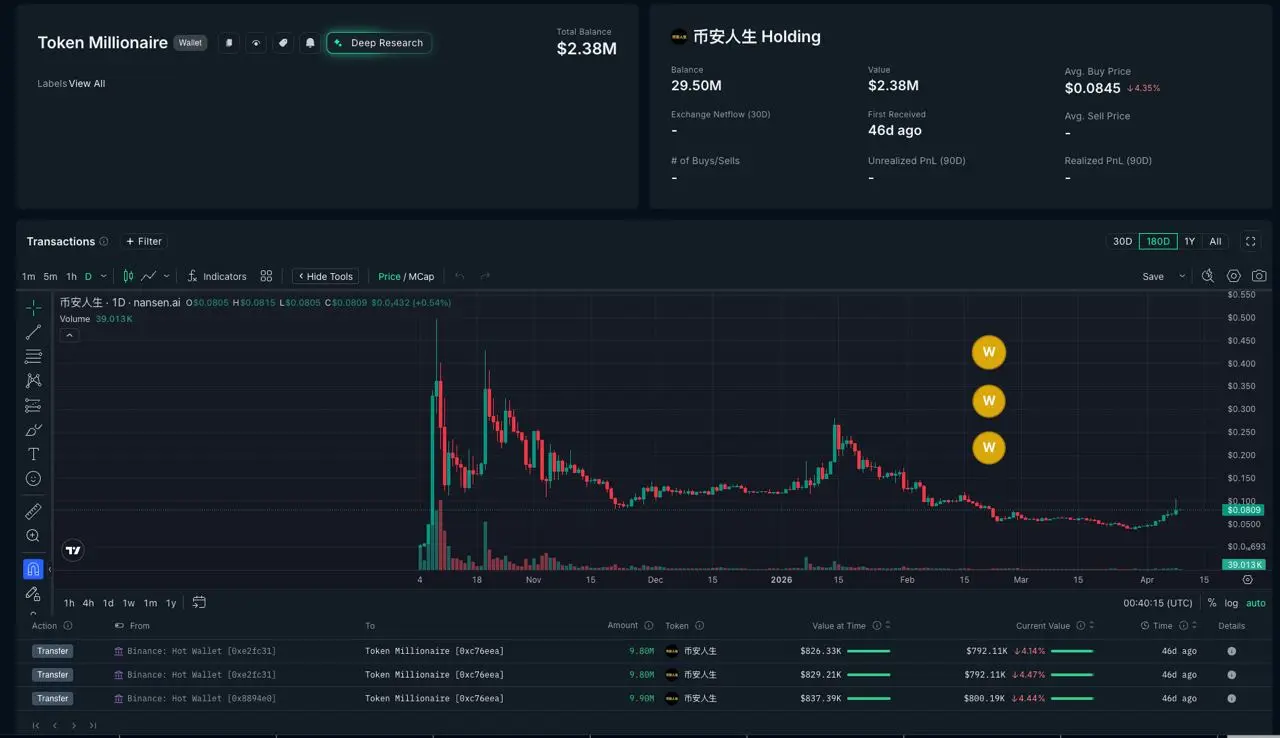
TKResearch’s analysis reveals internal structural issues with the Binance Life token’s supply. The 1 billion coins circulating supply claimed by the project, in practical terms, shows a serious liquidity discount:
Because 816 million tokens are stuck in exchange accounts, the circulating amount that can truly be freely bought and sold in the market is compressed to 184 million—just 18.4% of the nominal circulating supply. TKResearch noted that this structure of “a large apparent circulating supply, but a small amount that can actually be traded” allows a small number of large holders to exert a disproportionate influence on the market’s real liquidity with a relatively small amount of capital.
TKResearch’s Three Key On-Chain Findings: Analyzing Whale Behavior Patterns
Based on TKResearch’s on-chain data tracking, the following three points form the core basis for its judgment that there is “suspected insider control of circulation”:
Concentrated withdrawal activity: Over the past 60 days, the top 1 and top 2 external addresses (EOA) have continued to withdraw Binance Life tokens from Binance. The cumulative withdrawn amount totals 59 million coins, with an average entry price of about $0.06, indicating signs of organized low-level accumulation
Highly concentrated holdings: Currently, the top three holding addresses together hold 77.5 million coins, about 9.5% of the exchange’s supply, and 42% of the net circulating supply (184 million coins). The level of concentration is far higher than the holding distribution of most healthy tokens
Price has not reflected supply changes yet: The number of tokens in exchanges continues to decrease, but the token price is still relatively calm. TKResearch believes, “Supply is decreasing, but the price has not responded. This is usually the beginning of a price expansion.”
Related on-chain addresses (disclosed by TKResearch for research reference): 0x54957e1d025cb42a33ae98a693e48836979123af 0xd0a20458d96a1ab3f1f43e7270185546aa760dbf 0xc76eea4435b4451c3ceb8e8f0e30fb2a26df6fe5
Market Impact Assessment: Does Supply Contraction Mean Opportunity or Risk?
TKResearch’s analysis also points out that a reduction in exchange-held tokens usually corresponds to a decrease in selling pressure—because tokens stored on exchanges are the easiest to sell directly. When large amounts of tokens move from exchanges to private wallets outside exchanges, the market’s immediate sell pressure should theoretically decline accordingly.
However, from a risk perspective, with 42% of the actual circulating supply concentrated in three addresses, it also means these whales have the ability to cause significant impact on the market price within a short period of time—whether through concentrated selling at high levels, or by coordinating operations to influence market direction. It is worth noting that TKResearch’s analysis itself is based on on-chain observation and inference; the qualitative claim of “insider control” has not been confirmed by any official body or recognized by any regulator.
Frequently Asked Questions
Why is the actual tradable circulating supply of Binance Life far lower than the official claimed 1 billion coins?
According to TKResearch’s on-chain data, among the 1 billion coins of nominal circulating supply, 816 million coins are currently stored in exchange accounts, which is a relatively locked state. The number of tokens that are truly free to buy and sell on the market is only about 184 million coins, accounting for 18.4% of the nominal circulating supply.
What risk does it imply that the top three holding addresses hold 42% of the circulating supply?
A 42% concentration of tokens means that a small number of addresses have disproportionate influence on the market. If these addresses choose to sell in sync, it could trigger large fluctuations in the token price; conversely, if they continue to hold, it would suppress sell pressure. High concentration is itself a structural risk that needs attention, not direct certainty evidence of manipulation.
What are the limitations of TKResearch’s analysis method?
TKResearch’s analysis is based on observations and inferences from on-chain public data and is a third-party independent study. The description of “insiders quietly controlling the circulating supply” is its interpretation based on data patterns, not a fact that has been recognized by regulators. Investors should treat such on-chain analyses as one reference piece of information, not the sole basis for trading decisions.
Disclaimer: The information on this page may come from third parties and does not represent the views or opinions of Gate. The content displayed on this page is for reference only and does not constitute any financial, investment, or legal advice. Gate does not guarantee the accuracy or completeness of the information and shall not be liable for any losses arising from the use of this information. Virtual asset investments carry high risks and are subject to significant price volatility. You may lose all of your invested principal. Please fully understand the relevant risks and make prudent decisions based on your own financial situation and risk tolerance. For details, please refer to
Disclaimer.


