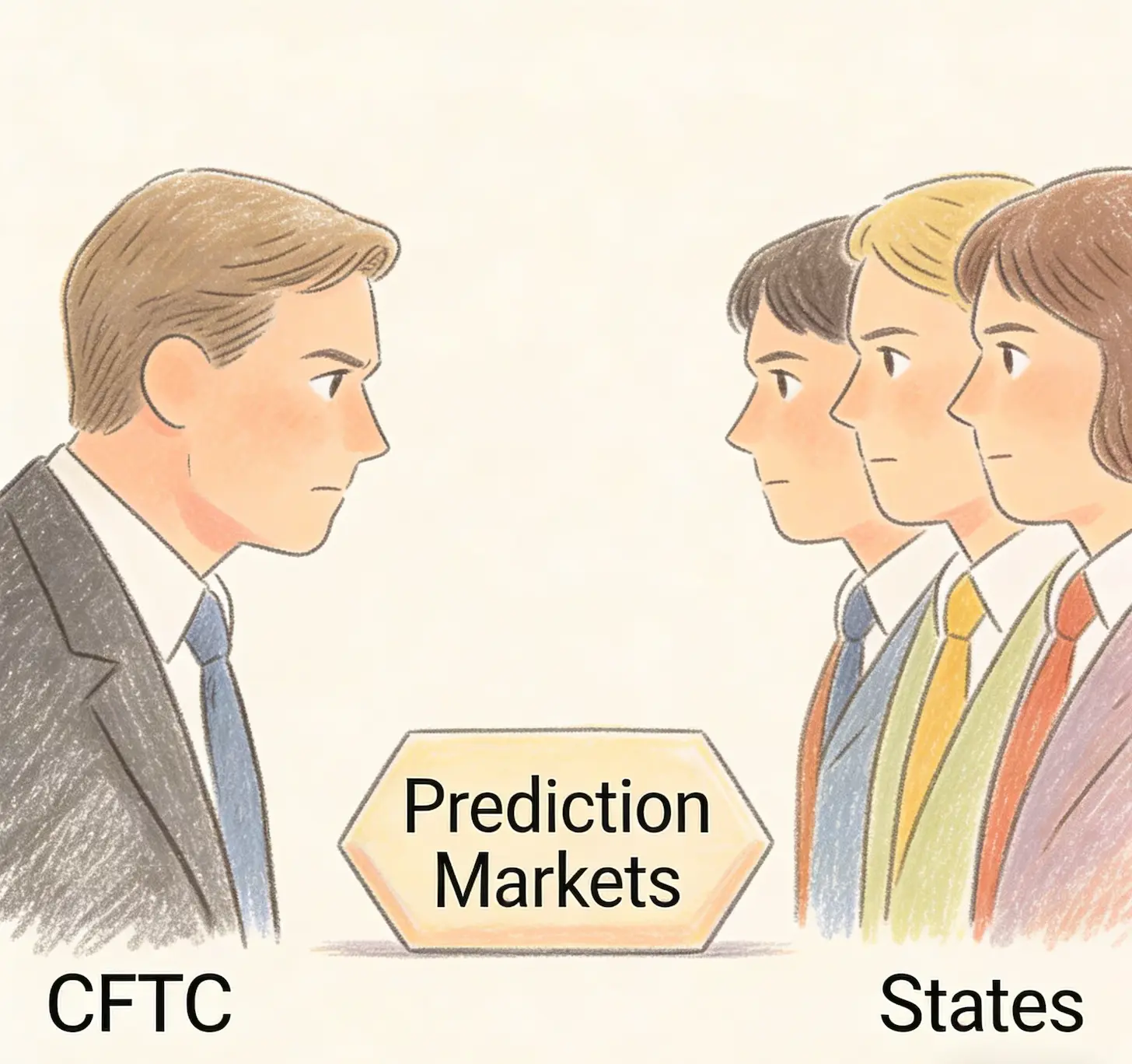
 The Commodity Futures Trading Commission (CFTC) and the U.S. Department of Justice filed separate lawsuits on April 2, 2026 against the states of Illinois, Connecticut, and Arizona, as well as their respective gaming regulators, asserting that the CFTC has “exclusive jurisdiction” over prediction markets under the Commodity Exchange Act (CEA).
The federal lawsuits argue that state efforts to shut down or restrict federally registered prediction market platforms such as Kalshi and Polymarket intrude on Congress’s exclusive federal scheme to oversee national swaps markets, following cease-and-desist letters sent by the states in 2025 claiming that event contracts violated state gambling laws.
CFTC Claims Exclusive Authority Over Event Contracts as Swaps
In each of the three lawsuits, the CFTC maintains that it has “exclusive jurisdiction” to regulate Designated Contract Markets (DCMs), which include prediction platforms, under the Commodity Exchange Act. The Illinois lawsuit states that the state’s attempt to shut down federally regulated DCMs intrudes on the exclusive federal scheme Congress designed to oversee national swaps markets, prompted by the evolution of national financial markets and repeated conflicts with state law.
The CFTC’s filing argues that the Illinois Gaming Board overstepped its authority by categorizing event contracts as “wagers” or “sports betting” instead of asset swaps. The agency further contends that unless restrained and enjoined by the court, the states are likely to continue their attempts to subvert federal law and the exclusive jurisdiction conferred on the CFTC by Congress.
CFTC Chairman Michael S. Selig stated that this is not the first time states have tried to impose inconsistent and contrary obligations on market participants, but Congress specifically rejected such a fragmented patchwork of state regulations because it resulted in poorer consumer protection and increased risk of fraud and manipulation.
States Escalate Legal Pressure on Prediction Market Platforms
The federal lawsuits come amid increased legal scrutiny of prediction markets by US lawmakers and state regulators. According to the CFTC, state regulators in Arizona, Nevada, Illinois, Maryland, New Jersey, Montana, Ohio, Connecticut, Tennessee, New York, and Massachusetts have taken legal action against prediction markets. In 2025, Illinois, Connecticut, and Arizona sent cease-and-desist letters to prediction platforms including Kalshi and Polymarket, claiming that event contracts violated state gambling laws and licensing requirements.
Selig said after the lawsuits were filed that the states’ aggressive and overzealous attempts to overstep the CFTC have led to market uncertainty and risks destabilizing effects for market participants and the agency’s registrants. The CFTC argued that Congress granted the agency—rather than individual states—the sole authority to regulate these markets.
Congressional and NFL Actions Add to Prediction Market Scrutiny
The CFTC’s lawsuits coincide with mounting scrutiny of prediction markets on Capitol Hill and elsewhere as platforms like Kalshi and Polymarket have skyrocketed in popularity. A group of Congressional Democrats recently introduced legislation banning prediction market bets on topics including elections, war, and sports. Representative Seth Moulton (D-Mass.) announced he would ban prediction market usage by his staff, a policy believed to be a first-of-its-kind in Congress.
The NFL’s Chief Compliance Officer, Sabrina Perel, asked prediction market operators to block event contracts deemed “objectionable” in a letter obtained by CNBC, pointing out that the CFTC believes sports-related contracts should have unique regulation. The CFTC’s top enforcer has also put prediction market insider traders on notice, signaling increased enforcement focus.
CFTC Lawsuits Seek to Block State Interference with Federally Registered Markets
The CFTC’s lawsuits ask the courts to restrain and enjoin the states from continuing their attempts to subvert federal law. The agency argues that its “exclusive jurisdiction” over event contracts was first officially recognized in 1992 and that Congress has repeatedly affirmed the CFTC’s sole authority over the national swaps markets, including prediction market contracts.
The lawsuits name Illinois Governor JB Pritzker, Attorney General Kwame Raoul, and the Illinois Gaming Board, as well as the gaming regulators of Connecticut and Arizona. The CFTC did not immediately respond to requests for comment about whether it plans additional lawsuits against other states.
FAQ
Why is the CFTC suing Illinois, Connecticut, and Arizona?
The CFTC and DOJ filed lawsuits against the three states, arguing that state efforts to shut down or restrict federally registered prediction market platforms violate the CFTC’s exclusive jurisdiction under the Commodity Exchange Act. The states had sent cease-and-desist letters to platforms like Kalshi and Polymarket claiming event contracts violated state gambling laws.
What authority does the CFTC claim over prediction markets?
The CFTC maintains that it has “exclusive jurisdiction” to regulate Designated Contract Markets (DCMs), including prediction platforms, under the Commodity Exchange Act. The agency argues that Congress granted the CFTC—rather than individual states—sole authority to regulate these markets to avoid a fragmented patchwork of state regulations.
Which states have taken legal action against prediction markets?
According to the CFTC, state regulators in Arizona, Nevada, Illinois, Maryland, New Jersey, Montana, Ohio, Connecticut, Tennessee, New York, and Massachusetts have taken legal action against prediction markets. The CFTC’s lawsuits specifically target Illinois, Connecticut, and Arizona for sending cease-and-desist letters to federally registered platforms.
Disclaimer: The information on this page may come from third parties and does not represent the views or opinions of Gate. The content displayed on this page is for reference only and does not constitute any financial, investment, or legal advice. Gate does not guarantee the accuracy or completeness of the information and shall not be liable for any losses arising from the use of this information. Virtual asset investments carry high risks and are subject to significant price volatility. You may lose all of your invested principal. Please fully understand the relevant risks and make prudent decisions based on your own financial situation and risk tolerance. For details, please refer to
Disclaimer.


