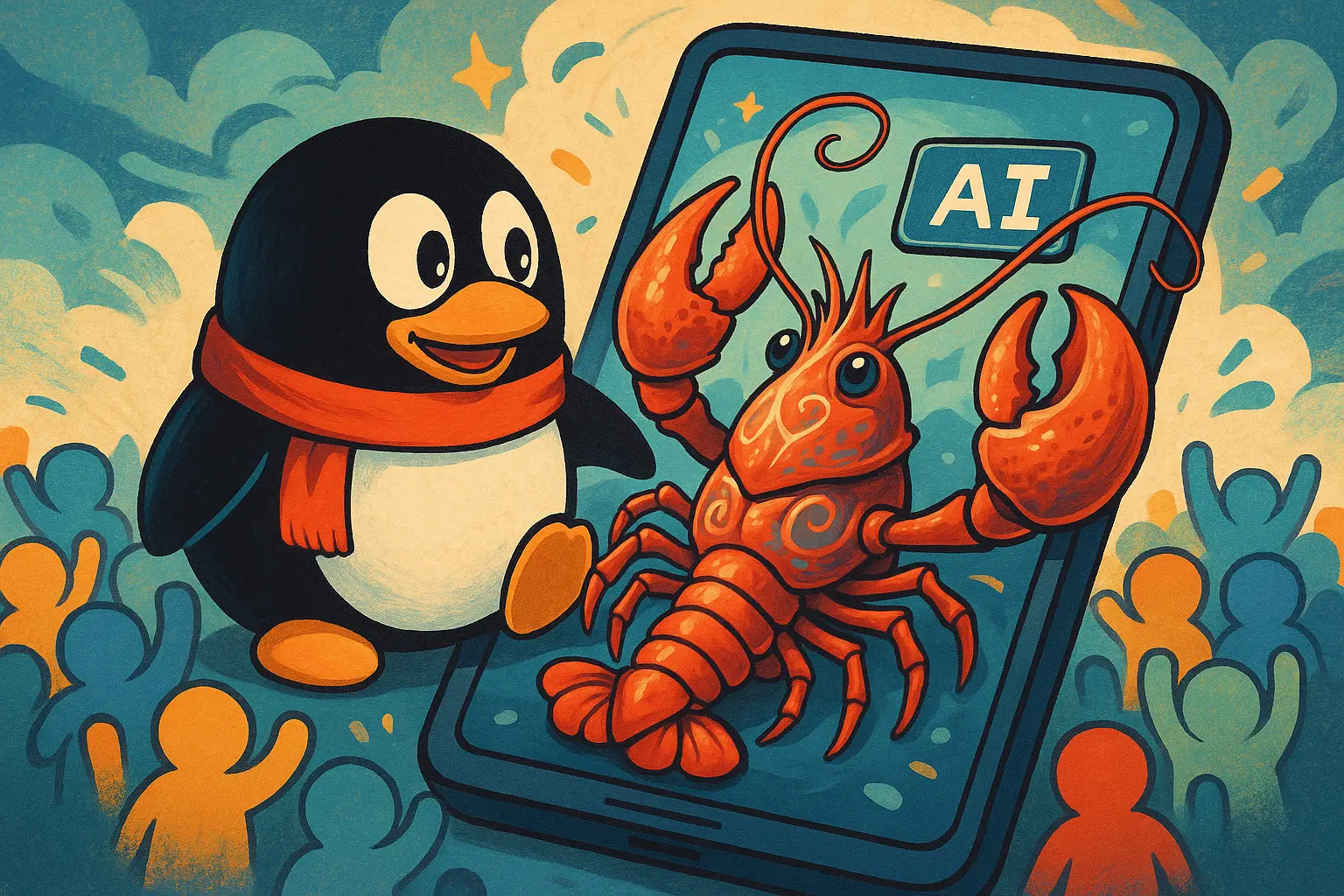
Tencent’s official QQ announcement states that QQ has officially achieved native integration with OpenClaw’s official platform. Tencent’s QQ Bot code has been merged into OpenClaw’s main code repository. This means that users who have QQ accounts can directly invoke the “crayfish” AI agent feature in the QQ chat window through text commands, without any additional technical setup. Tencent Cloud also released a “crayfish” long-term memory service, Agent Memory.
Five Core Features of QQ Native Integration with OpenClaw
According to Tencent QQ’s official announcement, this native integration supports the following features:
Private chat conversations: Users can chat directly with the OpenClaw crayfish in QQ private chats to complete various AI tasks
Multimedia message interaction: Supports receiving and sending multimedia-format messages in the QQ chat interface, going beyond plain-text limitations
Multi-account management: Allows a single OpenClaw instance to manage multiple QQ accounts, suitable for enterprise cross-account operations
Credential management (SecretRef): Securely manages sensitive credentials without storing keys in plain text in configuration files
Slash commands and reminders: Quickly invoke preset functions using the “/command name” format, and set up automated time-based reminders
Tencent emphasized that simply having a QQ account allows users to directly access and use the crayfish, greatly lowering the barrier for ordinary users to enter the AI agent ecosystem. This is currently one of the OpenClaw ecosystem integrations with the largest user coverage among instant messaging platforms.
Tencent’s Comprehensive AI Upgrade: Memory Service, Compute Expansion, and Vedas AI
On April 3, Tencent Cloud simultaneously released the “crayfish” memory service, TencentDB Agent Memory, as a plugin that seamlessly integrates into products like Tencent Cloud Lighthouse and ClawPro, with support for a free one-click enablement. This service addresses the core pain point of AI agents having unconnected memory across conversations, significantly improving the long-term dialogue experience of crayfish within Tencent’s ecosystem.
At the infrastructure level, Tencent Group’s Deputy General Manager, Li Qiang, disclosed that Tencent is expanding AI compute data centers on a large scale both domestically and internationally, advancing the “power-telecom collaboration” strategy—this includes using wind and solar direct-supply data centers in Inner Mongolia, combining hydrogen energy and energy storage technologies to balance electricity peak and troughs and reduce electricity costs. Tencent’s capital expenditures last year totaled 79.2 billion yuan, and this year will also see a substantial increase.
Meanwhile, Tencent is developing a task-execution AI assistant called “Vedas AI.” Its functions include data analysis, PPT creation, building websites, generating research reports, and automating task execution. It has not yet been officially released to the public.
Frequently Asked Questions
How do QQ users start using the OpenClaw crayfish feature?
All you need is a QQ account. You can directly invoke the crayfish in the QQ chat window via text commands, with no additional installation or technical configuration required. You can obtain the specific access entry and command format through Tencent’s official QQ channels or the documentation in OpenClaw’s main code repository.
What is the real significance of the long-term memory service that Tencent has released for OpenClaw?
TencentDB Agent Memory solves the core issue of AI agents “forgetting across conversations.” Traditional AI chats are limited by the context window, but long-term memory services allow crayfish to retain user preferences, task progress, and historical interaction records across conversations. This significantly improves the coherence and effectiveness of AI agents in repetitive or long-term tasks.
What does Tencent’s deep integration of OpenClaw mean for the AI agent industry?
Tencent’s native integration of OpenClaw in QQ means AI agent tools enter China’s largest communications ecosystem in a native way for the first time, covering a potential user scale far beyond any previous single platform. This integration marks an important transition for AI agents—from tools exclusively for developers to consumer products for the mass market—and may also accelerate other communications platforms’ competitive deployment for integrating AI agents.
Disclaimer: The information on this page may come from third parties and does not represent the views or opinions of Gate. The content displayed on this page is for reference only and does not constitute any financial, investment, or legal advice. Gate does not guarantee the accuracy or completeness of the information and shall not be liable for any losses arising from the use of this information. Virtual asset investments carry high risks and are subject to significant price volatility. You may lose all of your invested principal. Please fully understand the relevant risks and make prudent decisions based on your own financial situation and risk tolerance. For details, please refer to
Disclaimer.


