
Less than 24 hours after the source code for Claude Code was leaked, an open-source project named Claw Code quickly accumulated more than 100,000 stars on GitHub. According to the project’s own description and citations from multiple technology media outlets, this is the fastest repository in GitHub history to reach this milestone. As of the time of publication, Claw Code has received 124,000 stars and 102,000 forks.
Engineering decisions at 4:00 a.m.: the origin story of Claw Code
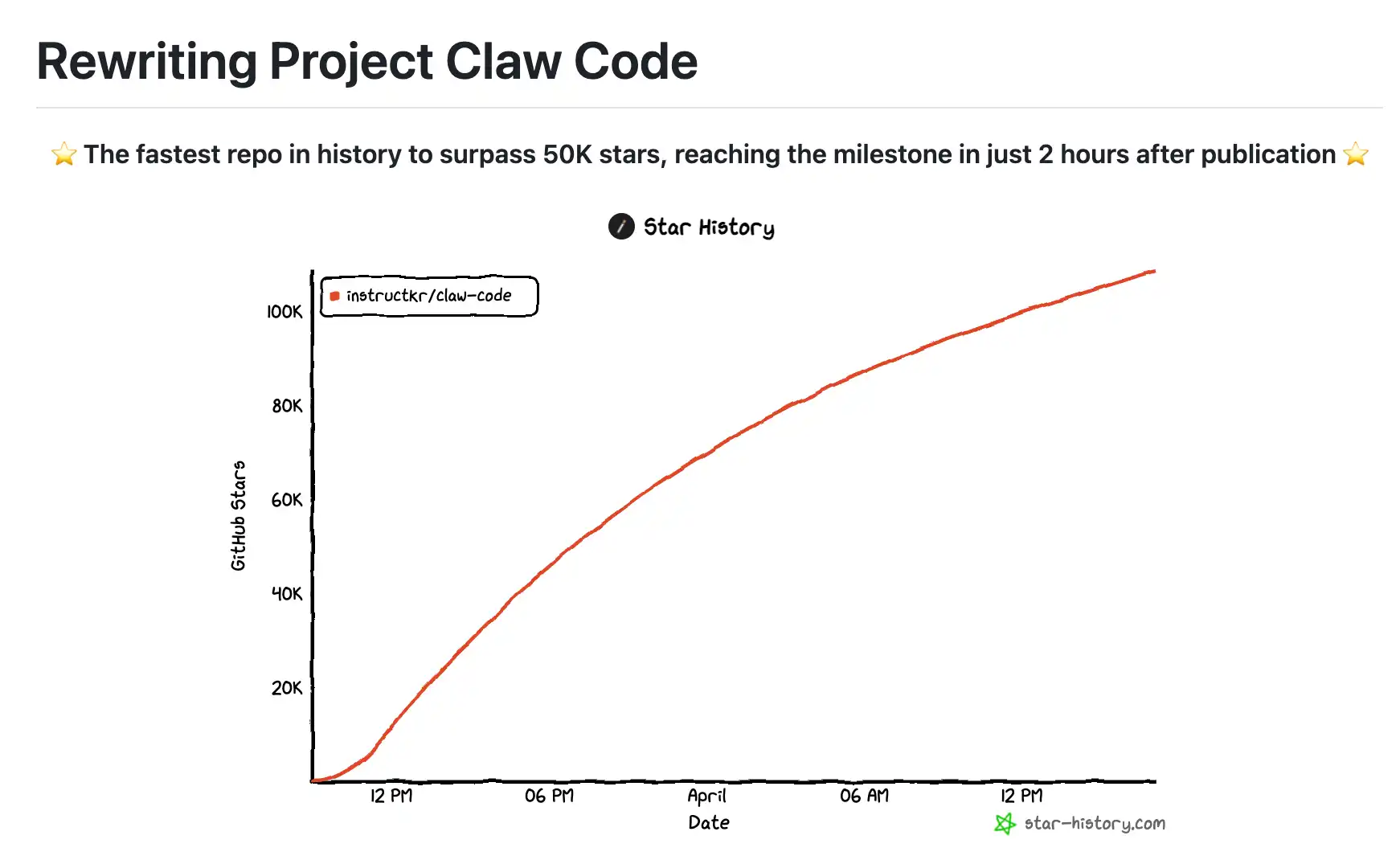 (Source: Star History)
At 4:00 a.m. on March 31, 2026, developer Sigrid Jin’s phone was flooded with notifications about the Claude Code leak. On his girlfriend’s computer in South Korea, she was concerned that the leaked code might bring legal risk. This pressure pushed him to make a classic decision in an emergency: sit down and rewrite everything from scratch.
Before daybreak, he used Python to complete a rewrite of the core functionality and pushed it to GitHub. The entire process was assisted by an AI coding workflow tool, oh-my-codex (OmX), developed by developer Yeachan Heo. After that, the project gradually migrated from Python to Rust. As of now, 92.9% of the codebase is Rust, including the following 7 Rust crates:
· API client, runtime state management, MCP orchestration
· Tool execution framework, plugin system, command体系, interactive CLI
Sigrid Jin is not an unknown developer. In a report dated March 21, 2026, titled “ The Trillion Dollar Race to Automate Our Entire Lives ”, The Wall Street Journal portrayed him as one of the most active heavy users of Claude Code worldwide. It noted that last year, he used 25 billion Claude Code tokens by himself, and that he even flew to San Francisco to attend Claude Code’s one-year anniversary gathering.
A clean-room implementation: why DMCA can’t do anything to Claw Code
Anthropic issued DMCA copyright protection notices to 8,100 GitHub repositories with directly mirrored leaked source code, and Claw Code was not among them. The reason is that the codebase contains no lines of original TypeScript source code.
“Clean-room implementation” is a long-established concept in the engineering and legal fields. Developers only study the target system’s architecture and design, then completely write the implementation code independently, without accessing any original source code. Under copyright law frameworks, this approach is typically considered independent creation rather than copying. Claw Code first rewrote everything from scratch in Python, then moved to Rust. Legally, this creates a clear separation from the leaked TypeScript source code—this is the core reason it successfully avoided being included among the 8,100 affected repositories.
The real signals behind the GitHub data
Claw Code presents a data structure worth paying attention to: 124,000 stars correspond to 102,000 forks, and the fork-to-star ratio is over 80%. For a typical open-source project, this ratio is usually only 10% to 20%.
This abnormal ratio suggests that many users not only collected the project, but also actively forked it. Combined with the background of the leak incident, this reflects more of event-driven, immediate usage behavior rather than long-term community adoption. Previously, the fastest project reported to reach 100,000 stars on GitHub was OpenClaw, taking weeks. Claw Code compressed this timeline to within a day. However, note that GitHub’s official site does not publish rankings for repository growth speed. The basis for this record comes from the project’s own description and citations from technology media, and lacks third-party official verification.
Frequently asked questions
What is the relationship between Claw Code and Claude Code?
Claw Code is an open-source replacement project independently rewritten by developer Sigrid Jin after the leak of the Claude Code source code, using a “clean-room implementation” approach. The codebase contains no original Anthropic TypeScript source code. It references the architecture design of Claude Code, but all implementation code is original, with Rust as the primary language.
Why wasn’t Claw Code taken down under the DMCA?
Anthropic’s DMCA targets repositories that directly copy leaked source code. Claw Code uses a “clean-room implementation,” written from scratch entirely in Python and Rust, and it does not include any original TypeScript source code. Under copyright law frameworks, this is typically considered independent creation, which is why it was not included among the 8,100 impacted repositories.
Is Claw Code truly the fastest 100,000-star project in GitHub history?
Based on Claw Code’s own description and citations from multiple technology media outlets, this is the GitHub repository that reached 100,000 stars the fastest, completed within 24 hours. Note that GitHub does not publish official repository growth-speed rankings, so this claim lacks third-party official verification. Also, over 80% of the forks relative to the star count indicates that this explosive growth was mainly driven by the leak incident, not long-term community adoption.
Disclaimer: The information on this page may come from third parties and does not represent the views or opinions of Gate. The content displayed on this page is for reference only and does not constitute any financial, investment, or legal advice. Gate does not guarantee the accuracy or completeness of the information and shall not be liable for any losses arising from the use of this information. Virtual asset investments carry high risks and are subject to significant price volatility. You may lose all of your invested principal. Please fully understand the relevant risks and make prudent decisions based on your own financial situation and risk tolerance. For details, please refer to
Disclaimer.


