Reuters reports that Amazon is in acquisition talks with the satellite communications company Globalstar, with a deal size of about $9 billion, aiming to strengthen its satellite network service Amazon Leo and directly challenge SpaceX’s Starlink. However, Apple holds a 20% stake in Globalstar, making this deal especially complicated.
(Backgrounder: The biggest IPO in history is coming! SpaceX’s Elon Musk reportedly secretly filed for a listing application, with a valuation of $1.75 trillion )
(Additional background: Apple “challenges Starlink” by upgrading iPhone and Apple Watch satellite features, expanding from emergency use to everyday connectivity).
Table of contents
Toggle
- The obstacle posed by Apple’s 20% stake
- Amazon Leo vs. Starlink: the space internet battle heats up
- Another variable added to the tech giants’ space race
Amazon appears to be brewing a deal that could rewrite the map of the space internet market. Citing sources, Reuters reports that Amazon is in talks to acquire the satellite communications company Globalstar (GSAT), in a transaction valued at roughly $9 billion.
After the news broke, Globalstar’s after-hours share price surged as much as 20%, topping $85 per share, before falling back to $76.7.
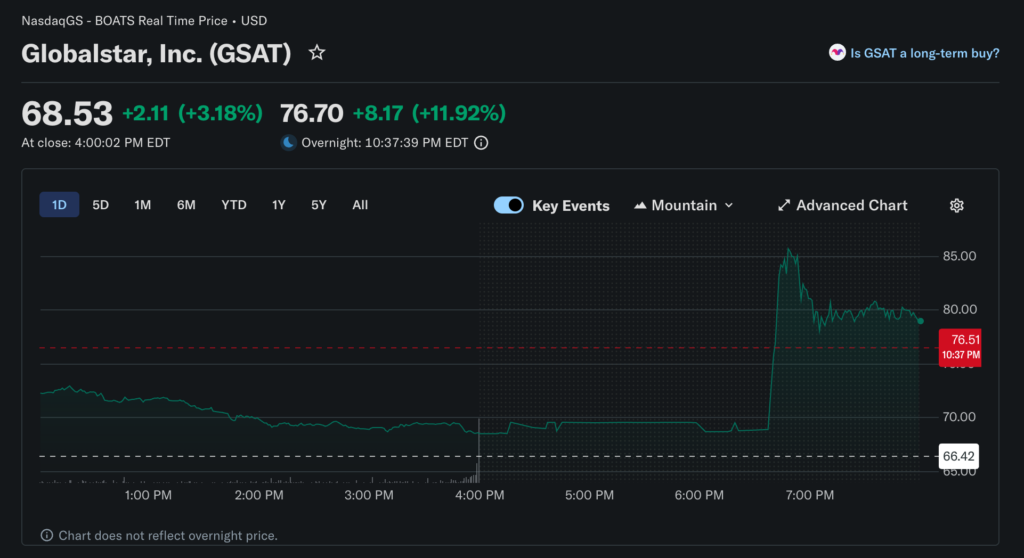
The report says Amazon’s goal is to inject key resources into its satellite network service “Amazon Leo” (formerly Project Kuiper) by acquiring Globalstar’s satellite spectrum and ground infrastructure.
The obstacle posed by Apple’s 20% stake
However, this deal faces a hurdle that can’t be avoided: Apple.
Reuters reports that in 2024, Apple invested $1.5 billion in Globalstar, obtaining about a 20% stake, and integrated Globalstar’s satellite network into the “Satellite Emergency SOS” feature for iPhone models 14 and above. This means that any acquisition of Globalstar must be negotiated not only with Globalstar, but also with Apple.
The Financial Times further notes that if the deal is completed at an estimated valuation of about $9 billion, the value of Apple’s stake on its books would increase by roughly $1.1 billion. But whether Apple is willing to let go strategically is another question. In recent years, Apple has continued to deepen its satellite communications features, expanding from emergency use to everyday connectivity; Globalstar is at the core of that effort.
An industry analyst told Reuters that the key to the deal is not the price, but how Amazon can convince Apple: “Either buy out Apple’s stake, or reach some kind of long-term cooperation agreement to ensure that the satellite feature on iPhones doesn’t stop.”
Amazon Leo vs. Starlink: the space internet battle heats up
Amazon’s active push into satellite networking is nothing new. Amazon currently has about 200 satellites deployed in low Earth orbit, with the ultimate goal of building a constellation system of roughly 7,700 satellites, with commercial service expected to launch in earnest later in 2026.
However, compared with SpaceX’s Starlink, Amazon Leo still lags behind. Starlink currently has more than 6,000 satellites in orbit, more than 4 million users worldwide, and SpaceX has recently been moving forward with an IPO, with a valuation estimated at $1.5 trillion.
The Financial Times analysis says that acquiring Globalstar would allow Amazon to gain mature satellite spectrum resources and a network of ground stations in one move, substantially narrowing the gap with Starlink.
Another variable added to the tech giants’ space race
If the deal goes through, it would make competition in the space internet industry even more concentrated: the three major tech forces—Amazon, SpaceX, and Apple—would be vying in the same arena.
However, Apple and Amazon have fundamentally different needs for satellite communications: Apple is focused on lightweight satellite connectivity on the phone side, while Amazon is targeting broadband-class satellite network services. Reuters reports that this difference may leave room for both sides to reach an agreement; but it could also become the spark that breaks negotiations.

Disclaimer: The information on this page may come from third parties and does not represent the views or opinions of Gate. The content displayed on this page is for reference only and does not constitute any financial, investment, or legal advice. Gate does not guarantee the accuracy or completeness of the information and shall not be liable for any losses arising from the use of this information. Virtual asset investments carry high risks and are subject to significant price volatility. You may lose all of your invested principal. Please fully understand the relevant risks and make prudent decisions based on your own financial situation and risk tolerance. For details, please refer to
Disclaimer.


