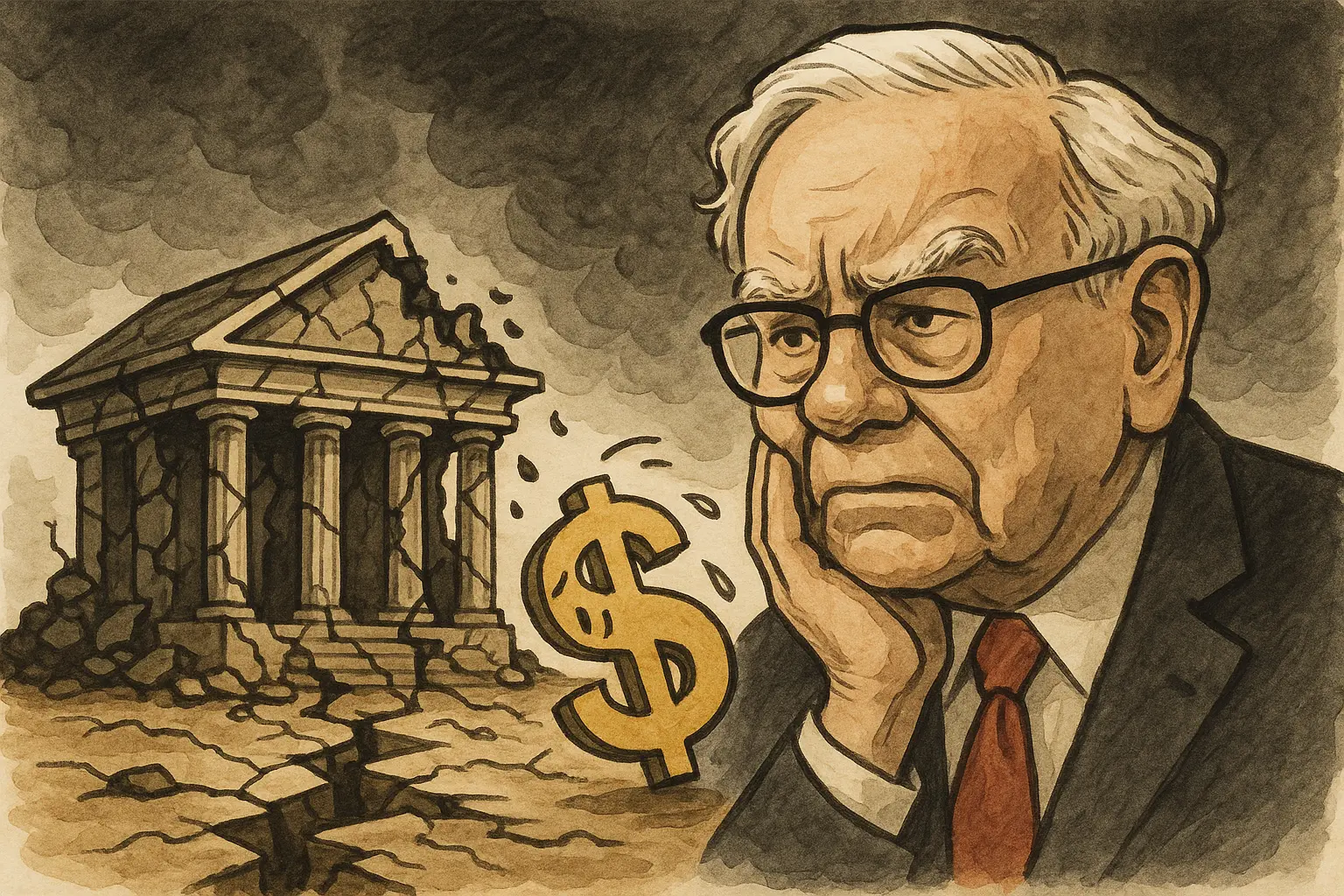
Billionaire investor Warren Buffett, in an interview with CNBC on March 31, said that as connections between the banking system and non-bank entities have grown tighter, he has started to see signs of vulnerabilities emerging in the financial system. He also emphasized that the Federal Reserve should prioritize maintaining stability in the financial system. Buffett said he is concerned about the U.S. dollar’s role as the world’s reserve currency—more than he is worried about an economic recession itself.
Financial Fragility Warning: Structural Concerns Behind the Risk of Bank Chain Transmission
In the interview, Buffett pointed to a systemic risk that is increasingly drawing market attention—namely that growing interconnections between the banking industry and non-bank entities such as private credit funds are creating potential transmission loopholes. He cited JPMorgan as an example, noting that major banks handle trillions of dollars in cash flows every day, making them a crucial hub for how the broader economy runs.
“They affect each other. If one starts having problems, it could transmit to other institutions,” he said.
The context for this warning is a series of recent credit-market blowups that have triggered concerns about banks’ and private credit funds’ balance sheets. Buffett said that if panic spreads, many investors could quickly pull out, accelerating a spiral of market declines. He also revisited the 2007 to 2008 financial crisis, when even the biggest companies at one point stopped answering the phone—reminding people that the destructive power of a systemic financial crisis far exceeds that of a typical market downturn.
$373 Billion in Cash: The Underlying Logic of Disciplined Waiting
In response to outside skepticism, Buffett made his position clear on Tuesday: this cash will not be tapped lightly. “If the market drops sharply, we’ll step in,” he said, and confirmed that Berkshire has again purchased $17 billion in Treasury bills at this week’s auction.
With the stock market currently only about 5% to 6% cheaper than its recent highs, Buffett said that is far from enough for Berkshire’s investment standards: “Our purpose in investing is not to get a 5% or 6% return.” His investment patience is rooted in decades of disciplined accumulation—waiting for opportunities like those that emerged years ago with American Express (AXP) and Occidental Petroleum (OXY), when prices fell low enough to support the prospect of truly strong long-term returns.
He also noted that Berkshire’s stock price has fallen by more than 50% three times since he took the helm, whereas the current market pullback “really is nothing.”
U.S. Dollar Reserves, Inflation Targets, and the Core Contradiction of American Capitalism
In the interview, Buffett’s remarks on the dollar and the inflation issue—especially—drew a lot of attention:
Hidden concerns about the dollar reserve status: Buffett said his concern about the dollar’s role as the world’s reserve currency goes beyond his worry about an economic recession itself, and emphasized that stability in the banking system matters far more than any single-market fluctuation.
Doubts about the Fed’s inflation target: He expressed skepticism about the Fed’s 2% inflation target, saying, “I’d like their inflation target to be zero. Once you start saying you can tolerate 2% inflation, over time, this will lead to very serious consequences.”
Casino analogy: He used a vivid analogy to describe the core contradiction of the U.S. market—“You have a grand palace called the U.S. economic system, but right next to it there’s a casino, and people will go back and forth between the two.”
He also stressed the fundamental logic of holding long-term stakes: “If investors hold a certain number of stocks for 50 years, they will make a lot of money. The American capitalist system works, and betting against the ‘house’ doesn’t.”
Frequently Asked Questions
What exactly did Buffett’s warning about the financial system’s fragility refer to?
Buffett said that as banks and non-bank institutions such as private credit funds become more tightly linked, a problem at one institution can spread to other institutions through transmission effects, forming chain risk. He emphasized that maintaining stability in the financial system should be the Fed’s top priority, and he revisited the systemic impact of the 2008 financial crisis as a warning.
Why is Buffett more concerned about the dollar’s reserve-currency status than about a recession?
Buffett believes that the dollar’s role as the world’s reserve currency is a cornerstone for the long-term functioning of the U.S. financial system, and that stability in the banking system matters far more than any single-market volatility. If the dollar’s reserve status were to be shaken, its long-term structural impact could be far greater than a one-off, ordinary cyclical recession.
When will Berkshire use the $37.3 billion in cash?
Buffett said Berkshire will only consider taking aggressive action when there is a real opportunity for “a major drop” in the market. Right now, the market is only about 5% to 6% below recent highs, which does not meet its investment return threshold. The cash will continue to be kept in the form of Treasury bills, waiting for the right time.
Disclaimer: The information on this page may come from third parties and does not represent the views or opinions of Gate. The content displayed on this page is for reference only and does not constitute any financial, investment, or legal advice. Gate does not guarantee the accuracy or completeness of the information and shall not be liable for any losses arising from the use of this information. Virtual asset investments carry high risks and are subject to significant price volatility. You may lose all of your invested principal. Please fully understand the relevant risks and make prudent decisions based on your own financial situation and risk tolerance. For details, please refer to
Disclaimer.


