
The Japan Chain Drugstore Association has introduced the “DCJPY” tokenized deposit to achieve 24/7 instant settlement, reducing transaction fees and enhancing logistics efficiency. This, along with the USDC test at Haneda Airport, showcases Japan’s ambition to actively develop blockchain and digital finance.
Japan’s Drugstore Association Introduces Tokenized Deposits to Accelerate Business Efficiency
Japan continues to implement blockchain technology! Yesterday (3/26), the Japan Chain Drugstore Association (JACDS) officially announced a basic agreement with the Japanese blockchain company DeCurret DCP to explore and introduce the tokenized deposit DCJPY.
The Japan Chain Drugstore Association stated that the goal is to reduce payment transaction fees for drugstores in Japan and comprehensively enhance supply chain efficiencies in logistics and return management.
Before the association announced the collaboration, SBI Shinsei Bank had also announced plans to explore the introduction of DCJPY to provide new value financial services to customers.
Association members include Matsumoto Kiyoshi and Welcia, dual-layer structure enables instant payments
The Japan Chain Drugstore Association was established in 1999, with members including well-known chain drugstore giants such as Matsumoto Kiyoshi, Welcia, and Tsuruha Drug (鶴羽藥妝). Although the chain stores have generally adopted standard digital payment services like PayPay, this is the first time the association has attempted to solve logistics management issues with a digitalized yen.
The “DCJPY Network” is a dual-layer system composed of a “Financial Zone” and a “Commercial Zone.” The DCJPY is issued by Japan Post Bank in collaboration with DeCurret DCP, mainly to digitalize physical bank deposits and implement a dual-layer structure.
According to the explanatory diagram provided in the official press release, the underlying layer is the Financial Zone, primarily where banks issue after digitalizing physical bank deposits; the upper layer is the Commercial Zone, where businesses can write and execute various services. By introducing a digital advanced solution platform for tokenized deposits, the industry can achieve the integration of “business flow” and “capital flow.”
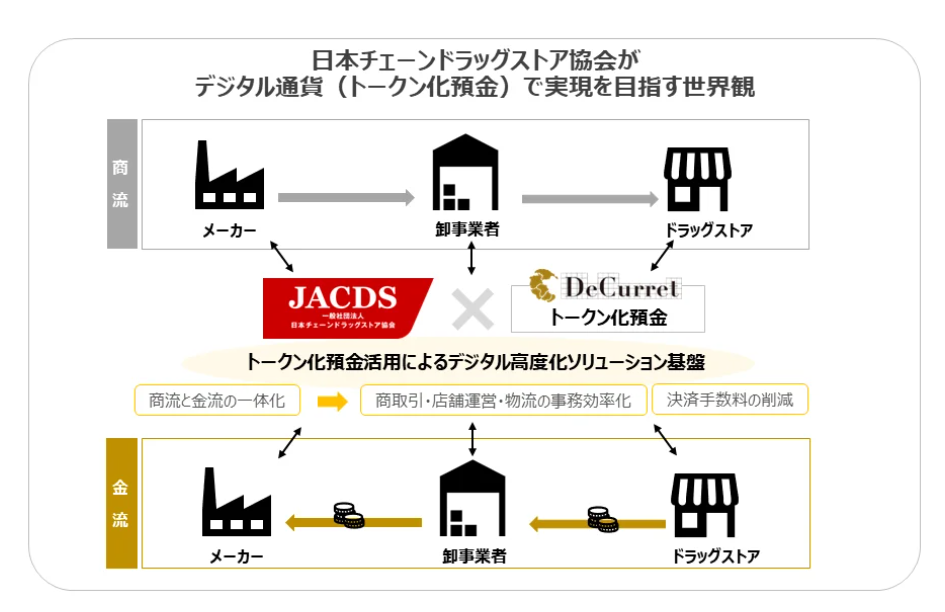
Source: Official press release on the dual-layer structure of DCJPY in commercial and financial applications
For example, when physical goods are delivered from manufacturers and wholesalers to drugstores, DCJPY can synchronize the payment capital flow in reverse through program settings, achieving instant settlement 24 hours a day, all year round.
This process can significantly reduce traditional transaction fees and effectively enhance overall administrative efficiency in business transactions, store operations, and logistics.
What is the difference between tokenized deposits and stablecoins?
Tokenized deposits are different from stablecoins. The essence of DCJPY is to directly tokenize bank deposits, representing users’ claim on the bank’s deposits, and operates on a permission-based network; while yen stablecoins mainly maintain their value through reserves held by the issuer, such as cash or government bonds, making their structures entirely different.
Japan Post Bank revealed last year that it plans to issue DCJPY to depositors in the fiscal year 2026, allowing depositors to instantly convert their account deposits into tokens operating on the blockchain in the future.
Related Knowledge Supplement:
What stablecoins are there? Which has the highest market value? 2025 Stablecoin Investment Analysis Guide
What is RWA? Understand the practical applications of RWA tokenization of real assets at once.
Focusing on Cross-Border Payments, the International Expansion of Tokenized Deposits
The ambition of DCJPY is not limited to Japan; DeCurret DCP’s marketing director, Kinjo Mai, revealed in an interview with NADA News that they have collaborated with the Singapore blockchain company Partior to push tokenized deposits into the cross-border settlement field. The spokesperson stated that they hope to bring DCJPY into the global financial market through establishing phased connections.
The DeCurret DCP team stated that Japan faces pressure to catch up quickly, and the collaboration will assist DCJPY in connecting with various national financial networks, enhancing the efficiency of capital allocation for multinational enterprises.
Blockchain Moves to the Background, Haneda Airport Launches USDC Experiment
As tokenized deposits flourish, Japan is also promoting the application of stablecoins.
At the beginning of this year, the Japanese digital payment company Netstars launched a payment test for the US dollar stablecoin USDC at Haneda Airport, allowing travelers to complete payments by scanning a QR Code with the MetaMask wallet. Netstars revealed that the testing process utilized the efficient Solana blockchain, aiming to shorten checkout times.
From the introduction of DCJPY in drugstores to airport support for USDC, it is evident that Japan is actively embracing blockchain technology, allowing complex technology to remain behind the user interface, further linking traditional finance with the digital economy.
Related Reports:
You can use stablecoins in Japan during the New Year! Some stores at Haneda Airport are piloting USDC, supporting MetaMask payments.
Disclaimer: The information on this page may come from third parties and does not represent the views or opinions of Gate. The content displayed on this page is for reference only and does not constitute any financial, investment, or legal advice. Gate does not guarantee the accuracy or completeness of the information and shall not be liable for any losses arising from the use of this information. Virtual asset investments carry high risks and are subject to significant price volatility. You may lose all of your invested principal. Please fully understand the relevant risks and make prudent decisions based on your own financial situation and risk tolerance. For details, please refer to
Disclaimer.
Related Articles
Circle Issues 250M USDC on Solana
Gate News message, April 16 — According to Whale Alert, Circle has minted 250 million USDC on the Solana blockchain.
GateNews4h ago
Circle CEO: We believe RMB stablecoins conceal enormous business opportunities, and we are optimistic that Hong Kong can become a cross-border payments hub.
Circle CEO Jeremy Allaire said the yuan stablecoin faces a huge business opportunity. He expects that China will roll out related products within the next three to five years and may change its regulatory stance toward digital assets. With rising demand for USDC, Hong Kong’s cross-border payment potential is also gaining attention, and Circle is closely monitoring changes in U.S. regulatory policy.
ChainNewsAbmedia9h ago
Whale Deposits 3,500 ETH to Aave V3, Borrows 8M USDC, and Buys Back 3,386 ETH
A whale deposited 3,500 ETH worth $8.26 million into Aave V3, borrowed 8 million USDC, then purchased 3,386 ETH and redeposited it, now holding 6,886 ETH valued at around $16.22 million.
GateNews11h ago
Circle Launches Cross-Chain USDC Settlement Mechanism Supporting Batch Payments
Circle has launched a new cross-chain USDC payment mechanism for high-frequency settlements, utilizing the Cross-Chain Transfer Protocol to pre-fund transfers and enable batch settlements, thereby minimizing operational overhead and reducing burn operations.
GateNews17h ago
The Stablecoin Era! Circle founder Jeremy Allaire makes the 2026 Global Top 100 Most Influential People list
Against the backdrop of the gradual expansion of global crypto and financial regulation, Circle co-founder Jeremy Allaire was named to Time’s 2026 list of the 100 most influential people, symbolizing the growing importance of stablecoins. Circle has evolved from a digital payments company into a stablecoin platform centered on USDC, and plans to become part of global financial infrastructure. This shift makes its business model more akin to a digital money market fund, foreshadowing the potential profitability and growth of stablecoins in the future.
ChainNewsAbmedia04-15 17:25
Criticized for freezing too slowly: USDC freezes are taking too long! Circle CEO: We will definitely wait for a court order before freezing; we refuse to freeze it on our own
Circle CEO Jeremy Allaire said the company will not proactively freeze wallet addresses unless it receives a court order or law-enforcement requirement. Even amid allegations of hacker money laundering and community backlash, Circle continues to insist on operating under the rule of law.
Jeremy Allaire sets Circle’s law-enforcement bottom line
-----------------------------
As the global cryptocurrency market surges with uncertainty, Circle’s CEO Jeremy Allaire, at a press conference in Seoul, South Korea, made a clear stance on the market’s most sensitive issue of “asset freezes.” He noted that while Circle has technical means to freeze specific wallet addresses, unless it receives a court order or an official directive from law-enforcement agencies, the company will not
CryptoCity04-15 12:03


