Ethereum-based decentralized finance (DeFi) lending protocol Fira said on Tuesday it was launching with about $450 million in deposits, highlighting demand for fixed-rate onchain credit.
Fira said the protocol’s fixed-rate credit market allows users to lock borrowing costs and lending returns for defined periods by organizing lending around maturities rather than floating utilization-based rates, according to an announcement shared with Cointelegraph.
The fixed-rate model differs from most DeFi lending protocols, where borrowers cannot lock funding costs, and lenders cannot predict returns, making long-term DeFi lending less predictable. Fira’s said its model organizes markets by maturity and determines interest rates by supply and demand mechanics, replacing utilization algorithms that fluctuate with borrowing activity.
Fira said the design is intended to create a more predictable onchain credit market by introducing yield curves and defined maturities, features that are standard in traditional fixed-income markets but rare in DeFi.
Fira is not the first DeFi lending protocol built around fixed-rate credit. Other protocols with similar structures include Notional Finance, IPOR and Term Finance.

Fira debuts fixed-rate onchain credit market. Source: Fira
Euler-linked liquidity migrated into Fira
Fira said it debuted with $450 million in deposits, which were “reallocated” from users of the modular lending platform Euler Finance during the pre-launch phase that started on Jan. 8, Pete Siegel, chief financial officer at Fira, told Cointelegraph.
“Fira was pre-launched in January. It opened with a first market called UZR, which enabled roughly a thousand users who were already on Euler, in a product available on Euler to migrate their assets at a fixed rate.”
Siegel said the deposits reflect user interest in fixed-rate lending products.
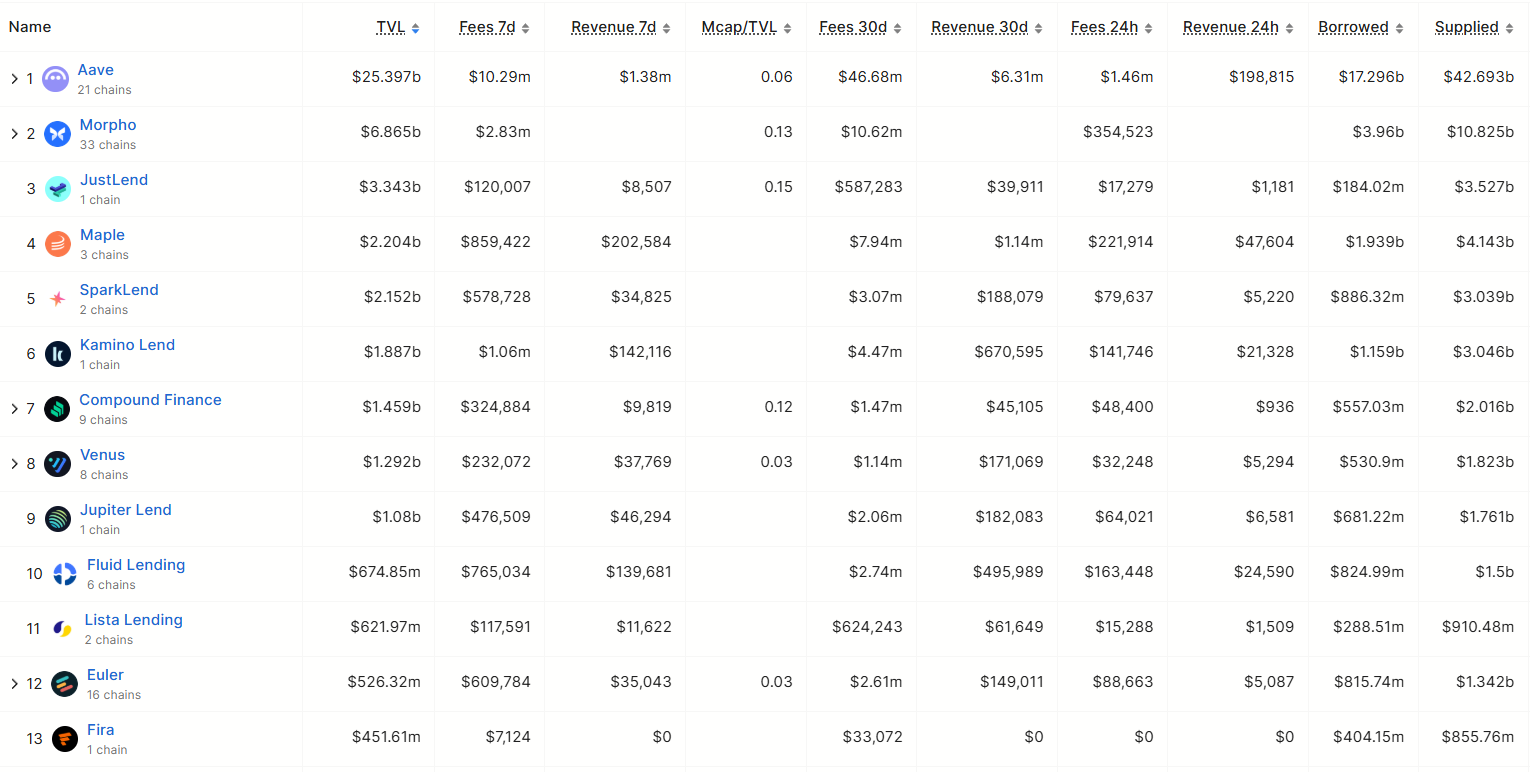
DeFi lending protocol rankings by TVL. Source: DeFiLlama
DefiLlama currently shows Fira with about $451.6 million in total value locked on Ethereum, compared with roughly $25.3 billion for Aave, the sector’s largest lending protocol.
**Related: **__Maestro launches mining-backed Bitcoin credit market for institutions
Fira said its smart contracts have undergone six independent security audits conducted by Sherlock, Spearbit via Cantina, Hexens and yAudit between November 2025 and early 2026.
Fira’s bug bounty program through Sherlock offers up to $500,000 in rewards for users finding critical vulnerabilities in the protocol’s open-source Ethereum-based smart contracts.
**Magazine: **__DeFi will rise again after memecoins die down: Sasha Ivanov
Cointelegraph is committed to independent, transparent journalism. This news article is produced in accordance with Cointelegraph’s Editorial Policy and aims to provide accurate and timely information. Readers are encouraged to verify information independently. Read our Editorial Policy https://cointelegraph.com/editorial-policy
- #Blockchain
- #Cryptocurrencies
- #Decentralization
- #Lending
- #Credits
- #DeFi
Disclaimer: The information on this page may come from third parties and does not represent the views or opinions of Gate. The content displayed on this page is for reference only and does not constitute any financial, investment, or legal advice. Gate does not guarantee the accuracy or completeness of the information and shall not be liable for any losses arising from the use of this information. Virtual asset investments carry high risks and are subject to significant price volatility. You may lose all of your invested principal. Please fully understand the relevant risks and make prudent decisions based on your own financial situation and risk tolerance. For details, please refer to
Disclaimer.
Related Articles
BTTC Bridge Transaction Records Page Upgrade Goes Live with Enhanced Filtering and Tracking
BTTC Bridge has upgraded its transaction records page to improve asset tracking for cross-chain users. The new interface features dual viewing modes, enhanced filters, and clear identification markers, aiming to streamline transaction management. Further refinements are planned.
GateNews20m ago
South Korea Plans Blockchain Deposit Token Pilot for Government Spending in Q4 2026
South Korea plans to launch a blockchain-based deposit token pilot in Sejong City in Q4 2026, replacing traditional government payment methods. This initiative aims to simplify transactions and reduce costs for small businesses.
GateNews1h ago
Cobo Launches Adoption Clearing Layer (ACL) for Multi-Chain Payment Incentives
Cobo has introduced the Adoption Clearing Layer (ACL), an incentive settlement platform for blockchains and payment institutions. It offers multi-chain payment routing, enabling users to earn rebates and boosting transaction volumes in the ecosystem.
GateNews2h ago
Will the WLFI token be locked up until Trump is ousted? Justin Sun was ruthlessly “harvested” like a sucker, and bitterly condemned “world tyranny.”
Donald Trump’s family crypto project WLFI has rolled out a new governance proposal that would extend the token lock-up period for early investors to four years, sparking strong opposition from investors including Justin Sun. Sun criticized the proposal as a “threat,” and believes it is coercion directed at investors. WLFI, meanwhile, said the proposal can help ensure a healthy market and that it is facing legal challenges from outside the organization.
ChainNewsAbmedia2h ago
Aave Labs Launches Aave Checkpoint, an AI-Driven Governance Security System
Aave Labs has launched Aave Checkpoint, an AI-driven governance security system aimed at enhancing Aave's decentralized autonomous organization by ensuring rigorous review of proposals through automated analysis and mandatory human verification.
GateNews3h ago
Aave Labs launches Aave Checkpoint, using human review to mitigate DAO governance risks
Aave Labs released the Aave Checkpoint on April 15, combining AI-based automated analysis and mandatory manual review, requiring at least two reviewers to verify governance proposals. The system has been operating since March 2026 and covers DeFi risks such as oracle manipulation. At the same time, Aave V4 introduces a reinvestment module that dynamically allocates idle liquidity while maintaining immediate fund liquidity.
MarketWhisper4h ago


