Will Quantum Computing “Kill” Bitcoin? A Deep Dive into the Possibility of BTC Surging to $1 Million
Current Bitcoin Price and Market Outlook
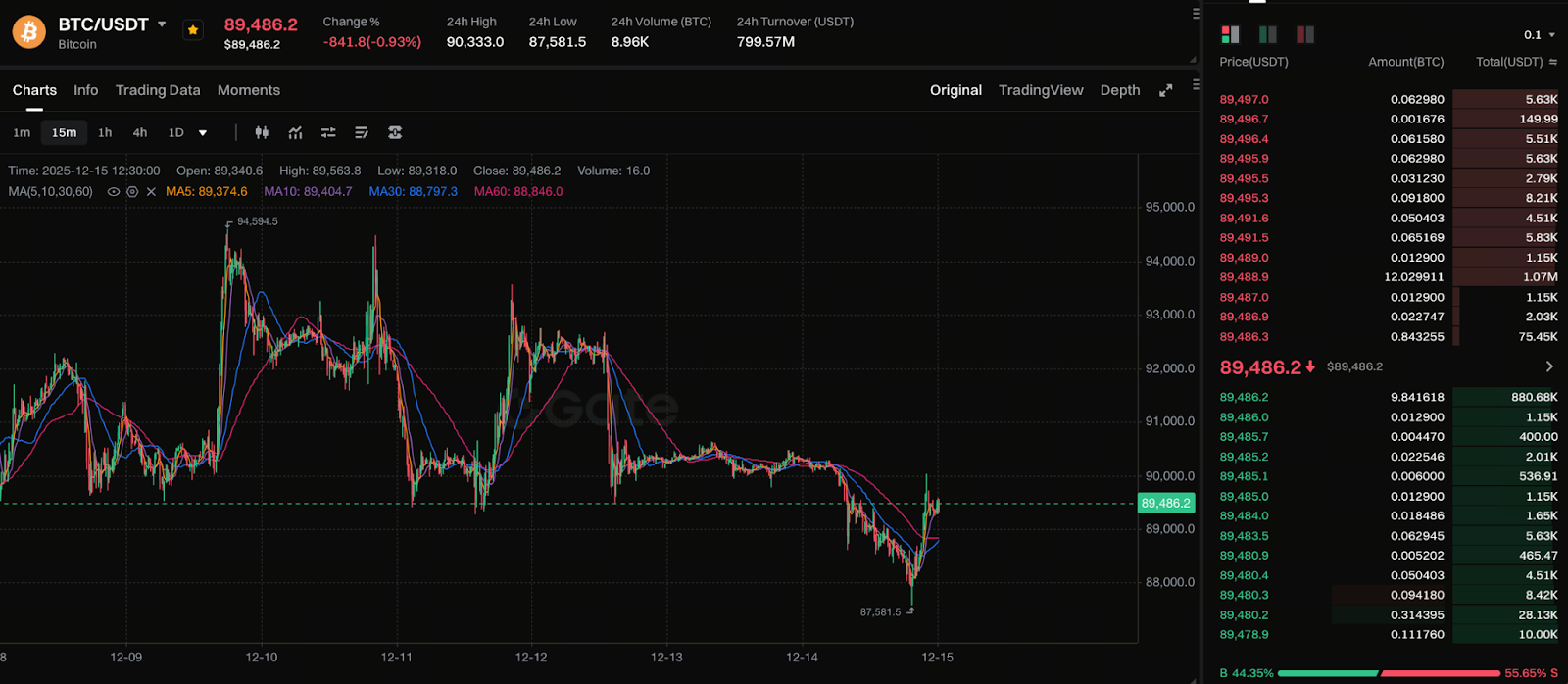
Chart: https://www.gate.com/trade/BTC_USDT
As of December 15, 2025, Bitcoin is trading at approximately $89,500. The price has seen several corrections recently, but some prominent industry figures remain highly optimistic about Bitcoin’s long-term prospects. For example, Coinbase CEO Brian Armstrong has publicly predicted that Bitcoin could hit $1,000,000 before 2030, sparking significant debate across the market.
This eye-popping target isn’t an outlier. Similar bullish forecasts have come from institutional investors, analysts, and leading hedge funds. While the current price is still far from this milestone, investor confidence in Bitcoin’s role as “digital gold” remains strong.
Still, beyond the anticipation of price surges, a deeper risk is quickly gaining attention—the potential threat that quantum computing poses to blockchain cryptographic security.
How Powerful Is Quantum Computing? Bitcoin’s Core Security Mechanisms
Bitcoin’s security is built on two foundational cryptographic technologies:
- Elliptic Curve Digital Signature Algorithm (ECDSA)
- SHA-256 Hash Algorithm
These cryptographic schemes are currently considered unbreakable by classical computers, which ensures the safety of users’ private keys and the integrity of transactions.
However, quantum computers use “qubits” instead of traditional “bits.” This allows them to compute in superposition, handling multiple states simultaneously. In theory, this enables exponential processing power and makes it possible for certain algorithms—like Shor’s algorithm—to eventually break today’s cryptographic protocols.
If large-scale quantum computers are realized, they could drastically reduce the effort required to break ECDSA, putting Bitcoin wallets and even the entire transaction system at risk.
Is the Quantum Threat Really Imminent? Expert Predictions and Timelines
Industry views on quantum risk have diverged sharply in recent months:
Solana co-founder Anatoly Yakovenko has warned that Bitcoin needs to prepare for quantum breakthroughs within about five years, or its current cryptographic safeguards could be breached.
Conversely, some technical experts—including the CTO of Ledger—believe quantum computing won’t pose a critical threat to Bitcoin in the near term.
In fact, multiple technical assessments indicate that breaking Bitcoin’s cryptography would require quantum computers with millions of fault-tolerant qubits—a level of technology that remains far out of reach today.
In short, while quantum attacks are a real concern, they’re generally seen as a medium- to long-term risk. This is especially true since Bitcoin’s core code and ecosystem have not yet been fully upgraded to address such threats.
Can Bitcoin Be Upgraded to Resist Quantum Attacks?
The good news is that quantum security is a solvable challenge.
The cryptography community is already developing Post-Quantum Cryptography solutions, such as quantum-resistant signature algorithms based on lattice cryptography or hash-based signatures.
If the Bitcoin community and developers decide to upgrade the protocol and transition to quantum-resistant algorithms, the network can proactively build defenses before quantum threats become a reality.
However, such a sweeping upgrade is a massive undertaking. It would require coordination among miners, node operators, and the global community—a process that can’t happen overnight.
Investor Perspective: Panic or Opportunity?
For investors, quantum risk is both a potential reason to sell and a call to pay attention to technological progress and network upgrades.
Could Bitcoin reach $1,000,000? The market is full of bold predictions—Coinbase’s CEO among the most optimistic—but such targets should be approached with caution.
If Bitcoin continues to operate securely and upgrades its cryptographic safeguards, it could keep attracting long-term investors and remain a store of value in the evolving financial system.
Summary: Quantum Is Not the End, But a New Turning Point
In summary, the question “Will quantum computing kill Bitcoin?” doesn’t have a simple yes or no answer. Quantum computing does present a theoretical risk to current cryptographic systems, but any real threat is still years—if not decades—away.
If the Bitcoin community deploys quantum-resistant upgrades in advance, and momentum from price appreciation and institutional capital continues, BTC won’t just survive—it could thrive, driven by technological innovation and growing market expectations.
Share
Content
Current Bitcoin Price and Market Outlook
How Powerful Is Quantum Computing? Bitcoin’s Core Security Mechanisms
Is the Quantum Threat Really Imminent? Expert Predictions and Timelines
Can Bitcoin Be Upgraded to Resist Quantum Attacks?
Investor Perspective: Panic or Opportunity?
Summary: Quantum Is Not the End, But a New Turning Point


Related Articles

2025 BTC Price Prediction: BTC Trend Forecast Based on Technical and Macroeconomic Data

Flare Crypto Explained: What Is Flare Network and Why It Matters in 2025

Pi Coin Transaction Guide: How to Transfer to Gate.com

How to Use a Crypto Whale Tracker: Top Tool Recommendation for 2025 to Follow Whale Moves

What is N2: An AI-Driven Layer 2 Solution