As liquid staking (LSD) and restaking mechanisms continue to evolve, blockchain protocols are shifting from single-asset yield models toward multi-layered incentive systems. In this process, tokens are no longer used solely to represent asset ownership but are increasingly applied to governance and incentives, helping coordinate user behavior with protocol growth.
Against this backdrop, StakeStone introduces a dual-token structure that separates asset representation from governance incentives. STO, as the core protocol token, plays a central role in linking user participation, yield distribution, and ecosystem expansion, making it a critical component of the overall yield aggregation system.
StakeStone Overview
StakeStone is a yield aggregation protocol that combines liquid staking and restaking mechanisms. It aims to improve capital efficiency through automated strategies and cross-chain allocation. After depositing ETH or related assets, users can access multiple sources of yield without directly managing complex strategies.
Within this system, different tokens are assigned distinct roles for asset representation and protocol governance, enabling a layered and modular design.
The Role of STO in the StakeStone Ecosystem
STO is the native utility and governance token of the StakeStone ecosystem. It is designed to align the long-term interests of all stakeholders, including users, partners, and developers.
The total supply of STO is 1 billion tokens. Its primary functions include protocol governance, yield enhancement, and access to bribing rewards through vote-escrowed STO (veSTO).
In terms of use cases, STO serves three main functions:
First, as a governance tool, it is used to participate in protocol parameter adjustments, strategy selection, and system upgrades.
Second, as an incentive mechanism, it rewards users, liquidity providers, and ecosystem participants, helping drive protocol growth.
Finally, STO also plays a role in value distribution, allowing participants to indirectly benefit from the protocol’s development.
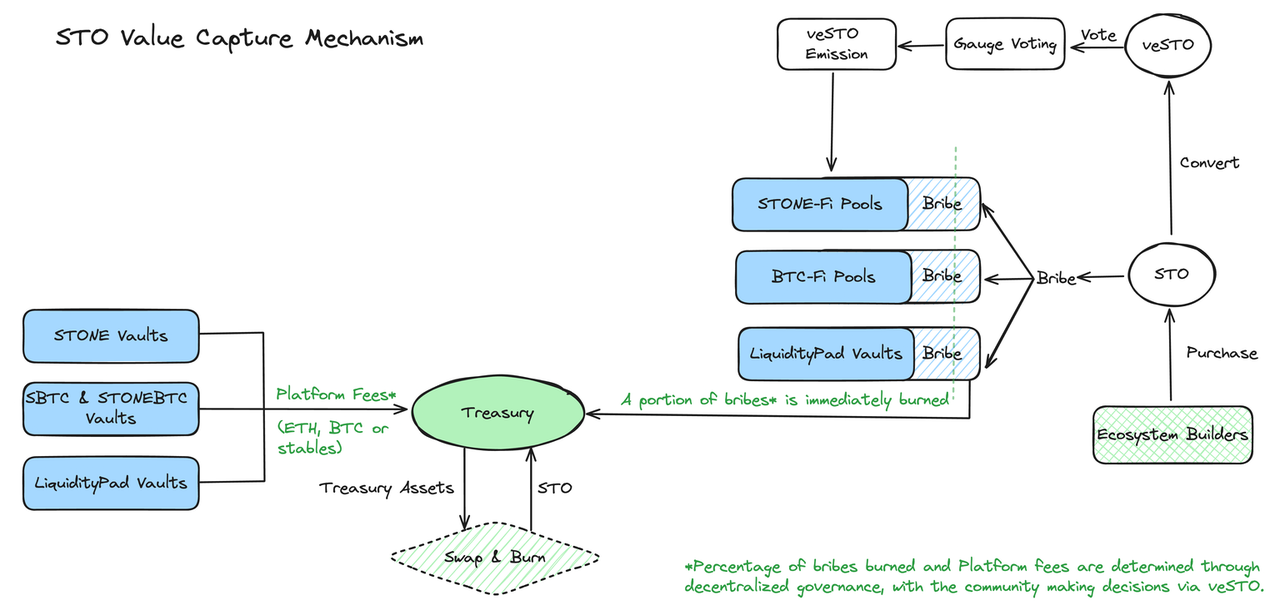
STO price capture mechanism, source: StakeStone
Overall, STO acts as the key bridge between “user behavior” and “protocol development.”
The Relationship and Differences Between STO and STONE
StakeStone adopts a dual-token structure in which STO and STONE serve different purposes.
| Dimension |
STO |
STONE |
| Type |
Governance / Incentive Token |
Yield-bearing receipt |
| Represents Assets |
No |
Yes |
| Core Function |
Governance, incentives, value distribution |
Represents deposited assets |
| Yield Source |
Incentive mechanisms |
Staking + restaking yield |
| Use Cases |
Governance, incentive distribution |
DeFi, liquidity, yield accrual |
This separation allows the system to introduce flexible governance and incentive mechanisms without compromising asset liquidity.
STO Issuance and Distribution Mechanism
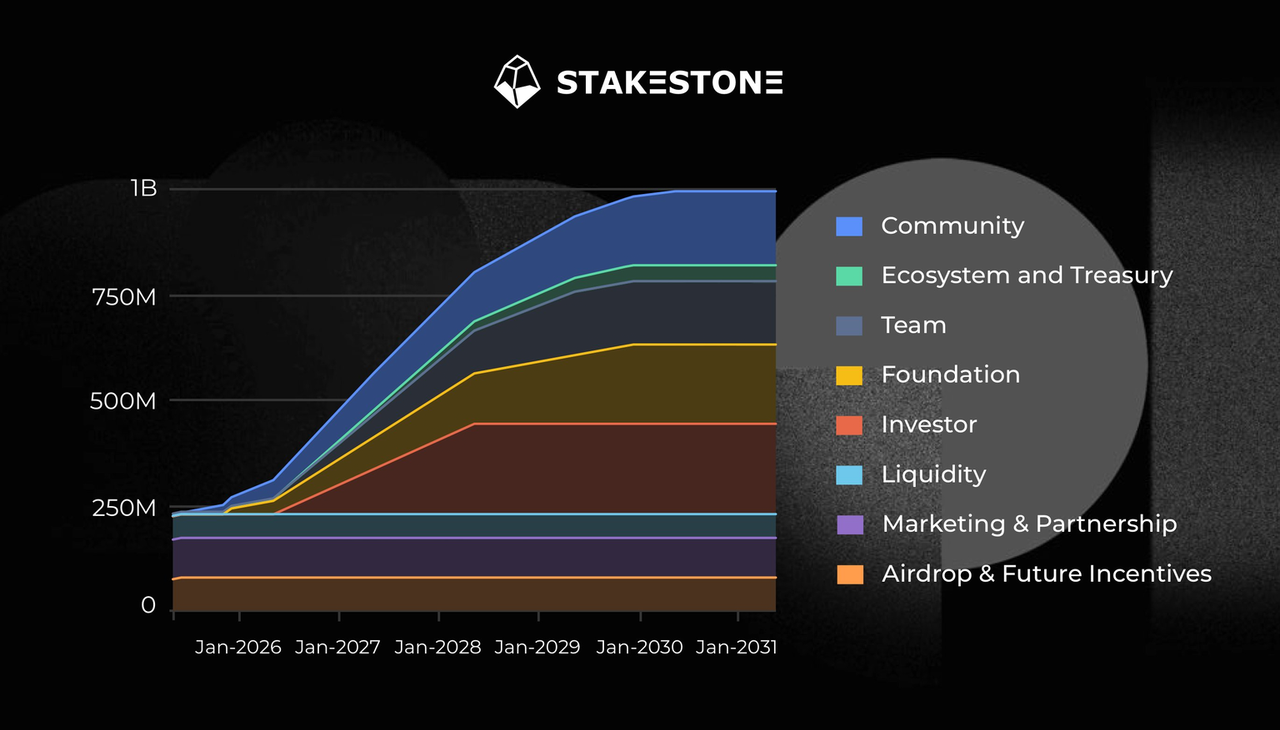
According to StakeStone’s token model, STO is typically introduced into the market through predefined allocations and gradual release.
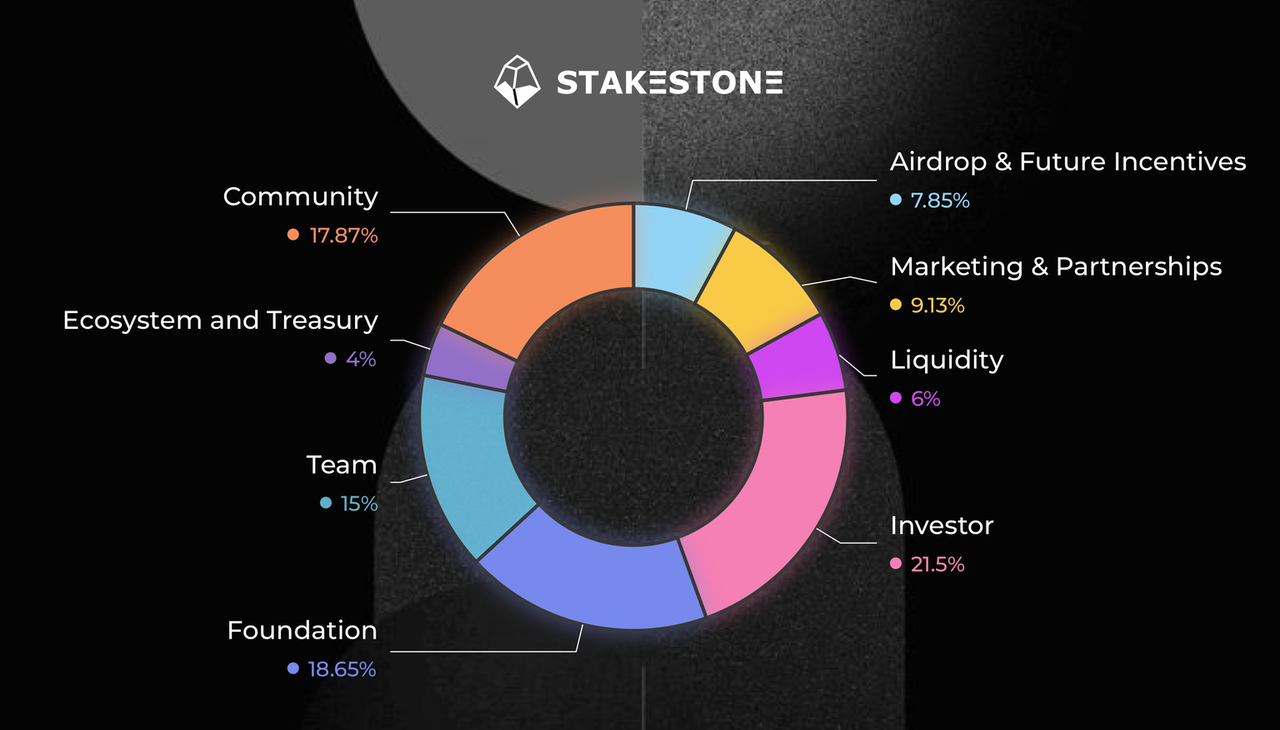
In the initial phase, STO is distributed among multiple stakeholders, including core contributors, ecosystem development, the community, and future incentive pools. This approach aims to balance early-stage growth with long-term incentives.
In terms of token release, STO is usually unlocked in phases or distributed based on participation. For example, some tokens may be allocated to reward users who provide liquidity or actively engage with the protocol, aligning token distribution with actual usage.
How Does the STO Incentive Mechanism Work?
The STO incentive mechanism is designed to guide user behavior and promote ecosystem growth.
At the user level, STO can be distributed as rewards to those who stake, provide liquidity, or use the protocol, increasing both total value locked and user activity. At the ecosystem level, STO can also incentivize partner protocols to integrate with StakeStone, expanding its use cases.
In addition, incentives are often tied to user behavior. For example, long-term participants or those who provide stable liquidity may receive higher rewards. This design helps enhance system stability and encourages sustainable growth.
STO Governance Mechanism Analysis
STO holders are typically able to participate in protocol governance, which mainly involves proposal submission and voting.
In terms of governance scope, STO can be used to decide key parameters such as yield strategy allocation, protocol upgrade directions, and risk management frameworks. Governance is generally conducted through decentralized voting, allowing token holders to influence the protocol’s future direction.
The introduction of governance mechanisms enables StakeStone to maintain automated operations while incorporating a degree of decentralized control.
Differences Between StakeStone STO and EigenLayer Incentive Models
The incentive models represented by STO and EigenLayer differ significantly in both purpose and structure. STO primarily focuses on governance and ecosystem incentives, whereas EigenLayer ties incentives directly to restaking activities and security services.
| Dimension |
StakeStone (STO) |
EigenLayer |
| Core Positioning |
Governance + Incentive Token |
Restaking Infrastructure |
| Incentive Source |
Protocol allocation / ecosystem incentives |
AVS service revenue |
| Direct Asset Binding |
No |
Yes (restaked assets) |
| Target Participants |
Users + ecosystem participants |
Validators / restakers |
| Yield Type |
Indirect incentives |
Direct yield |
| System Role |
Coordination / incentive layer |
Security extension layer |
EigenLayer’s model is closer to a foundational security economy, where rewards are directly tied to network security services such as validation tasks or AVS (Active Validation Services). In contrast, StakeStone’s STO functions more as a coordination and incentive layer, guiding capital and user behavior rather than generating base-layer yield directly.
Potential Advantages and Limitations of the STO Model
From an advantages perspective, the STO model improves system flexibility by separating assets from governance. This allows the protocol to adjust incentive strategies across different stages. Its incentive structure also helps attract users and ecosystem participants, supporting overall growth.
However, the model also has limitations. The effectiveness of incentives depends heavily on their design and execution. If incentives become disconnected from actual usage, system efficiency may suffer. Additionally, token release schedules and distribution structures may impact long-term stability.
Conclusion
As StakeStone’s core token, STO does not directly represent user assets. Instead, it connects user behavior with protocol development through governance and incentive mechanisms. Together with STONE’s asset-layer role, StakeStone establishes a token framework that balances yield generation with protocol control, enabling strong scalability within a multi-chain yield aggregation ecosystem.
FAQs
What is the difference between STO and STONE?
STO is used for governance and incentives, while STONE represents user assets and yield.
Does STO represent staked assets?
No, assets are represented by STONE.
What are the main use cases of STO?
Governance, incentives, and ecosystem development.
Can holding STO generate returns?
Typically, returns are obtained indirectly through participation in incentives or governance.
Does STO participate in protocol governance?
Yes, holders can usually participate in proposals and voting.