In a modular blockchain framework, tokens function as more than just a medium of exchange—they’re integral to network security and incentivization. Consequently, users closely examine token allocation, inflation models, and specific utilities.
This topic typically covers three dimensions: token distribution, fee structures, and incentive mechanisms. Together, these elements shape the economic model for SOON within the SVM Rollup ecosystem.
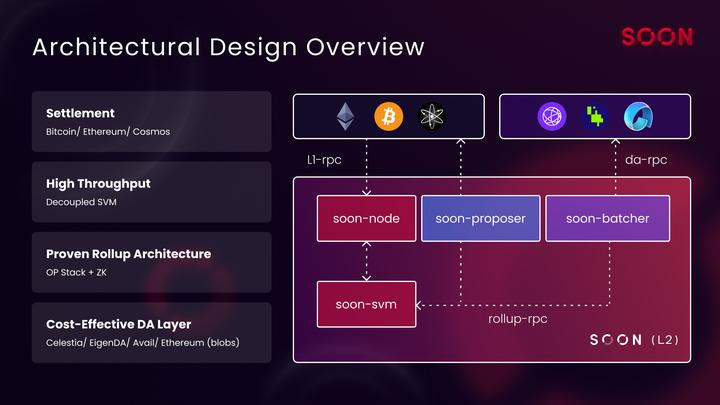
What is the SOON Token? Core Functionality in the Execution Layer
SOON is the native asset powering the entire execution layer network, operating seamlessly across all SOON Chains and the mainnet.
Functionally, SOON serves as gas, staking collateral, and governance utility—the central medium connecting user actions with network operations. All transaction execution, node participation, and governance activities depend on SOON.
Structurally, SOON is a multifunctional token, not limited to a single use case. It underpins execution resource consumption, network security, and ecosystem incentives, facilitating both execution layer functions and cross-chain communications.
This unified design enables the execution layer to capture value through a single asset, directly aligning network usage with token demand.
How SOON Powers Transaction Fees and Resource Allocation
SOON is used as gas within the execution layer, covering the computational and data processing costs of transactions.
Practically, users spend SOON when submitting transactions. Fees are determined by factors such as computational complexity and data size. Execution nodes allocate resources in response to these fees.
This fee model links user requests to execution resources, allowing the network to dynamically adjust load through pricing and prevent abuse.
In essence, this mechanism ensures efficient resource pricing, supporting stable operation of a high-performance network.
How SOON Staking Secures the Network
SOON’s security framework is built on staking.
Validators must stake SOON to participate in transaction execution and validation. Their actions are governed by economic incentives and penalties for violations. Validators can earn roughly 3% annualized rewards for their participation.
The staking system consists of validators, reward distribution, and penalty rules—ensuring security is driven by economic alignment.
This approach transforms network security into an economic problem, motivating participants to maintain system stability through aligned interests.
How SOON Enables On-Chain Governance
The governance mechanism empowers SOON holders to shape protocol decisions.
Holders can vote on network upgrades, funding allocations, and ecosystem strategies, and actively engage in the proposal process.
The governance framework is structured around proposals, voting, and execution—enabling community-driven decisions to take effect at the protocol level.
This decentralizes network control, enhancing transparency and long-term sustainability.
How Inflation and Distribution Affect SOON Participants
SOON’s model features a fixed initial supply with ongoing inflationary incentives.
Key facts:
- Initial total supply: 1,000,000,000 SOON
- Annual inflation: 3% (rewards validators and ecosystem contributors)
- Burned tokens to date: 30,000,000 SOON
Supply is managed through initial issuance, inflationary rewards, and token burns, allowing for dynamic long-term adjustments.
Official SOON Token Distribution
| Category |
Proportion |
Details |
| Community |
51% |
Distributed via NFT minting and on-chain activities |
| Ecosystem Fund |
25% |
Developer incentives and ecosystem growth |
| Airdrops & Liquidity |
8% |
Market launch and liquidity support |
| Foundation / Treasury |
6% |
Operations and long-term development |
| Team & Co-Builders |
10% |
Core development and long-term incentives |
This community-centric structure allocates over half of all SOON directly to users and ecosystem participants.
The resulting distribution promotes decentralization and incentivizes continuous network expansion through inflation and rewards.
Use Cases for SOON Across the Ecosystem
SOON delivers foundational utility across multiple scenarios.
It is used to pay transaction fees, participate in staking, cast governance votes, and incentivize developers and ecosystem projects.
SOON connects the execution layer, cross-chain operations, and application layer—enabling seamless value transfer throughout the ecosystem.
This design ensures SOON functions not only as a transactional medium but also as the essential resource underlying the ecosystem’s operation, supporting the growth of a multi-chain execution environment.
Summary
With its transparent distribution, inflationary incentives, and multifunctional design, SOON integrates execution layer utility, network security, and ecosystem growth into a unified economic model—positioning the token as the core value anchor of the SVM Rollup architecture.
FAQ
What is SOON’s total supply?
The initial supply is 1 billion tokens, with ongoing 3% annual inflation.
Why is 51% of SOON allocated to the community?
This is part of a fair launch model, designed to increase decentralization and user participation.
Does SOON include a burn mechanism?
Thirty million tokens have been burned to manage supply dynamics.
Where do staking rewards originate?
Staking rewards come primarily from inflation, incentivizing validators to secure the network.
What drives SOON’s core value?
Demand for SOON is fueled by execution layer utility, gas consumption, and ongoing ecosystem growth.