Strategy Builds $1.44 Billion Cash Reserve to Weather Volatility and Secure Dividends — What Does It Mean?
Background: MicroStrategy (now referred to as “Strategy”) and Bitcoin Holdings Overview
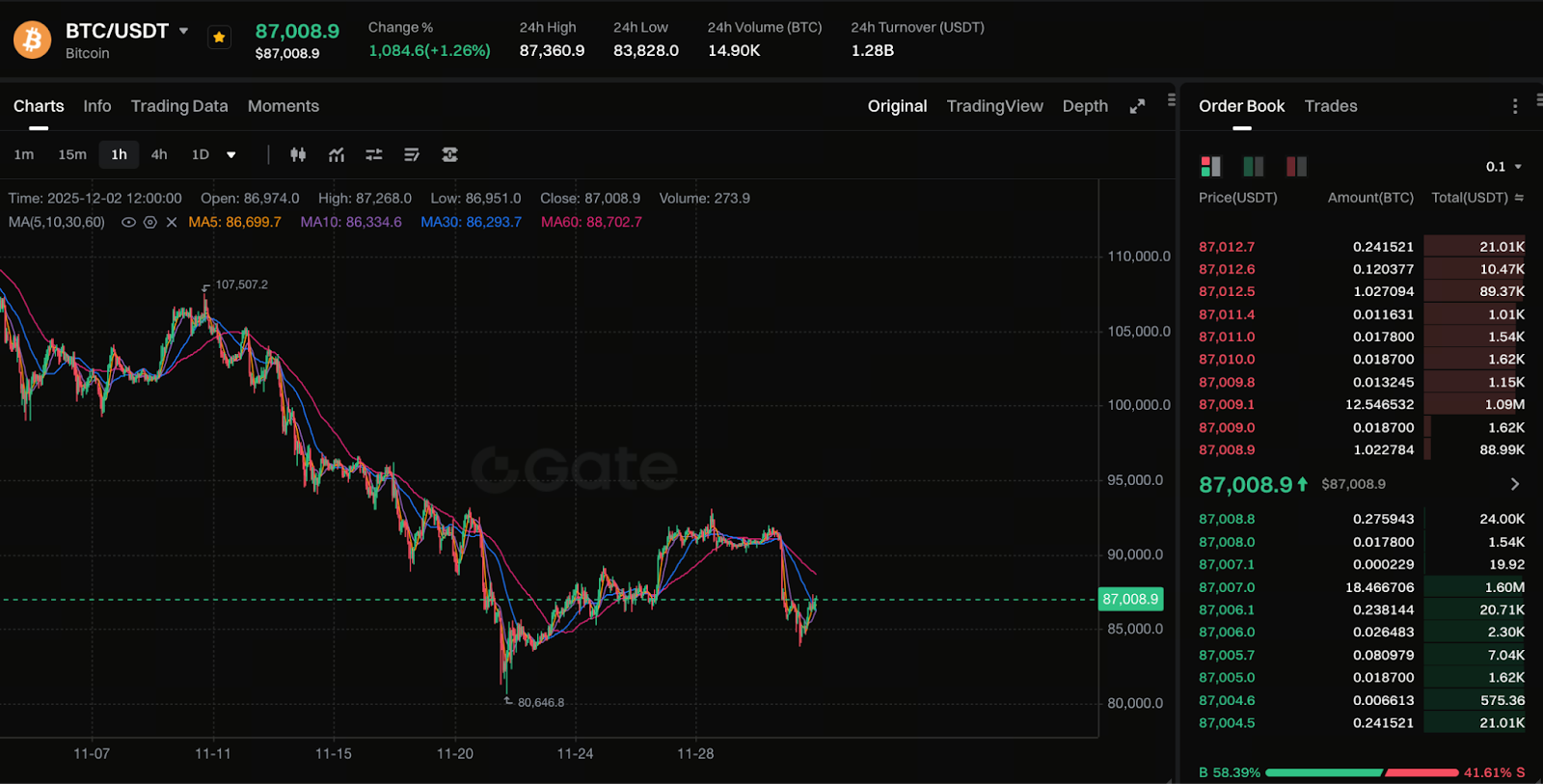
Image: https://www.gate.com/trade/BTC_USDT
MicroStrategy (now referred to as “Strategy”) has built its reputation on holding significant amounts of Bitcoin (BTC) over the long term. As of November 2025, the company reported a total of 650,000 BTC in its portfolio. However, with Bitcoin’s price experiencing sharp swings recently—from a previously projected $150,000 down to a low of approximately $80,660 at November’s end—concerns have emerged regarding the company’s balance sheet and liquidity position.
In response, Strategy has opted for a more conservative financial strategy: retaining its Bitcoin holdings while instituting a cash reserve mechanism.
What Is the “$1.44 Billion Cash Reserve”?

On December 1, 2025, Strategy announced it had established a $1.44 billion cash reserve to support dividend payments on its preferred stock and service its debt obligations. This reserve was funded by proceeds from an At-The-Market Offering of Class A common stock. The company stated that the reserve currently covers at least 12 months of dividend commitments, with plans to extend coverage to 24 months or longer.
Relative to the company’s enterprise value and asset structure, the $1.44 billion cash reserve accounts for roughly 2.2% of Strategy’s enterprise value, 2.8% of its equity, and about 2.4% of the value of its Bitcoin holdings.
Why Strategy Established a Reserve: Market Conditions and Risk Management
1. Bitcoin Price Volatility — Liquidity Risk
Recent volatility in Bitcoin’s price poses liquidity risks for companies heavily invested in BTC. Relying solely on digital assets can lead to shortfalls when it comes to paying dividends or debt. By introducing a cash reserve, Strategy adds a layer of protection against market swings.
2. Dividend and Debt Payment Commitments — Stability Needs
Strategy is obligated to pay dividends and interest to preferred shareholders and creditors. When BTC prices are depressed, a cash reserve ensures these commitments can be met without liquidating Bitcoin holdings.
3. Investor Confidence & Market Expectation Management
Establishing and publicly reporting a cash reserve helps ease market anxieties over price volatility, makes preferred shares and bonds more attractive to risk-averse investors, and enhances the company’s stability in capital markets.
Impact and Significance: For Investors, Company Outlook, and the Crypto Market
- Preferred stock and bond investors gain greater confidence that dividends and interest will be paid in the short term, reducing risks tied to Bitcoin price declines.
- This move demonstrates a defensive adjustment for Strategy’s operational stability, signaling that the company values not only BTC as a store of value but also prudent management of liquidity and capital structure.
- Strategy’s approach could set a new standard for crypto asset companies—demonstrating that supplementing substantial digital asset holdings with traditional cash reserves is a viable management strategy.
- This step may help ease concerns about the high volatility of crypto assets, attracting more institutional and conservative investors and boosting market sentiment and industry confidence.
Potential Challenges and Market Perspectives
Some analysts and market participants remain cautious. While holding a cash reserve means the company won’t need to sell large amounts of Bitcoin in the near term, a worsening market could still force BTC liquidation—contrary to Strategy’s long-standing “buy-and-hold” philosophy. Additionally, raising capital through common stock issuance (dilution) may erode the interests of current shareholders and preferred stockholders, putting pressure on capital structure and shareholder returns.
Even though the cash reserve secures dividend payments, if BTC does not recover to previous highs, the company’s overall profit targets—including year-end earnings and return targets for Bitcoin assets—have already been revised downward.
Conclusion and Outlook
By setting up a $1.44 billion cash reserve, Strategy has taken a major defensive step amid intense Bitcoin market volatility and growing macroeconomic uncertainty. Balancing digital assets with traditional cash reserves, the company has reinforced its commitments to preferred shareholders and creditors, while also boosting liquidity and financial resilience. If Bitcoin prices recover, Strategy stands to benefit from both capital appreciation and stable dividends. If prices remain low, the cash reserve could be vital for weathering challenges. The company must manage shareholder interests, dilution, and asset value effectively.
For the broader crypto asset sector, Strategy’s initiative sets a new benchmark for large institutional holders—showing that even in highly volatile markets, adopting prudent and traditional financial management strategies can support both growth and stability.
Share
Content
Background: MicroStrategy (now referred to as “Strategy”) and Bitcoin Holdings Overview
What Is the “$1.44 Billion Cash Reserve”?
Why Strategy Established a Reserve: Market Conditions and Risk Management
Impact and Significance: For Investors, Company Outlook, and the Crypto Market
Potential Challenges and Market Perspectives
Conclusion and Outlook


Related Articles

2025 BTC Price Prediction: BTC Trend Forecast Based on Technical and Macroeconomic Data

Pi Coin Transaction Guide: How to Transfer to Gate.com

Flare Crypto Explained: What Is Flare Network and Why It Matters in 2025

How to Use a Crypto Whale Tracker: Top Tool Recommendation for 2025 to Follow Whale Moves

What is N2: An AI-Driven Layer 2 Solution