In traditional DeFi trading architectures, most decentralized exchanges rely on the AMM model for trade matching. While this approach is permissionless and highly composable, it falls short in performance, slippage control, and support for complex order types. As demand for on-chain Derivative trading grows, the market is seeking solutions that deliver a user experience closer to centralized exchanges. The integration of the Order Book model with Layer2 scaling technologies is emerging as a key pathway to enhance both performance and user experience.
Within the current decentralized Perp DEX landscape, Lighter exemplifies a “hybrid architecture” approach—prioritizing execution efficiency off-chain while leveraging on-chain verification to ensure system integrity. This design is becoming a major trend in building high-performance DeFi infrastructure.
Lighter’s Overall Operational Architecture
Lighter’s system is structured into three primary layers: the order input layer, the matching execution layer, and the clearing verification layer. Users interact with the system by submitting orders, and the process concludes with on-chain state updates, forming a closed operational loop.
Unlike fully on-chain systems, Lighter shifts the most resource-intensive matching processes off-chain, using zk technology to guarantee verifiability of all outcomes—striking a balance between efficiency and security.
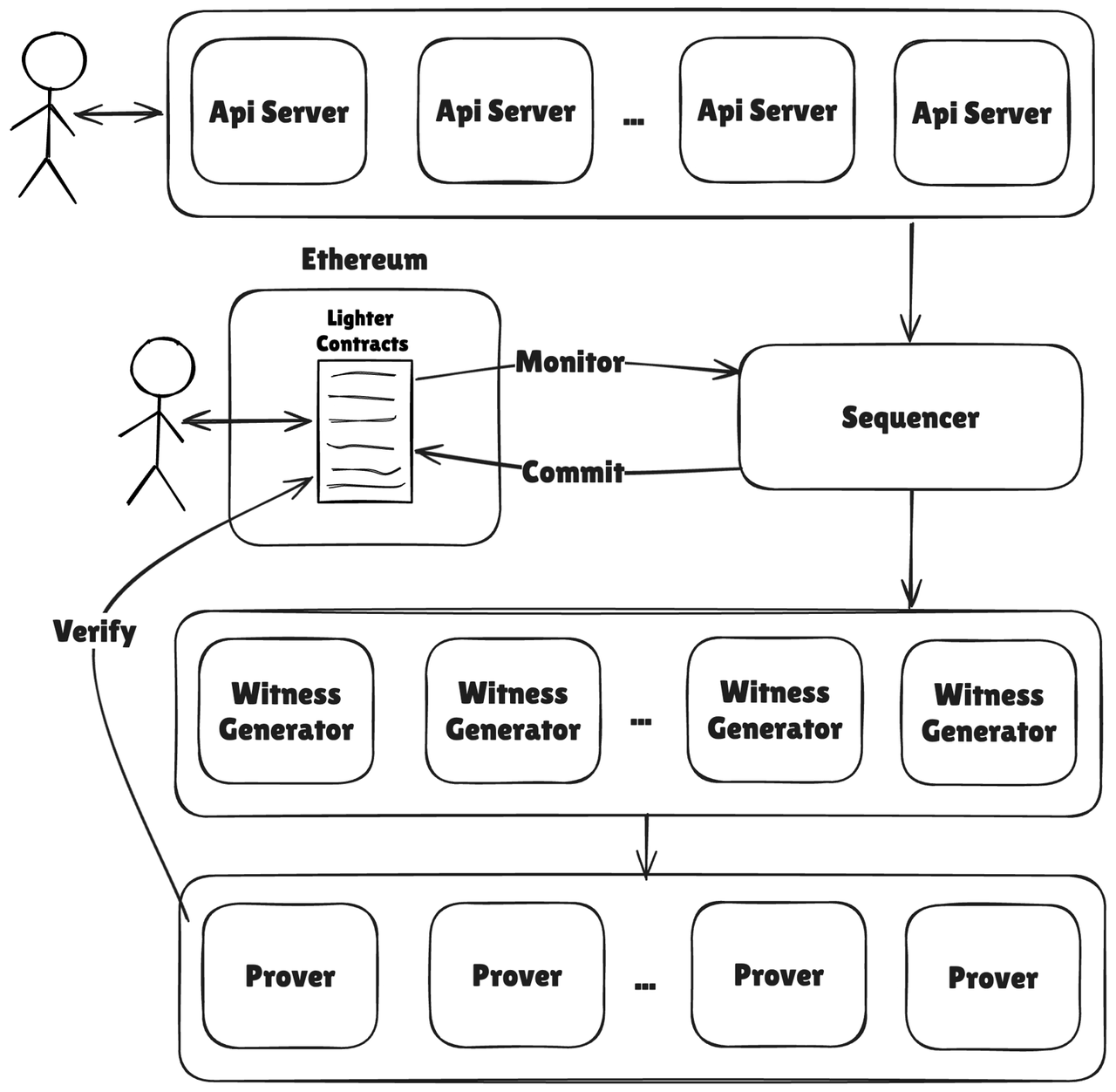 Simplified diagram of Lighter’s technical architecture. Source: Lighter
From Order Submission to Settlement: A Step-by-Step Breakdown
In Lighter, each trade—from initiation to final settlement—progresses through several stages, collectively delivering a high-performance trading experience.
When a user submits an order, the details are not immediately executed on the main chain. Instead, the order enters the system’s off-chain matching engine, which rapidly collects and sorts orders in preparation for matching.
The matching engine then pairs buy and sell orders based on price and time priority. Once matched, the trade result is recorded and queued for batch processing. Because this occurs off-chain, the system achieves ultra-low latency and high throughput.
Next, multiple trade results are bundled and a corresponding zk proof is generated. These are submitted to the zk-rollup contract, where the main chain verifies their validity. This stage is critical to system security, ensuring that all off-chain computations are verifiable.
Upon successful verification, the trade results are settled on-chain and the user’s Account Balance is updated. This completes the full transaction lifecycle.
The core advantage of this workflow lies in concentrating high-frequency operations off-chain, while final state confirmation is performed on-chain—delivering both speed and security.
The Role of zk-rollup in the Workflow
Throughout the trading process, zk-rollup functions as the “verification and settlement layer.” It compresses Trading Data and applies zero-knowledge proofs to guarantee the correctness of all state transitions.
Unlike traditional Layer1, which processes trades individually, zk-rollup batches large volumes of trades for unified verification. This dramatically reduces Gas costs and boosts overall system throughput.
Crucially, zk technology eliminates the need for users to trust the matching engine itself, as any errors or tampering will be caught by on-chain verification logic. This is foundational to Lighter’s off-chain matching approach.
Matching is one of the most resource-intensive components of any trading system. If performed entirely on-chain, it incurs high costs and is constrained by block times.
By moving the matching engine off-chain, Lighter enables order matching at speeds comparable to traditional trading systems. This architecture supports more complex order types and higher-frequency trading.
At the same time, because final results are verified by zk-rollup, system security is uncompromised. In essence, off-chain delivers “speed,” while on-chain guarantees “trust.”
Clearing and Asset Security Mechanisms
Once a trade is complete, clearing is essential to ensure accurate asset state updates. Lighter’s clearing process leverages zk-rollup’s state update mechanism, recording and verifying all Account Balance changes on-chain.
User assets are always managed by Smart Contracts, not centralized custodians, so users are not exposed to exchange misappropriation risks. This upholds DeFi’s core strengths of self-custody and transparency.
Batch clearing further enhances system efficiency, enabling stable performance even under heavy load.
Summary
Lighter’s operational framework is fundamentally a highly efficient layered design. By executing order matching off-chain and utilizing zk-rollup for on-chain verification and clearing, it achieves a robust balance between performance and security.
This “off-chain execution + on-chain verification” paradigm not only accelerates trading speed but also lays the groundwork for high-frequency and institutional-grade applications. As DeFi evolves toward greater specialization, this architecture is poised to become a mainstream standard.
FAQs
What are the steps in Lighter’s trading process?
The process includes order submission, off-chain matching, trade batching, zk proof generation, and on-chain clearing—together forming a complete trading loop.
Why does Lighter use off-chain matching?
Off-chain matching dramatically increases trading speed and reduces costs, while supporting more complex order types. Security is maintained through zk-rollup verification.
What is zk-rollup’s core function in Lighter?
zk-rollup verifies the correctness of all trade results and performs final settlement on-chain. It is central to the system’s security.
Is Lighter’s trading fully decentralized?
Asset custody and settlement are decentralized, but the matching process occurs off-chain, making this a trade-off between performance and decentralization.
Is Lighter’s architecture scalable for the future?
Thanks to its modular design, Lighter is highly scalable and can support additional Trading Pairs, features, and higher throughput upgrades.







