The Evolution of Ethereum’s Consensus Mechanism
Consensus mechanism design has always been fundamental to maintaining network security and efficiency throughout the evolution of blockchain technology. With Ethereum’s upgrade from Proof of Work (PoW) to Proof of Stake (PoS), the network’s operational model has undergone significant changes.
Under the PoS model, network security no longer depends on massive computational competition. Instead, participants stake assets to support system operations. ETH holders can stake their assets, join the block validation process, and earn corresponding block rewards according to network rules. For many long-term holders, staking has become an increasingly stable method for accumulating returns.
Liquidity Constraints of Traditional Staking
While staking offers returns, traditional models typically require assets to be locked for a certain period. Once funds are staked, users must often wait for a designated period before they can withdraw.
This mechanism poses little challenge during stable market conditions, but in the fast-moving crypto market, asset lock-up can restrict investors’ ability to adjust strategies. For instance, when new investment opportunities or price swings occur, locked assets are hard to reallocate in time. As a result, liquidity has become a crucial factor in staking strategies.
GTETH: Tokenizing Staked Asset Rights
To address liquidity concerns, liquid staking has emerged as a new solution. GTETH is a tokenized asset introduced under this model.
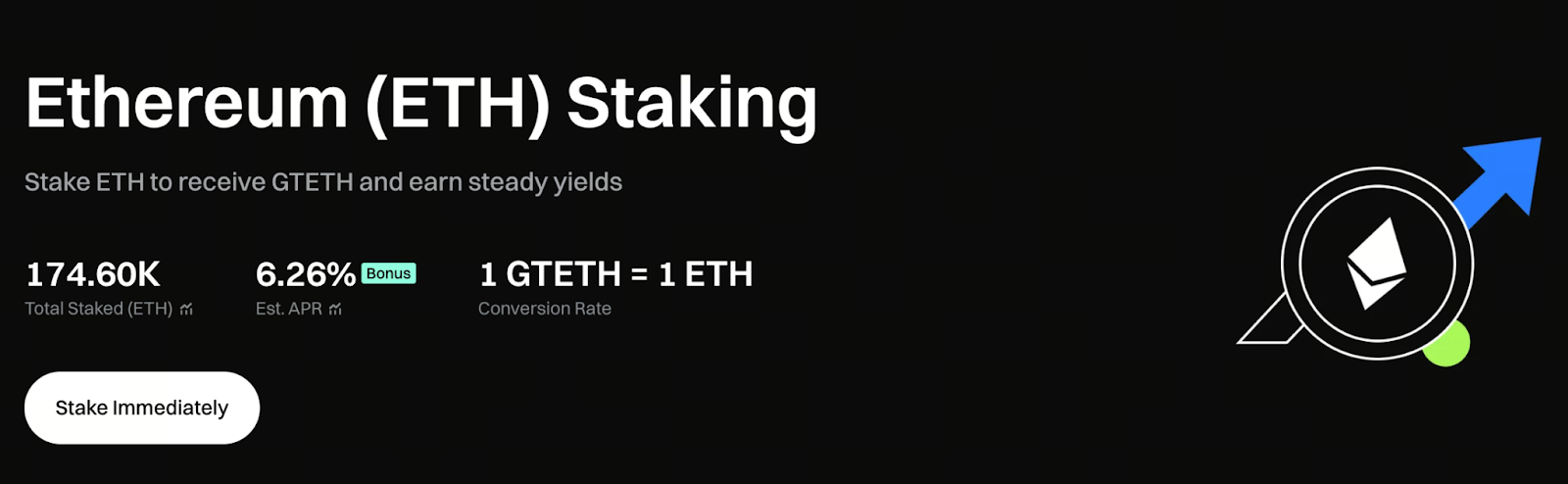
When users stake ETH, the system issues GTETH at a 1:1 ratio. This token represents the corresponding staked assets, and its value reflects the accumulation of staking rewards.
Unlike some staking products that distribute extra reward tokens, GTETH’s yield is gradually reflected in the token’s value. As network validation rewards continue to accumulate, GTETH’s value rises accordingly. When users want to exit staking, they can redeem their GTETH for the equivalent amount of ETH through the platform’s mechanism.
Lowering the Staking Entry Barrier
In Ethereum’s early staking architecture, running a validator node directly required substantial capital and technical expertise—a high threshold for most investors.
With platform-based staking services, users no longer need to deploy nodes or handle complex technical steps. They simply deposit assets to participate in staking rewards. Additionally, GTETH is fully backed by ETH reserves, with each token corresponding to an equal amount of staked assets. This design enhances transparency and makes the mechanism easier to understand.
GTETH Yield Sources
GTETH yields primarily come from two sources:
-
Ethereum network validation rewards: Staked ETH participates in block validation and network maintenance, earning block rewards according to protocol rules.
-
Platform incentives: During certain campaigns or periods, the platform may offer additional incentives to boost overall staking returns.
Note that staking yields are not fixed. Annualized returns may be affected by several factors, including:
Platforms typically charge a service fee from actual earnings to cover node maintenance and system operations, while some high-tier users may benefit from lower fee rates.
Start staking ETH on Gate now and unlock on-chain yield opportunities: https://www.gate.com/staking/ETH?ch=ann46659
Asset Allocation Flexibility with Liquid Staking
The core value of liquid staking is restoring liquidity to assets that would otherwise be locked. Through GTETH’s tokenized structure, ETH staked in the process is no longer just passively held—it can be integrated into more flexible investment strategies.
For example:
-
Staking returns are gradually reflected in GTETH’s value
-
Investors can adjust asset allocation based on market conditions
-
GTETH can serve as an income-generating asset within an investment portfolio
This approach keeps staking connected to market dynamics, making asset management more agile.
Maintaining Capital Flexibility in Volatile Markets
The crypto market moves quickly, with new opportunities and risks arising simultaneously. If funds remain locked for long periods, investors may be unable to adjust strategies in time. By converting staked rights into tradable tokens, GTETH enables investors to earn on-chain yields while maintaining a degree of capital flexibility. This design transforms staking from a purely long-term yield tool into a component of comprehensive asset management strategies.
Conclusion
As the blockchain market matures, investor demand for both yield and liquidity is becoming increasingly clear. Through its 1:1 staking mechanism and redeemable structure, GTETH enables ETH to retain liquidity while participating in staking. This liquid staking model turns assets that once required long-term lock-up into more flexible investment tools. In a rapidly evolving market, strategies that balance yield with capital flexibility are gaining traction, and GTETH offers a new direction for asset management.