In traditional application architectures, developers typically rely on servers to handle requests. On the Internet Computer network, however, application logic runs directly on the blockchain, creating a fundamentally different user perspective on how applications operate.
This distinction primarily involves three aspects: application architecture, request execution, and consensus validation. These factors together define the full operational lifecycle of a Dfinity application, from deployment to execution.
How Dfinity Application Architecture Differs from Traditional Web Applications
Dfinity applications are built on an on-chain computing architecture, which stands in stark contrast to traditional web applications.
In traditional models, applications rely on a layered structure: frontend, backend, and database. Dfinity, by contrast, integrates these functions within Canisters, allowing both application logic and data to reside directly on-chain.
Structurally, a Dfinity application consists of a frontend interface and multiple Canisters. Each Canister handles business logic and data storage, minimizing dependence on centralized servers.
This approach empowers applications to operate in a fully decentralized manner while maintaining complete functionality.
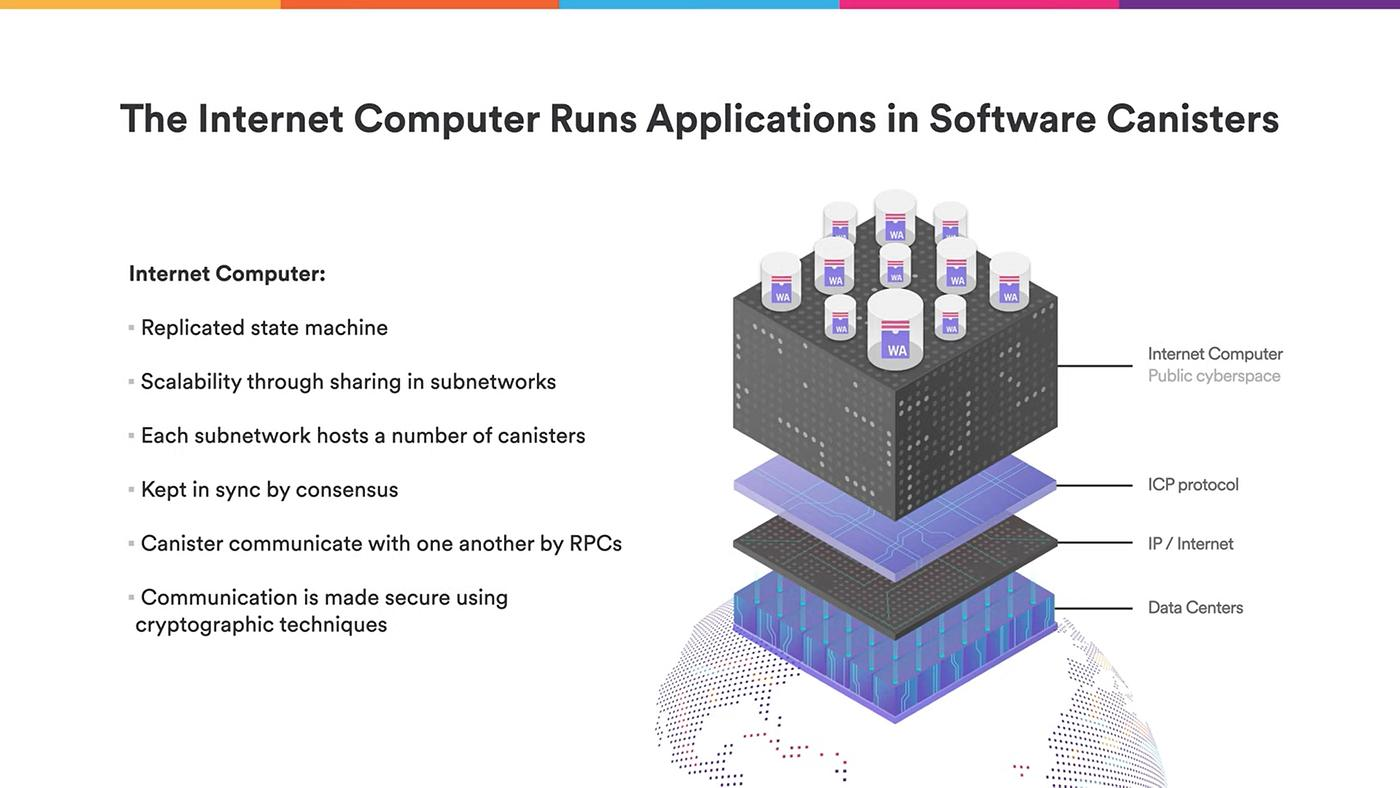
Developers deploy Canisters to publish application logic onto the network.
The process involves writing application code, compiling it into Canisters, and deploying them to designated subnets with specialized tools. Deployment consumes Cycles, which serve as computational resource fees.
Deployment involves three main steps: code packaging, resource allocation, and subnet registration. Once deployed, a Canister is ready to receive user requests.
This process transforms an application from a local environment into an on-chain operational entity.
How Canisters Manage Data Storage and Request Processing
Canisters act as the core execution units for applications on Dfinity.
Each Canister contains both code and state, enabling it to process user requests and update data. Canisters handle computation and provide persistent data storage.
Every Canister functions like an independent microservice and can interact with other Canisters, collectively forming a complete application system.
This mechanism allows the blockchain to support backend functionalities similar to those of traditional systems.
How User Requests Are Executed in ICP Subnets
User requests are executed and processed within subnets.
A request is sent to the subnet hosting the target Canister. Nodes within the subnet collaborate to process the request and generate a result.
Every subnet is composed of multiple nodes working together to handle requests and maintain consistent state. The results are then returned to the user.
This decentralized process ensures that request execution is both distributed and consistent.
How Dfinity's Consensus Mechanism Ensures Consistent Execution Results
The consensus mechanism ensures all nodes agree on execution outcomes.
Nodes synchronize state and validate computation results using a consensus protocol, preventing forks and data inconsistencies.
The consensus system connects all nodes in the subnet to maintain unified state during execution.
This mechanism delivers reliable computation in a distributed environment.
How Canister Upgrades and Application Maintenance Work
Canisters support in-place upgrades and ongoing maintenance.
Developers can update Canister code while preserving existing data. This upgrade method prevents data loss.
Upgrades are managed collaboratively by deployment and state management modules, enabling continuous evolution of the application.
This design ensures that on-chain applications are maintainable for the long term.
Execution Flow and Request Lifecycle in On-Chain Applications
Dfinity applications operate through a series of sequential steps:
Step 1: Canister Deployment Developers deploy application logic as Canisters and allocate computing resources.
Step 2: User Initiates Request Users interact with the frontend to send requests to Canisters.
Step 3: Request Routed to Subnet The request is forwarded to the appropriate subnet to await processing.
Step 4: Nodes Execute Logic Subnet nodes collaborate to execute Canister code and update state.
Step 5: Consensus Confirms Results Nodes use the consensus mechanism to confirm consistent results.
Step 6: Return Results to User The processed result is returned to the user, completing the interaction.
Each step engages different system modules, creating a transparent and traceable execution path.
This process turns user requests into verifiable on-chain computations.
Summary
Dfinity applications leverage Canisters, subnets, and consensus mechanisms to create a complete, on-chain operational framework—enabling decentralized deployment, execution, and maintenance.
FAQ
What is a Canister?
A Canister is a smart contract on Dfinity used to run application logic.
Do applications have to run within a subnet?
Yes. Execution occurs collaboratively among subnet nodes.
How are user requests handled?
Requests are processed by Canisters and results are confirmed through consensus.
Can Canisters be upgraded?
Yes. Upgrades preserve original data.
What is the main difference between Dfinity and traditional applications?
Application logic and data run directly on the blockchain.







