New Challenges in the Rapid Evolution of AI Models
Artificial intelligence technology has advanced rapidly in recent years, with new models emerging across diverse fields—from text generation to complex reasoning tasks—broadening the scope of applications. However, these advances in model capabilities have also made development workflows more complicated.
For developers, the challenge is less about finding suitable models and more about how to seamlessly integrate different model services into a single system. Differences in API structures, approval methods, and data formats across platforms have driven up development and maintenance costs. This integration burden becomes even more pronounced when an application needs to interact with multiple models at once.
In this context, building a streamlined integration architecture has become a key issue in AI development.
Unified API Architecture: Streamlining Multi-Model Integration
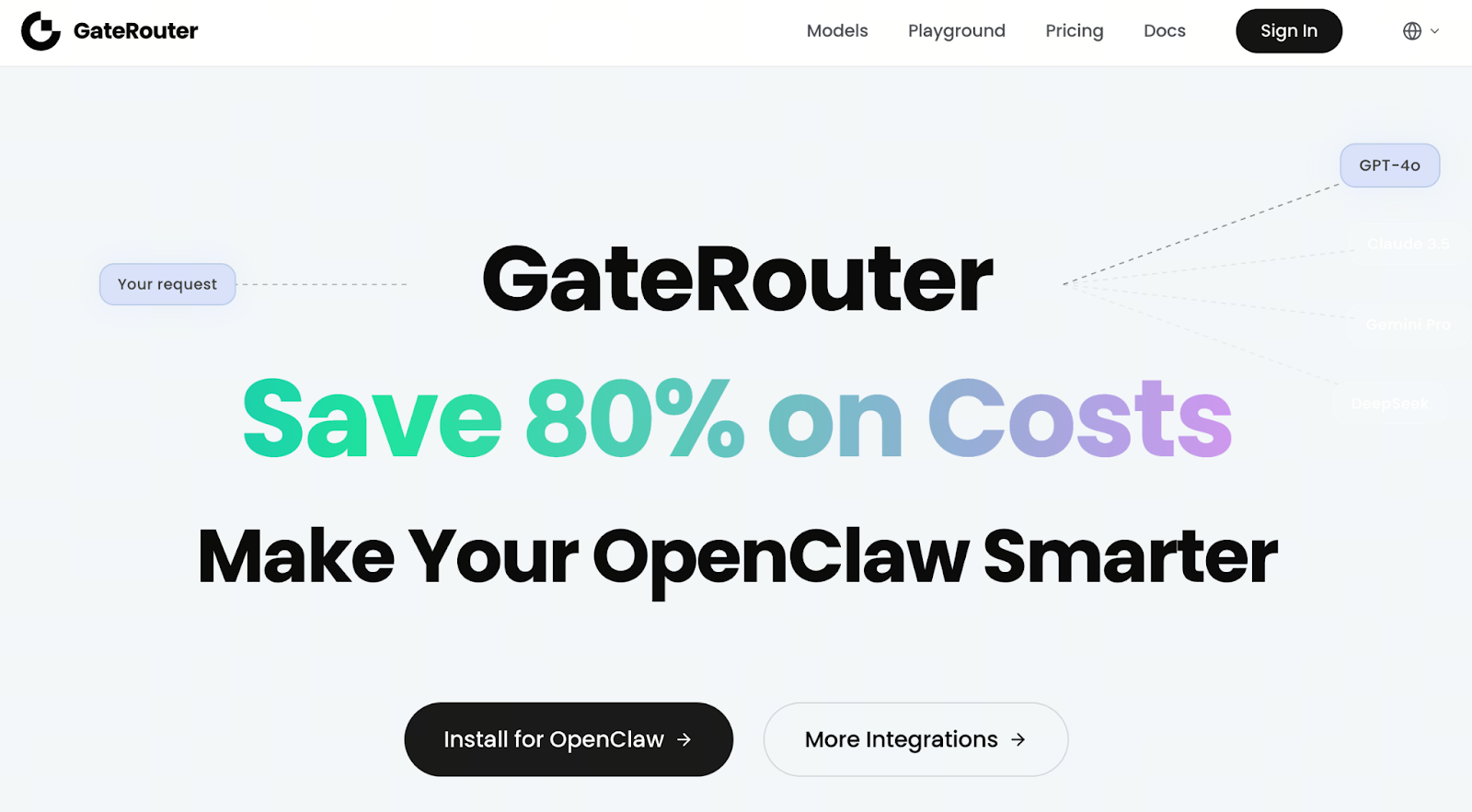 To reduce integration complexity, GateRouter employs a single-entry approach. With a unified API, developers can access multiple AI model services through one interface, eliminating the need to tackle technical differences across platforms individually.
This architecture delivers several clear advantages:
-
No need to create separate integration processes for each model
-
Flexibility to switch between different models within the same environment
-
Lower system complexity and maintenance costs
By leveraging a unified interface, developers can focus on application logic and feature design—instead of spending valuable time on multi-platform integration.
Intelligent Scheduling: Maximizing Resource Efficiency
In practice, different tasks require varying levels of model capability. Some jobs need only basic computational power, while others demand more advanced reasoning models.
GateRouter uses automated scheduling to allocate the right model resources based on task requirements. For example:
This approach enables the system to control overall computing costs while maintaining output quality. For applications that rely heavily on AI, this scheduling mechanism significantly improves resource utilization.
Centralized Management: Greater System Transparency
Beyond integration and scheduling, GateRouter provides a suite of management tools to help developers monitor system performance. Through a centralized dashboard, users can instantly view key metrics, including:
-
API calls and operational status
-
Usage statistics and invocation logs
-
Cost distribution and resource utilization
The platform also offers testing and evaluation environments, allowing developers to compare the effectiveness and cost of different models before deployment to make more informed decisions.
This visual management approach makes AI application operations more transparent and supports long-term maintenance and optimization.
Data Security and Privacy by Design
As AI applications become more deeply embedded in various scenarios, data protection is increasingly critical. GateRouter incorporates multi-layered security mechanisms into its platform to minimize the risk of data leaks or misuse.
Core security strategies include:
-
Encrypted transmission to safeguard data
-
Default non-storage of conversation content
-
Adjustable log management settings
These features help developers strike a balance between system debugging and privacy protection, with flexible options for data recording based on actual needs.
Versatile Applications: Meeting Diverse User Needs
GateRouter is designed for a broad range of use cases, not just a single user group.
- Developers and AI Agent Builders
Quickly integrate multiple model capabilities to build automated workflows or intelligent agent systems.
- Enterprises and Organizations
Ideal for large-scale data processing and analytics, with more efficient resource management.
- Web3 Developers
Supports digital asset payments, making it easier to embed AI functionality into blockchain applications or decentralized services.
With this cross-domain design, GateRouter can deliver value in various technical environments.
Pay-As-You-Go Pricing: Flexible Cost Control
GateRouter uses a pay-as-you-go pricing model, directly linking costs to actual usage.
Key benefits of this approach include:
-
Avoiding high fixed costs
-
Aligning expenses with computing needs
-
Better fit for fast-paced, iterative development environments
The platform also supports multiple payment methods, making it easier for users from different backgrounds to access and use the service.
Integrating AI and Web3 Infrastructure
From an industry perspective, the convergence of AI and blockchain is opening up new application frontiers. As AI Agents play a growing role in trading, automated decision-making, and data processing, the challenge of integrating model capabilities with on-chain resources is becoming more prominent.
Platforms like GateRouter serve as a bridge between these technologies, enabling AI models to connect more easily with the Web3 ecosystem through unified interfaces and resource scheduling—driving the rise of automated applications.
View More about GateRouter: https://www.gaterouter.ai/
Conclusion
As the number of AI models continues to rise, development challenges are shifting from model capabilities to integration efficiency. When applications must leverage multiple models at once, streamlining integration and resource management becomes critical. GateRouter offers developers an efficient solution through a unified API, intelligent model scheduling, and centralized management tools. This not only lowers technical barriers but also delivers greater flexibility in cost control and system maintenance. As the AI and Web3 ecosystems evolve, platforms that can effectively integrate multi-model resources will become increasingly central to technology infrastructure—with GateRouter standing out as a leading example.







