What Is Chainlink? A Comprehensive Guide to the Principles, Mechanisms, and Application Ecosystem of Web3 Oracles
By doing so, it enables smart contracts to interact with real-world conditions without relying on a single trusted intermediary.
As Web3 applications move beyond purely on-chain logic into real-world scenarios, a fundamental challenge emerges: how can blockchains access external information while preserving decentralization and verifiability? Understanding Chainlink through its definition, operating model, network roles, incentive structure, use cases, and practical limitations provides a clearer picture of how oracles function as critical infrastructure.
What Is Chainlink?
In blockchain systems, smart contract execution is deterministic. The same input will always produce the same output. This property ensures high verifiability, but it also means that contracts cannot natively access information from outside the chain. Oracles were introduced to address this structural limitation, and Chainlink is one of the most prominent decentralized implementations.
Chainlink is not an independent blockchain, nor does it replace the consensus or execution layers of public chains. Instead, it operates as a cross-chain, cross-system data and computation infrastructure layer. Running on top of multiple blockchains, it provides a standardized way for smart contracts in different ecosystems to access off-chain resources. Through parallel node operation, result aggregation, and economic incentives, Chainlink transforms what would otherwise be a highly centralized point of “input from the external world” into a decentralized service governed by protocol rules.
Importantly, Chainlink does not aim to determine what is “true.” Rather, under clearly defined trust assumptions, it reduces reliance on any single data source or service provider, allowing contracts to behave predictably when triggered by real-world events.
How Does Chainlink Work?
The Chainlink workflow typically begins with an on-chain request. When a smart contract requires off-chain data or a computation result, it submits a request through an oracle contract, specifying the type of data needed, quality parameters, and response conditions. The request is then distributed to a set of qualified oracle nodes.
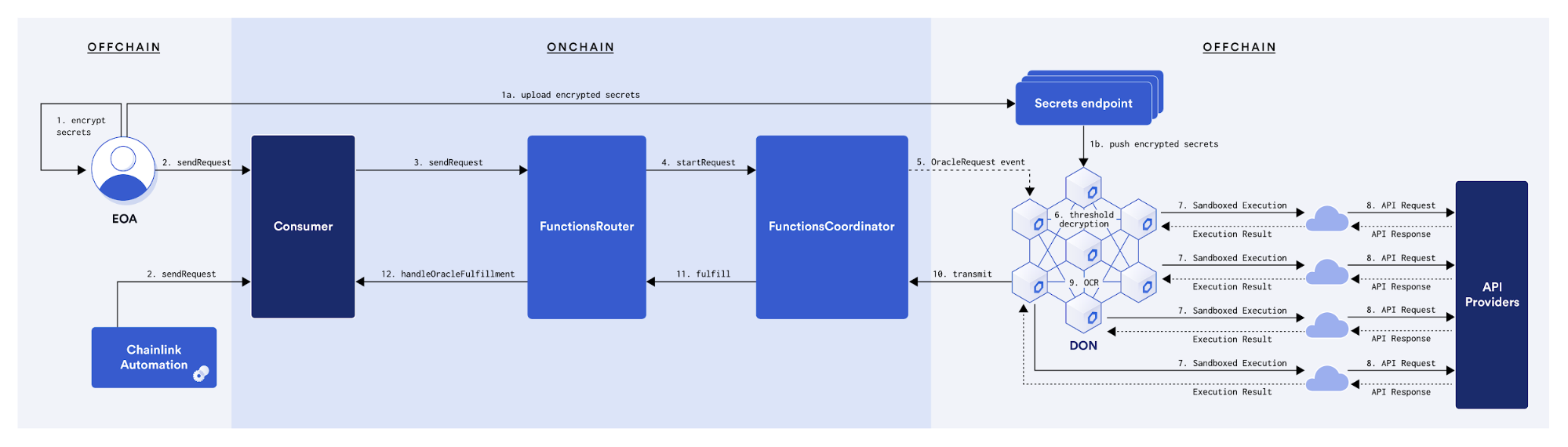
These nodes independently execute the task off-chain. They retrieve data from designated or self-selected sources, perform any required processing or computation, and return their results. An on-chain aggregation contract then applies predefined statistical or filtering rules to combine the responses and produce a final output that the smart contract can use.
The key is not whether a single node is “absolutely correct”. Instead, security emerges from a group of independent nodes that are economically incentivized and constrained to provide consistent, acceptable results. By shifting trust away from a “single authority” and toward a “set of independent, rule-bound participants”, Chainlink strikes a balance between real-world practicality and decentralized security.
What Roles Exist Within the Chainlink Network?
A complete Chainlink network consists of several distinct but interdependent roles.
Oracle node operators maintain nodes, connect to data sources, and execute off-chain tasks. They may be individuals, technical teams, or professional infrastructure providers, and they operate independently from one another.
Requesters are smart contracts or applications that need off-chain data or computation. Through contract parameters, they specify requirements for data type, frequency, and reliability, and they pay for the service.
Data sources and external systems are not direct participants in the Chainlink network, but their outputs are brought on-chain through oracle nodes. The diversity and independence of these sources are essential for reducing systemic risk.
On-chain contract components manage requests, aggregate results, and confirm state transitions, ensuring that the entire process remains verifiable and auditable on-chain.
This division of responsibilities allows the network to function without centralized coordination.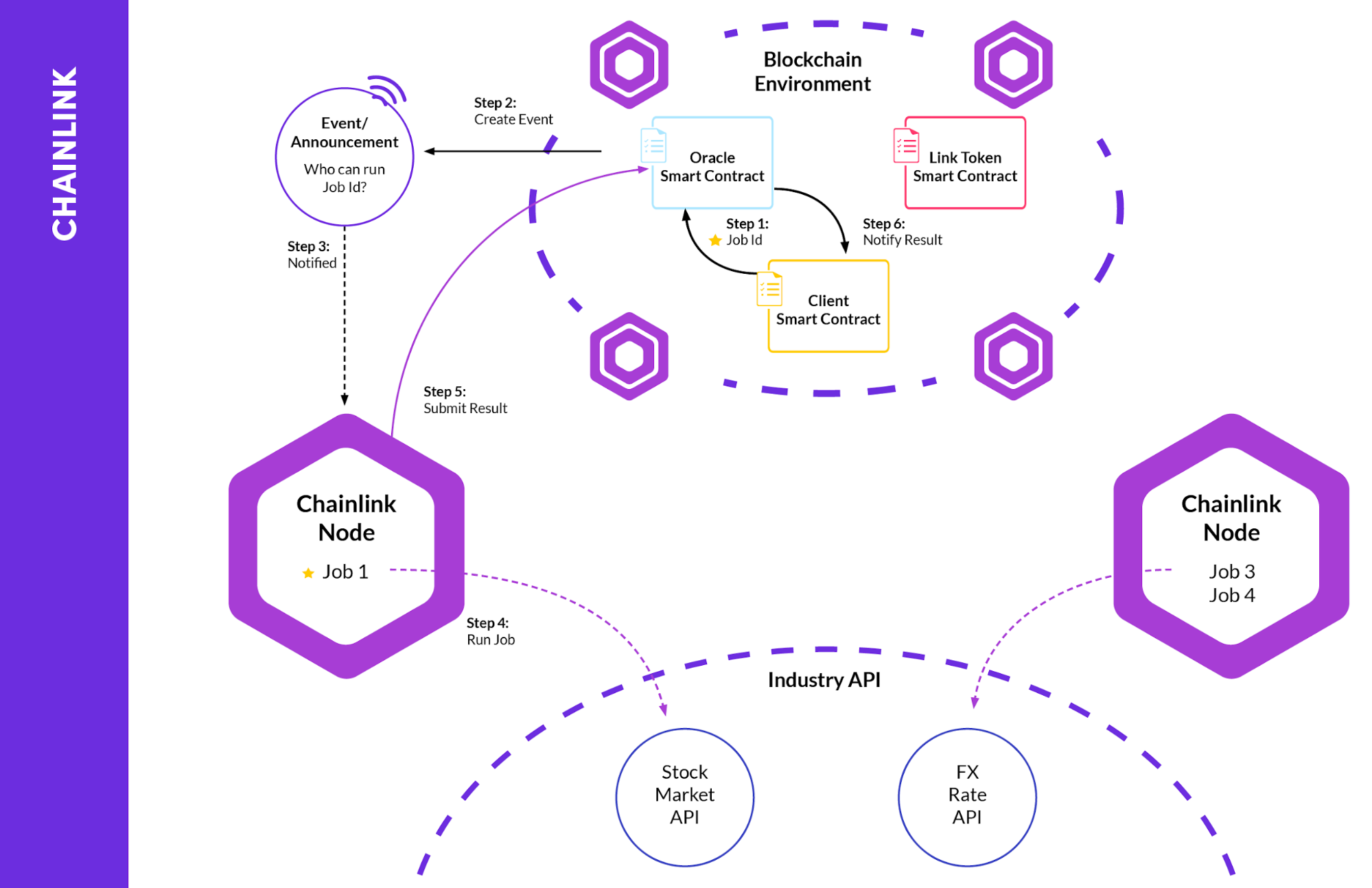
What Role Does LINK Play in Chainlink?
LINK is the functional token of the Chainlink network. It is used to pay for oracle services, incentivize honest node behavior, and reduce the likelihood of malicious actions through economic constraints. It is not intended to replace native tokens of public blockchains; instead, it is purpose-built around oracle services.
At the service layer, LINK serves as the settlement medium that connects demand from requesters with supply from node operators. Nodes receive compensation only after completing a request and having their results accepted through the aggregation mechanism.
At the security layer, LINK can be used for staking and performance guarantees. If a node behaves maliciously, it faces direct economic penalties and long-term reputational damage.
The core logic of this design is to bind technical behavior to economic outcomes. Providing accurate and stable service increases the likelihood of sustained revenue, while short-term misconduct undermines long-term returns. Over time, this incentive structure encourages nodes to act in alignment with the network’s objectives.
What Are Chainlink’s Use Cases in the Web3 Ecosystem?
Chainlink’s applications are not confined to any single protocol category or industry. Instead, they extend to every scenario that requires reliable off-chain input. In decentralized finance, oracles provide price references, determine collateralization levels, and trigger state changes. In contract settlement and conditional execution, they are used to confirm timestamps, index values, or event outcomes.
In insurance and other risk-triggered applications, oracles serve as event verifiers, such as confirming weather conditions or flight statuses. Within NFT and on-chain asset ecosystems, off-chain data can drive attribute changes or state updates. In multi-chain and cross-system environments, oracles enable contracts to detect the state of external systems or other blockchains.
What unites these use cases is a shared constraint: blockchains cannot natively perceive the external world, yet application logic often depends on that external information. Chainlink does not provide “universal data.” Rather, it offers configurable infrastructure designed to meet varying risk requirements under different deployment assumptions.
What Are Chainlink’s Strengths and Limitations?
Chainlink’s primary strengths lie in its degree of decentralization, architectural flexibility, and ability to distribute risk.
Parallel operation by multiple nodes
Separation of on-chain and off-chain components
Configurable aggregation rules
These features enable it to support diverse applications and increase the cost of attacks in high-value environments.
At the same time, there are clear boundary conditions.
Oracles cannot independently verify the objective truth of real-world events. Their security ultimately depends on data source quality, node independence, and proper configuration.
In extreme cases, economic incentives cannot eliminate malicious intent entirely; they can only raise its cost.
Recognizing these limitations prevents the misconception that oracles are “fact generators.” Instead, they should be understood as risk management tools operating under explicit assumptions.
What Are Common Misconceptions About Chainlink?
One common misunderstanding is treating Chainlink as a centralized or authoritative data provider. In reality, it does not produce data; it coordinates the process of acquiring and validating it.
Another misconception is that oracles eliminate all risk, overlooking the importance of application-level design and careful data source selection.
Some also reduce LINK to merely an investment or governance token, ignoring its functional role within the protocol’s operation.
Clarifying these points leads to a more accurate understanding of Chainlink’s position within Web3 architecture.
Conclusion
Chainlink introduces the ability for blockchains to interact with the real world through a decentralized oracle network. It does not alter blockchain execution rules, but it expands the range of problems that blockchains can securely address. By understanding its principles, role distribution, and incentive constraints, we gain a clearer view of how Web3 infrastructure is evolving toward increasingly complex real-world applications.
FAQ
Is Chainlink an independent blockchain?
No. Chainlink is an oracle network that runs on multiple blockchains, providing off-chain access services across different ecosystems.
Where does Chainlink’s security come from?
From its multi-node decentralized architecture, result aggregation mechanisms, and the integration of economic incentives into its design.
Do oracles determine the rules of smart contracts?
No. Oracles only supply external inputs; contract rules are defined by the contracts themselves.
Can Chainlink verify the objective truth of the real world?
It cannot provide absolute verification. It reduces error probability under defined assumptions through multi-source inputs and incentive mechanisms.
What is the core purpose of LINK?
It is used to pay for services, incentivize node behavior, and function as an economic constraint that supports network security.
Share
Content


Related Articles

The Future of Cross-Chain Bridges: Full-Chain Interoperability Becomes Inevitable, Liquidity Bridges Will Decline

Solana Need L2s And Appchains?

Sui: How are users leveraging its speed, security, & scalability?

Navigating the Zero Knowledge Landscape

What is Tronscan and How Can You Use it in 2025?