Traditional blockchains often treat data as a secondary element, separating storage from execution. This structure makes it challenging for on-chain applications to directly utilize large-scale data and increases reliance on external services. Irys addresses this architectural challenge by integrating data storage, verification, and execution into a unified framework.
Understanding Irys requires familiarity with its full data lifecycle: how data is uploaded, verified across the network, and accessed or utilized. Its underlying partition storage and mining mechanism (Partition Lifecycle) is essential to grasping its verifiability.
Core Principles of Irys Data Storage: Decentralized Data Layer and Verifiable Storage
Irys uses a Datachain architecture, embedding data directly into the blockchain consensus mechanism. Unlike traditional storage, data is not merely preserved—it becomes a verifiable on-chain state.
In this model, every data entry must be confirmed by the network as genuinely present and accessible. This approach turns data from passive storage into provable existence, enhancing system trustworthiness.
Additionally, Irys combines data with its execution environment, allowing data to be both read and processed in on-chain computations. This elevates Irys from a storage protocol to a foundational data infrastructure layer.
Data Upload Process: From User Submission to On-Chain Data Recording
Data uploads in Irys resemble blockchain transactions. Users package their data and submit it to the network, after which the data enters the on-chain processing pipeline.
Data is not stored centrally; it is split and distributed across multiple storage partitions within the network. These partitions, each with a capacity of approximately 16TB, form the basic units of Irys's storage structure, supporting scalability and cost management.
As data is written into blocks, its state is recorded on-chain and enters subsequent verification steps. This process establishes the complete data write path, laying the foundation for later verification and retrieval.
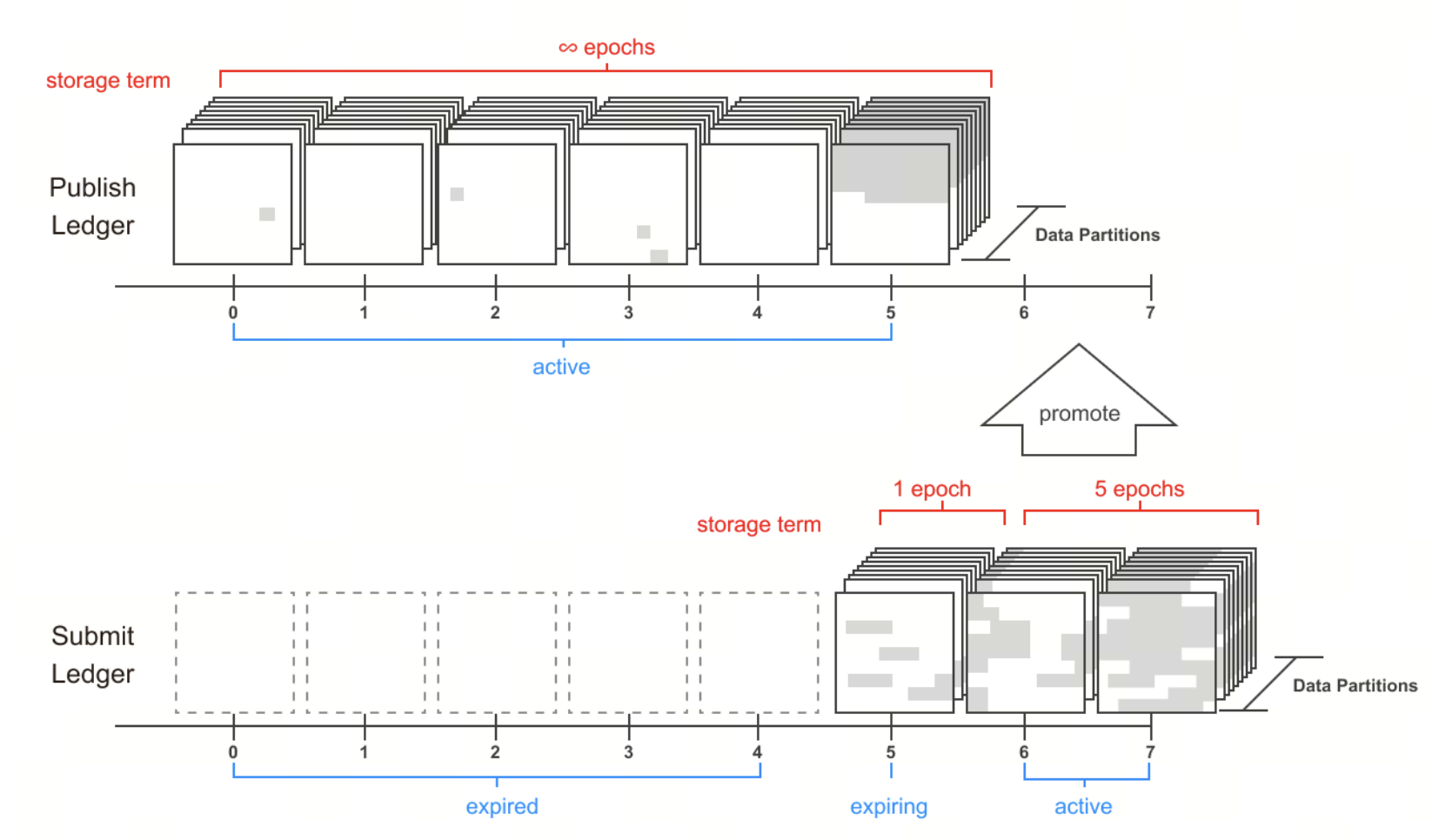
Source: irys.xyz
Data Verification Mechanism: How Irys Achieves Verifiable Data (Proof of Storage / Availability)
The key innovation of Irys is embedding data verification into the consensus mechanism. Each block not only validates transactions but also proves that data remains present and accessible.
This is accomplished through data sampling and hash verification. The network continuously prompts nodes to read portions of data and perform calculations, confirming genuine storage rather than simulated existence.
Irys introduces a storage mining mechanism: nodes must continually read and verify data blocks to participate in block generation. This makes data verification a core part of network operations, not just an auxiliary function.
This design solves the central challenge of decentralized storage—how to confirm data existence without requiring trust.
Data Retrieval and Query: Irys Data Access, Indexing, and Invocation
Once data is stored and verified, users can query and retrieve it via data identifiers. Network nodes return the relevant data content based on requests.
Unlike traditional storage, Irys allows data to be both read and directly called by on-chain applications. Smart Contracts can execute logic based on this data without depending on external APIs.
This readable and computable structure makes Irys a robust infrastructure layer for Web3 applications, especially those driven by data.
Ensuring Data Availability: Nodes, Consensus, and Partition Lifecycle
Irys guarantees long-term data availability through its Partition Lifecycle mechanism.
The network divides storage into multiple 16TB partitions, maintained through the following processes:
-
Partition Pledging: Nodes stake tokens to participate in storage
-
Partition Packing: Matrix Packing binds data to node identities, preventing replication attacks
-
Partition Mining: Nodes continuously read data and perform computations to prove data existence
-
Ledger Assignment: High-performing nodes are more likely to be assigned real data and earn higher returns
Throughout this lifecycle, nodes must consistently prove their storage capabilities or risk losing rewards and facing penalties.
When nodes leave the network, the system automatically reallocates data, ensuring no loss due to node downtime. This mechanism makes data availability an inherent feature of the system.
Irys's primary advantage is verifiable data. Data is continuously proven to exist by the network, eliminating reliance on trust and supporting highly credible applications.
The integration of data and execution enables applications to leverage on-chain data directly, reducing dependence on external systems. This is particularly valuable for DeFi, AI data, and similar scenarios.
However, the system is complex, involving partitions, verification, and consensus mechanisms, and it demands significant storage and computational resources.
As a result, Irys is best suited for environments requiring high data credibility, rather than simple file storage.
Summary
By unifying data storage, verification, and execution, Irys establishes a new Web3 data infrastructure. Its core innovation is enabling data to exist, be proven, and participate in computation.
Through partitioning and continuous verification, Irys ensures long-term data availability and minimizes reliance on external systems. This architecture distinguishes it from traditional storage protocols, positioning it as a leader in verifiable data layers.
FAQ
1. Why does Irys data require verification?
Because decentralized networks cannot rely on a single node; verification mechanisms are needed to confirm genuine data existence.
2. What is a Partition?
A Partition is the fundamental storage unit in Irys, used for storing and verifying a defined amount of data.
3. What is the purpose of Matrix Packing?
It binds data to nodes, preventing cheating through data replication.
4. How does Irys prevent data loss?
Distributed storage and partition reallocation ensure data integrity, even when nodes exit.
5. What is the main difference between Irys and traditional storage?
Traditional storage focuses on preserving data, while Irys emphasizes verifiable data that can be used in computation.







