As Web3 applications expand, demand for on-chain data queries is surging. DeFi protocols require access to transaction records, NFT platforms need to monitor asset status, and DAO tools depend on governance data—all relying on efficient data indexing services. The Graph, as a decentralized data indexing protocol, empowers developers with robust on-chain data query capabilities, with GRT serving as the core incentive mechanism that powers the entire network.
Within the The Graph ecosystem, GRT is far more than just a transactional token—it is fundamental to network operations. GRT is used to pay query fees, stake nodes, and participate in network governance, acting as the key medium connecting developers, node operators, and the broader protocol ecosystem. Demand for GRT is intrinsically linked to The Graph’s network usage, making its tokenomics central to the token’s long-term value proposition.
How Critical Is GRT Within The Graph Ecosystem?
In Web3 infrastructure, tokens are designed to incentivize participation and maintain protocol operations, and GRT is at the heart of The Graph’s value structure. Both developers querying data and nodes providing indexing services depend on GRT.
GRT introduces a “usage equals demand, participation equals stake” model, enabling The Graph to operate sustainably in a decentralized environment. As more developers and DApps leverage The Graph, demand for GRT—both for payments and staking—rises in tandem. As such, GRT is not only a functional token but also a vital tool for capturing value within The Graph network.
What Are the Primary Uses of GRT?
GRT has three core functions within The Graph network: paying query fees, node staking, and protocol governance.
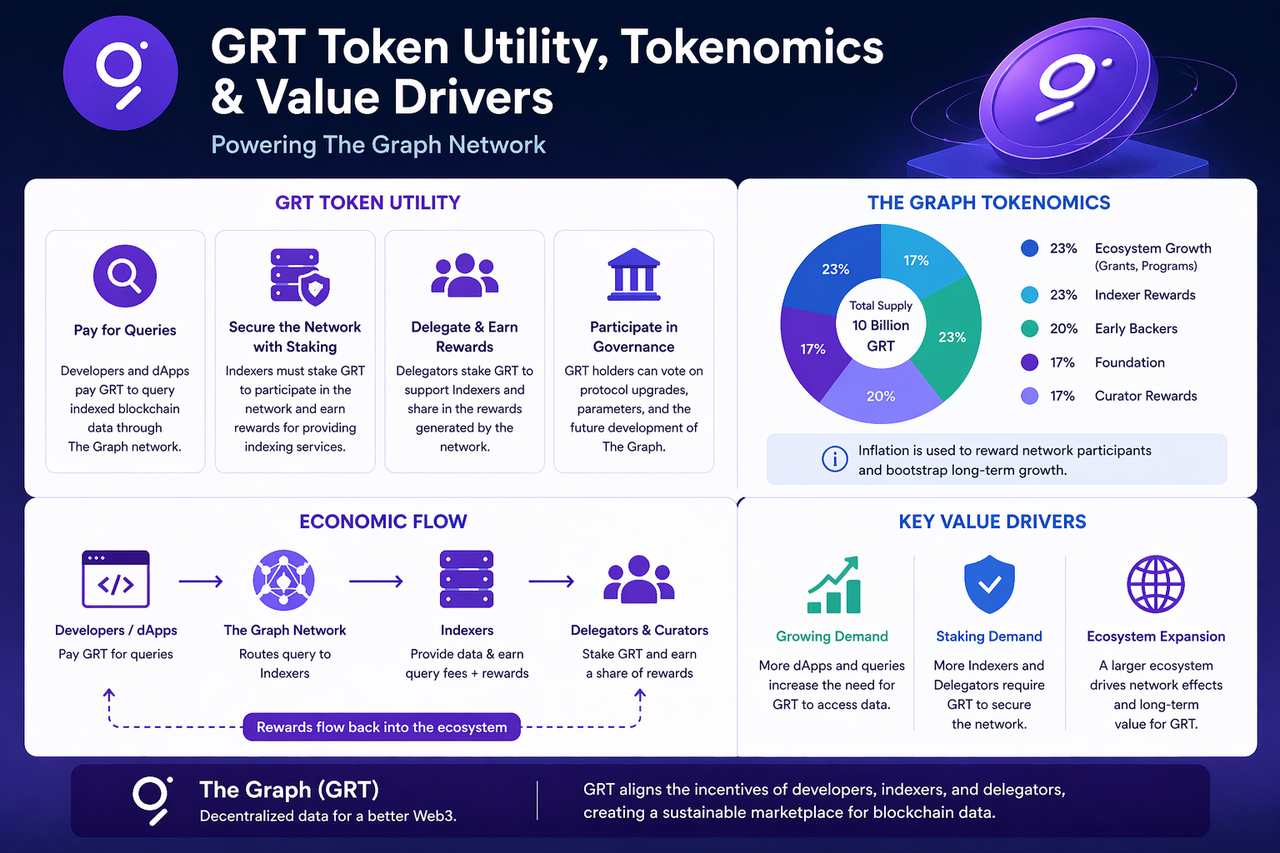
First, developers and decentralized applications must pay GRT as a query fee when accessing The Graph’s data services. Every data query creates demand for the token, making GRT a primary vehicle for capturing network value.
Second, participants such as Indexers, Curators, and Delegators must stake GRT to engage in protocol operations. Indexers stake GRT to qualify for indexing, Curators stake GRT to signal high-quality Subgraphs, and Delegators delegate their stake to share in returns. This structure positions GRT as a critical resource for both network security and operational efficiency.
Additionally, GRT is used for governance. Token holders can participate in decisions regarding protocol parameters and future upgrades, guiding The Graph toward increasingly decentralized governance.
How Does the GRT Query Fee Model Create Value?
The Graph’s core service is on-chain data querying, with GRT as the payment medium for query fees.
Developers querying blockchain data through The Graph must pay GRT, which is distributed to the Indexer nodes providing the service. As more DApps utilize The Graph and query volumes rise, the demand for GRT increases accordingly.
This model mirrors a pay-as-you-go approach: the more the protocol is used, the greater the demand for GRT, providing clear value support. Thus, data query demand is one of the most direct sources of value for GRT.
How Does GRT Staking Impact Token Value?
Beyond payment utility, GRT’s other major value driver is staking demand.
Indexers are required to stake GRT to operate nodes and provide indexing services; Delegators and Curators must also stake GRT to participate in network rewards and resource allocation. This mechanism locks a significant amount of GRT within the protocol, reducing its circulating supply.
As the network grows and node participation increases, staking demand for GRT rises. Staking not only strengthens network security but also supports GRT’s value by constricting supply.
How Does The Graph’s Tokenomics Operate?
The Graph’s tokenomics are structured around payment demand, staking demand, and incentive distribution.
Query fees paid by developers generate protocol revenue, nodes earn rewards by providing indexing services, and participants receive incentives for staking GRT. Economic rewards attract more nodes, ensuring stable and reliable data indexing services.
This model makes GRT the bridge between “protocol users” and “service providers.” As network usage increases, so do node rewards and staking incentives, creating a positive feedback loop.
What Drives GRT’s Value?
GRT’s value derives from three main drivers:
- Rising data query demand: The more DApps The Graph supports, the higher the query volume and the greater the need for GRT payments.
- Growing node staking demand: Increased participation from Indexers and Delegators results in more GRT being locked up.
- Ecosystem expansion expectations: As The Graph becomes the backbone for more Web3 applications, its network value rises, strengthening the long-term outlook for GRT.
Thus, GRT’s value logic is closely aligned with The Graph protocol’s adoption rate.
What Risks Does GRT’s Economic Model Face?
While GRT’s value logic is clear, its economic model faces several risks:
- If The Graph’s network growth falls short of expectations, insufficient query fee demand could weaken GRT’s value support.
- The competitive landscape for data indexing infrastructure is intense; rival protocols may attract developers, reducing The Graph’s market share.
- Token unlocks and market volatility can also impact GRT’s price performance.
Ultimately, GRT’s long-term value depends not only on sound tokenomics, but also on the protocol’s real-world adoption.
Why Is GRT’s Value Closely Tied to The Graph’s Adoption Rate?
GRT’s value is fundamentally driven by demand within The Graph network, making protocol adoption the key determinant of its long-term value.
As more DeFi, NFT, and DAO projects adopt The Graph, both query and staking demand will increase, elevating GRT’s economic value.
Conversely, if protocol growth stagnates, expanding demand for GRT will be difficult, limiting its value appreciation. Assessing GRT’s long-term potential thus hinges on monitoring The Graph’s adoption across the Web3 data layer.
Summary
GRT is the core utility token of The Graph network, primarily used for paying query fees, supporting node staking, and enabling protocol governance. Its value is anchored in on-chain data query demand, node staking requirements, and expectations for ecosystem growth.
As The Graph’s significance in Web3 data indexing rises, demand for GRT is likely to strengthen. However, its long-term value will ultimately depend on actual protocol adoption and network expansion.
FAQs
What are the uses of the GRT token?
GRT is primarily used to pay for The Graph’s data query fees, support Indexer node staking, and participate in protocol governance, making it essential for The Graph’s network operations.
What are the sources of GRT’s value?
GRT’s value is driven by increasing demand for data queries, growing node staking requirements, and long-term expectations tied to The Graph’s ecosystem expansion.
Why does the staking mechanism impact GRT’s value?
Staking locks up a significant amount of GRT, reducing circulating supply while enhancing network security, thereby supporting the token’s value.
What determines GRT’s long-term value?
GRT’s long-term value is primarily determined by The Graph network’s adoption rate—that is, how many developers and DApps continue to rely on its data query services.







