As blockchain infrastructure continues to evolve, the limitations of the traditional internet in terms of performance, latency, and bandwidth are becoming increasingly apparent. These constraints are now a bottleneck for Web3 applications, especially in areas such as DeFi, blockchain gaming, and high-frequency trading, where low latency and high throughput are essential.
Against this backdrop, DoubleZero has emerged as a key player in the DePIN (Decentralized Physical Infrastructure Network) sector. By aggregating private high-speed fiber networks and dedicated hardware resources, it builds a high-performance data transmission layer independent of the public internet. Its native token, 2Z, is not only central to network operations but also a critical mechanism for maintaining incentives and enabling long-term ecosystem growth.
2Z Token Overview
2Z is the native token of the DoubleZero network and is deeply integrated into its core operations, including resource payments, node incentives, and governance decisions. Users must use 2Z to access network bandwidth and connectivity services, while resource providers earn token rewards by contributing fiber links, node infrastructure, and other physical resources.
By design, 2Z serves three primary roles: a medium of payment, a staking asset, and a governance token. This multi-functional design makes it more than just a transactional currency; it is a foundational asset that supports the network’s security and operational efficiency.
Key details:
Notably, before its launch, the 2Z token received a “no-action letter” from the U.S. SEC. The letter states that if 2Z is distributed programmatically as described, the SEC would not recommend enforcement action, and the token would not need to be registered as a security.
2Z Token Distribution Structure
DoubleZero adopts a balanced token distribution model designed to support early development, ecosystem expansion, and long-term incentives. The total supply is allocated across different participant groups to sustain ongoing network growth.
The largest share is reserved for ecosystem and contributor rewards, incentivizing participants who provide fiber links, node hardware, and other infrastructure resources. This design ensures continuous expansion of physical resource supply and helps the network achieve scale.
| Entity |
Percentage |
Locking Schedule |
| DoubleZero Foundation and Ecosystem |
29% |
Unlocked |
| Jump Crypto |
28% |
5% unlocked; the remainder vests gradually over four years |
| Malbec Labs |
14% |
Vests gradually over four years |
| Team |
10% |
Vests gradually over four years |
| Institutions |
12% |
Vests gradually over four years |
| Contributors |
4% |
Vests gradually over four years |
| Builders |
2% |
Vests gradually over four years |
| Validators |
1% |
0.7% unlocked at launch; the remainder unlocks one year after purchase (April/May 2026) |
In terms of vesting, DoubleZero follows a relatively conservative long-term release strategy. Core team members and investors are typically subject to a one-year lock-up period, followed by gradual linear release over several years. This helps reduce short-term selling pressure on the market.
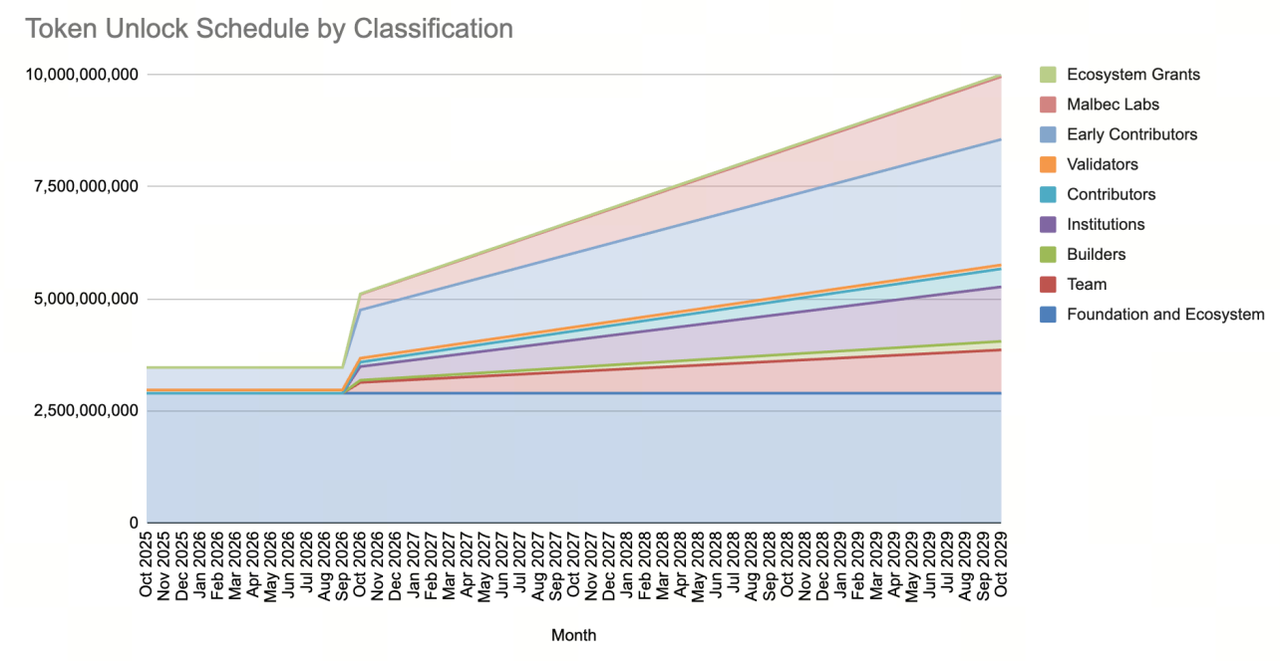 DoubleZero token vesting schedule. Source: DoubleZero
In addition, tokens allocated for ecosystem and contributor rewards are not released all at once. Instead, they are distributed gradually through a dynamic emission mechanism, often tied to network usage and node performance. This ensures that token supply growth remains aligned with actual network value.
Core Utilities and Use Cases of 2Z
2Z serves three primary functions within the DoubleZero network: payment, incentives, and security.
On the payment side, users must use 2Z to access network services, including high-speed data transmission and low-latency connectivity. This makes 2Z the direct gateway to network demand.
On the incentive side, resource providers earn rewards by contributing bandwidth, hardware, and network quality. Some mechanisms, such as contribution-based allocation models, distribute rewards based on actual node performance, encouraging higher-quality infrastructure participation.
On the security side, nodes are typically required to stake 2Z to ensure reliable service. If a node fails to meet performance standards, its staked assets may be penalized, helping maintain overall network quality.
How Does 2Z Capture Value? Sources and Growth Path
The value of 2Z primarily comes from growing demand for network usage. As more applications rely on DoubleZero’s low-latency connectivity, demand for 2Z increases, providing a foundation for its value.
At the same time, fee consumption, potential burn mechanisms, and staking requirements can reduce circulating supply, enhancing token scarcity. On the supply side, incentives drive continuous expansion, while on the demand side, real usage strengthens adoption. This two-sided growth model forms the core of its economic design.
From a growth perspective, the value of 2Z depends on the expansion of the DePIN network, its integration with high-performance blockchain ecosystems such as Solana, and the continued global demand for high-quality network connectivity.
The Long-Term Value Proposition of 2Z
From a long-term perspective, the value of 2Z depends on whether DoubleZero can establish itself as a critical infrastructure layer. If the network continues to attract developers, trading systems, and high-performance applications, 2Z will benefit from stable and growing demand.
As the network scales, its use cases are likely to expand, strengthening the intrinsic value of the token. Compared to single-purpose tokens, 2Z’s multi-functional design makes it more capable of forming a sustainable value loop.
However, this outlook depends on DoubleZero achieving real competitive advantages in performance, cost efficiency, and stability, and successfully scaling its deployment.
Risks and Uncertainties of 2Z
Despite its well-defined economic model, 2Z still faces several risks. First, token unlock events may increase circulating supply during certain periods, potentially putting pressure on price.
Second, the network relies on performance-based incentive mechanisms for resource providers. If these mechanisms are not well designed, they could affect the stability of the supply side. In addition, decentralized infrastructure projects often face significant technical challenges, and network quality and user experience still need to be validated over time.
Externally, regulatory uncertainty and competition from other DePIN projects may also impact DoubleZero’s growth. Therefore, evaluating its value requires a comprehensive view of technical, market, and regulatory factors.
Conclusion
As the core token of the DoubleZero network, 2Z connects computing supply with demand through its roles in payments, staking, and governance, making it essential to the ecosystem’s operation. Its value is primarily driven by the growth of AI computing demand and the expansion of the network.
In the long run, whether 2Z can sustain its value will depend on DoubleZero’s ability to build a stable computing market and achieve large-scale adoption. With both opportunities and challenges ahead, its development trajectory remains worth watching.
FAQs
What is the primary use of the 2Z token?
It is mainly used for paying for computing resources, staking by nodes, and participating in network governance.
What drives the value of 2Z?
Its value primarily comes from the growth in AI computing demand and increased network usage.
How does the vesting schedule affect the price?
Token unlocks may increase circulating supply, which can create short-term price pressure.
Is 2Z suitable for long-term holding?
This depends on the actual adoption of the DoubleZero network and the development of its ecosystem.







