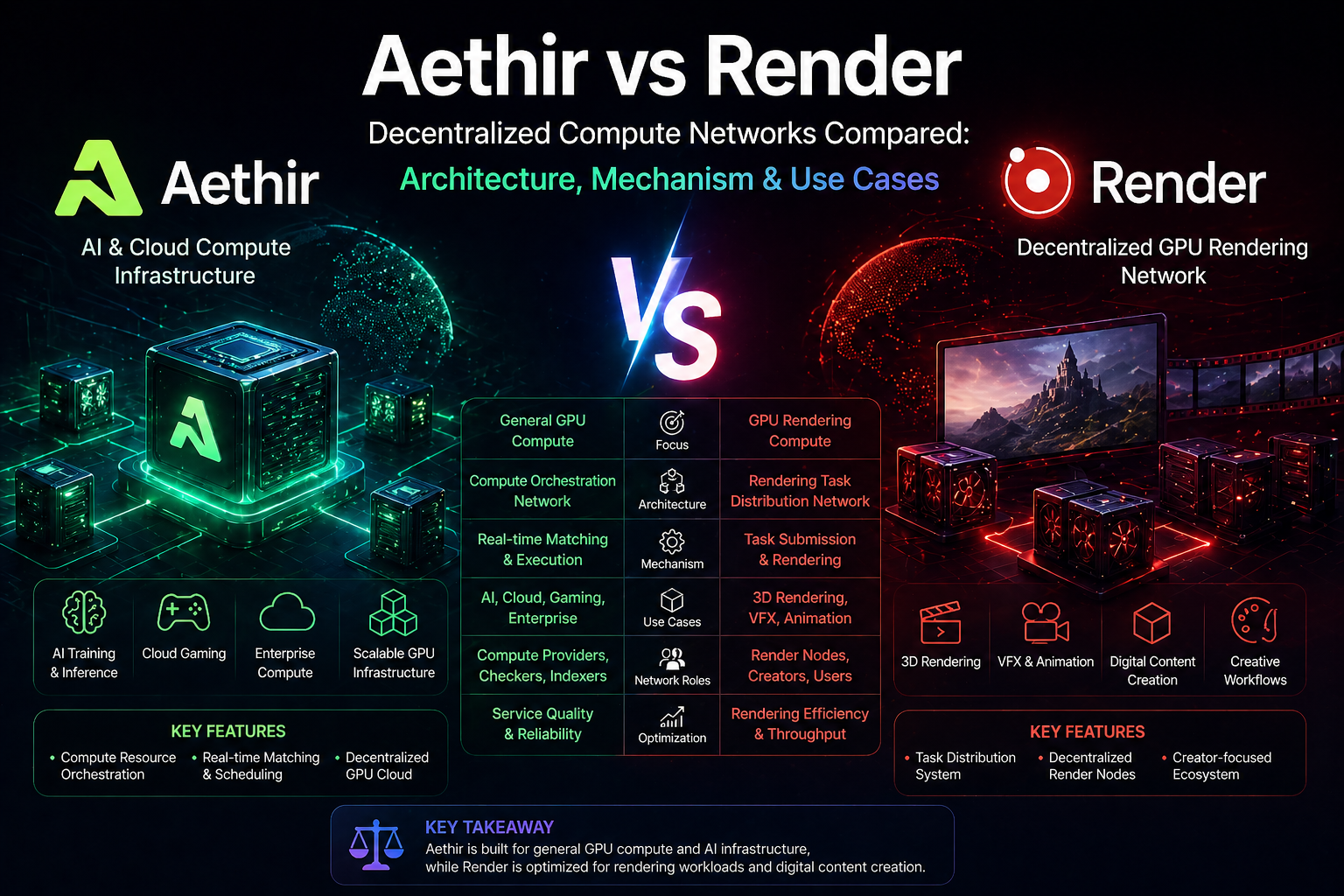
Users often compare Aethir and Render because both operate in the DePIN and GPU computing sectors, but they tackle distinctly different challenges. Aethir prioritizes flexible, general-purpose GPU cloud services, while Render focuses on distributing and executing rendering workloads.
Key differences arise across several dimensions: resource types, architectural design, task processing mechanisms, incentive models, governance structures, and application scenarios.
What is Aethir
Aethir is a decentralized GPU cloud network designed for AI, cloud gaming, and enterprise computing. Its core innovation is organizing distributed GPU resources into an on-demand, schedulable compute infrastructure.
The Aethir network features three main roles: Container, Checker, and Indexer. Containers execute compute workloads, Checkers monitor and validate performance and service quality, and Indexers match user requirements with optimal GPU resources. According to Aethir’s documentation, these roles form the backbone of network operations.
This structure positions Aethir as a decentralized cloud computing platform. When users submit AI inference, cloud gaming, or rendering requests, the system dynamically selects the optimal node based on performance, latency, and availability.
Aethir’s value proposition is transforming fragmented GPU resources into a unified, on-demand cloud service—not just a single-purpose task marketplace.
What is Render
Render is a decentralized GPU rendering network that connects creators requiring rendering power with nodes supplying GPU resources.
Render Network is designed as a distributed GPU rendering service for 3D content creation, animation, visual effects, and digital art. The official Render site highlights decentralized cloud rendering as the key to boosting creator workflow efficiency.
In practice, users submit rendering tasks, the network allocates those to GPU nodes for processing, and nodes earn rewards upon task completion. Unlike Aethir, Render’s core entry point is content production workloads, not general cloud compute services.
This focus makes Render a “rendering task network,” where value is driven by creators’ demand for high-performance graphics compute.
Architectural Differences: Aethir vs Render
Aethir and Render diverge significantly in network organization. Aethir emphasizes scheduling, quality validation, and resource matching; Render focuses on task distribution, node execution, and result delivery.
Aethir’s architecture—anchored by Container, Checker, and Indexer—creates a clear compute service structure. Indexers match user demand with GPU nodes, Checkers enforce quality standards, and Containers run compute workloads.
Render organizes its network around the rendering workflow. Users submit tasks, which are distributed to GPU nodes, with management and payments handled via protocol. Messari’s research notes Render’s distributed nodes support both 3D rendering and AI compute.
| Comparison Dimension |
Aethir |
Render |
| Core Focus |
Decentralized GPU Cloud Computing |
Decentralized GPU Rendering |
| Main Resource |
Schedulable GPU Compute |
Rendering GPU Resources |
| Architectural Emphasis |
Matching, Execution, Verification |
Task Distribution, Rendering Execution |
| User Entry Point |
AI, Cloud Gaming, Enterprise Compute |
Creators & Rendering Workloads |
| Service Model |
Compute-as-a-Service |
Render-as-a-Service |
Structurally, Aethir functions as cloud infrastructure, while Render operates as a rendering network for creators.
Operating Mechanisms: Aethir vs Render
Aethir’s system centers on real-time resource matching; Render’s emphasizes task submission and completion.
On Aethir, after a request enters the network, the Indexer matches it to the optimal GPU resource according to workload, node status, latency, and performance. For cloud gaming, the Indexer pairs game workloads with the most suitable GPU Containers.
Render is built for batch processing. Creators submit rendering jobs, nodes compute and return results. This suits high-intensity graphics tasks without real-time interaction, like 3D rendering, animation, and visual content generation.
As a result, Aethir prioritizes low latency, availability, and continuous cloud service, while Render focuses on compute efficiency, result quality, and creative tool compatibility.
Both leverage GPU resources, but their processing logic is fundamentally different.
Incentive Models Compared
Both Aethir and Render incentivize GPU resource contribution, but reward structures and participant roles differ.
Aethir rewards compute providers for integrating GPU resources and performing tasks per network standards. Checker and Indexer roles support quality and matching, creating a multi-role, collaborative incentive system.
Render’s model is centered on task execution. GPU nodes earn tokens for completing rendering or compute jobs; users pay tokens for GPU services. According to the whitepaper, users burn RENDER tokens to submit jobs, and node operators receive newly minted RENDER as compensation.
In essence, Aethir’s incentives prioritize cloud service quality; Render’s focus on task completion and creator alignment.
Ecosystem-wise, Aethir must ensure steady compute supply, while Render needs a balanced flow of creator demand and node capacity.
Compute Control & Resource Allocation
Although both aim to decentralize compute, Aethir and Render differ in resource control.
Aethir aggregates GPU resources from multiple providers into a unified infrastructure, managed by a scheduling system. Documentation describes Aethir as a decentralized, enterprise-grade platform delivering GPU resources globally for AI, gaming, and Web3.
Render connects idle GPU resources directly to creator demand. Resource allocation revolves around individual rendering jobs—users submit, nodes execute, and the network coordinates.
Aethir’s focus is on compute service availability and quality control; Render’s is on efficient allocation in the task marketplace.
Thus, Aethir serves as infrastructure, while Render operates as a creator-centric compute marketplace.
Application Scenarios & Ecosystem Focus
Aethir and Render have overlapping use cases, but distinct ecosystem priorities.
Aethir targets AI training, inference, cloud gaming, real-time rendering, and enterprise compute. Its ecosystem is aligned with AI infrastructure and decentralized cloud services. The official FAQ defines Aethir as an enterprise-grade, decentralized cloud network offering scalable GPU resources for AI, gaming, and Web3.
Render focuses on 3D rendering, animation, visual content, and digital art. Messari notes Render is expanding into AI and general compute, but its primary advantage remains in rendering and creator ecosystems.
So, Aethir is best described as AI/cloud GPU infrastructure, while Render is a decentralized rendering network for content and graphics.
Their differences extend beyond technology to target users and ecosystem priorities.
Summary
Aethir and Render are both decentralized GPU compute networks, but their positioning diverges. Aethir, with roles like Container, Checker, and Indexer, builds a schedulable GPU cloud service targeting AI, gaming, and enterprise infrastructure. Render is built around rendering workloads, serving 3D content, animation, and visual compute. The key distinction is between “general compute infrastructure” and a “rendering task network.”
FAQ
What is the biggest difference between Aethir and Render
Aethir focuses on AI, cloud gaming, and enterprise GPU cloud services. Render focuses on 3D rendering, digital art, and visual content. Both use GPU resources, but serve different scenarios.
Are Aethir and Render in the same category
Both are part of the DePIN and decentralized GPU compute space, but Aethir is more cloud infrastructure-oriented, while Render is geared toward rendering workloads.
Does Render only support 3D rendering
Render’s roots are in 3D rendering and content creation, but it’s expanding into AI and general compute. However, rendering workflows remain its core strength.
What are Aethir’s core node roles
Aethir’s core roles are Container (compute execution), Checker (quality validation), and Indexer (matching demand with GPU resources).
Which platform is better for AI compute needs
Aethir directly targets AI and cloud infrastructure workloads. Render also supports AI, but remains focused on creators and rendering tasks.







