


The Space Dream of Encryption Tycoons: Investing $1 Billion to Build a Commercial Space Station
Written by: Kiel Porter, Loren Grush, Bloomberg Businessweek
Compiled by: Luffy, Foresight News
Jed McCaleb has made a fortune in the cryptocurrency field, and now he is ready to invest a large portion of it into his dream of space.
This billionaire, who once founded the notorious Bitcoin exchange Mt. Gox and the cryptocurrency XRP, is independently funding an ambitious project: to build the world’s first commercial space station and send it into space.
If successful, his startup Vast Space LLC is poised to win a contract from NASA worth potentially billions of dollars next year to replace the International Space Station. McCaleb stated that if he fails, he is prepared to lose $1 billion. As of the end of 2023, McCaleb controls billions of dollars in assets through two foundations, with the $3.3 billion in assets of the foundations coming from his personal donations.
“For humanity to live beyond Earth in the future, this step is crucial.” McCaleb, 50, stated at the company headquarters in Long Beach, California, “Not many people are willing to invest so many resources, time, and bear risks like I do.”
Since then, he has hired an industry veteran as CEO, and SpaceX is providing some technical support to Vast as well. At the same time, Elon Musk urged the United States to speed up the timeline for the retirement of the International Space Station, which is currently scheduled for the end of 2030. Founded in 2021, some of the components of Vast spacecraft incorporate technology developed by SpaceX, specifically the docking adapter used to connect the SpaceX Dragon spacecraft to the Vast space station, and the space internet system that provides Wi-Fi to the space station via Starlink. Vast has booked SpaceX’s launch services to launch its hardware into orbit and send astronauts to the space station, and SpaceX has also agreed to deliver astronauts to Vast as long as NASA approves it.
However, this task remains daunting, and from McCaleb’s experience, it is hard to see him as the person capable of handling it. This boy from an Arkansas farm and a dropout from the University of California, Berkeley, has no background in the aerospace industry. His career is characterized by seizing opportunities in emerging technologies and then timely transforming before government regulation and other adverse factors disrupt the industry. This short-term thinking seems to contradict the long-term focus required to win a high-risk race to create technological miracles.
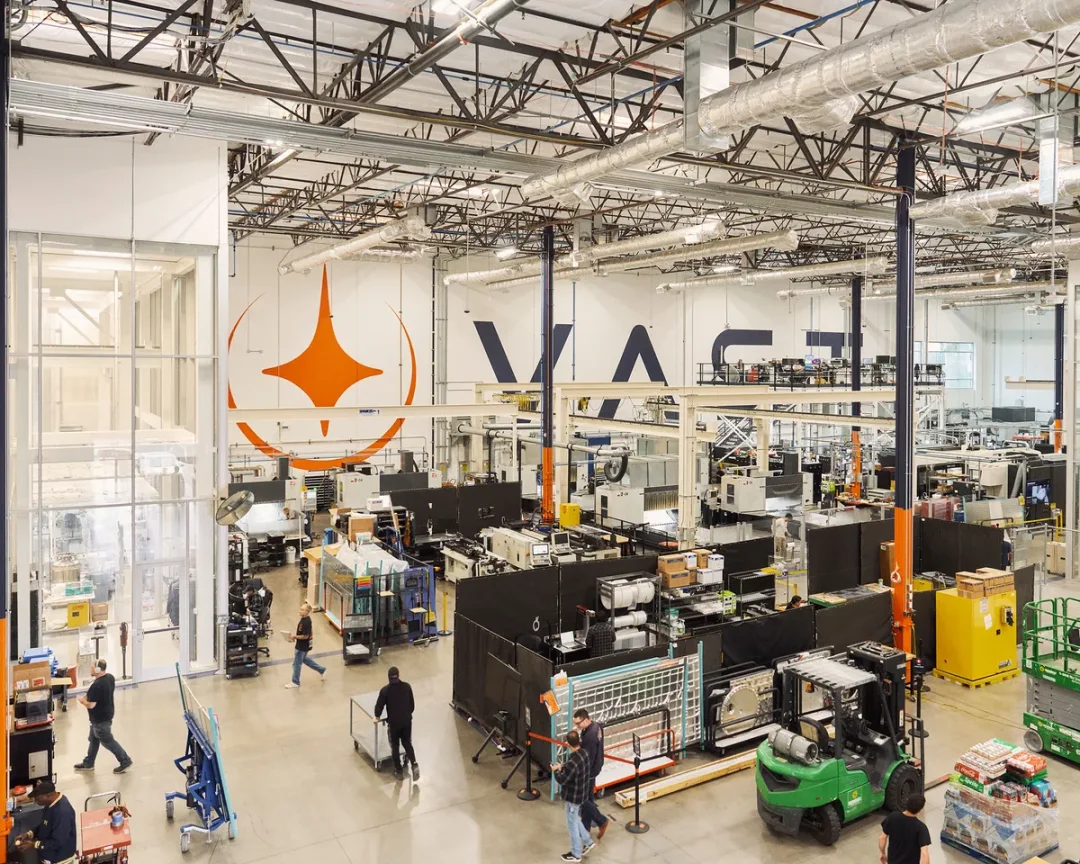
Vast is headquartered in Long Beach, Source: Bloomberg Businessweek
Sam Yagan is a friend of McCaleb, who co-founded an online file-sharing company with him over twenty years ago. Yagan is now the co-founder and managing director of Corazon Capital, and he stated that this entrepreneur is a thoughtful risk-taker. “He is very rational about these things,” Yagan said, “but he is willing to take on the huge risks that you and I might see as unconventional.”
Many employees at Vast have previously worked at SpaceX. The parking lot at the company headquarters is filled with cars produced by Tesla, a company owned by Musk. One of the Cybertrucks belongs to Max Haot, who joined Vast after McCaleb acquired his company in 2023. After that, Haot became the CEO of Vast, allowing McCaleb (who drives a more ordinary Model 3) to fly in once a week from his home in San Francisco to oversee project progress.
Before being acquired, Haot did not focus on the space station field. Instead, he tried to emulate Musk by founding another rocket launch startup, Launcher. The company secured $30 million in investment and made progress in developing rocket engines and launch vehicles, but the two satellites built by Launcher encountered failures after entering space. In 2022, Haot met McCaleb while looking for investors.
McCaleb proposed an acquisition offer and agreed that Haot would serve as the president of Vast, eventually becoming the CEO. Haot was initially reluctant to accept the deal, but when he realized that Launcher was struggling to secure the necessary funding, he changed his mind.
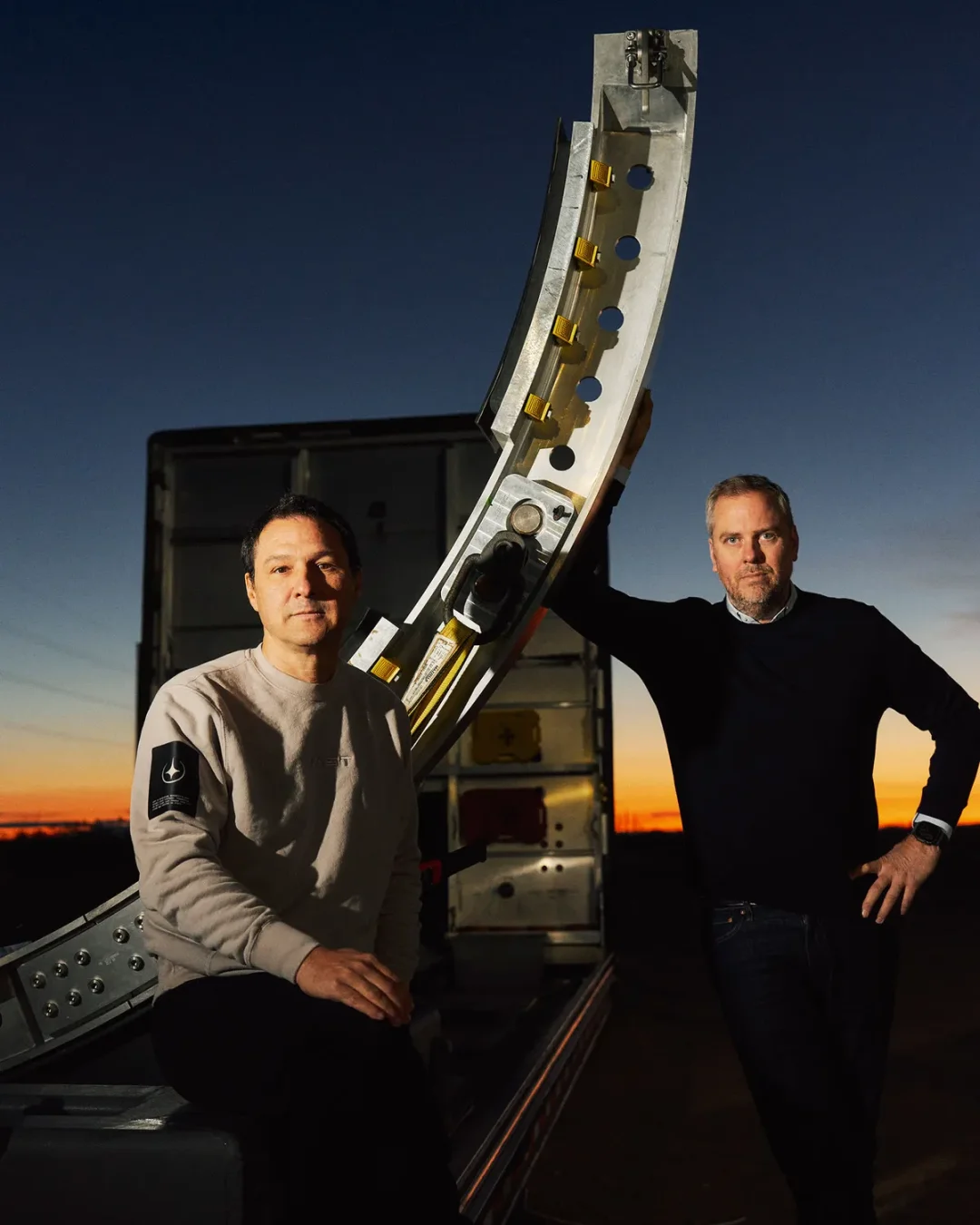
Vast founder and chairman Jed McCaleb with CEO Max Haot at the testing facility in Mojave, California, source: Bloomberg Businessweek
Vast’s grand vision is not just to build the first private space station. The company also aims to develop an artificial gravity system to simulate Earth’s environment for future astronauts. This engineering project is highly complex and requires the use of centrifugal force to set up massive rotating modules in space. This proposal is quite appealing, as human experience living and working on the International Space Station indicates that prolonged exposure to a microgravity environment can harm various biological systems.
However, all of this is still a long way off. Currently, Vast needs to launch its first space station into orbit. The number of employees has rapidly increased from fewer than 200 a year ago to 740, covering a range of talents from technical engineers to spacesuit manufacturers. Vast’s headquarters operates 24 hours a day, with engineers and construction workers working in shifts, either expanding the Long Beach facilities or constructing Vast’s first prototype space station “Haven-1.”
Space stations are common elements in popular culture, such as the Death Star in “Star Wars” and the namesake space station in “Star Trek: Deep Space Nine.” Since astronauts first boarded the experimental Skylab in 1973, space stations have also been an important part of U.S. space exploration. Decades later, with the end of the Cold War, NASA collaborated with countries like Russia to build a larger International Space Station. Since November 2000, there has always been at least one astronaut aboard the International Space Station, who frequently studies the behavior of materials and the human body in microgravity environments.
A technician from Vast headquarters, source: Bloomberg Businessweek
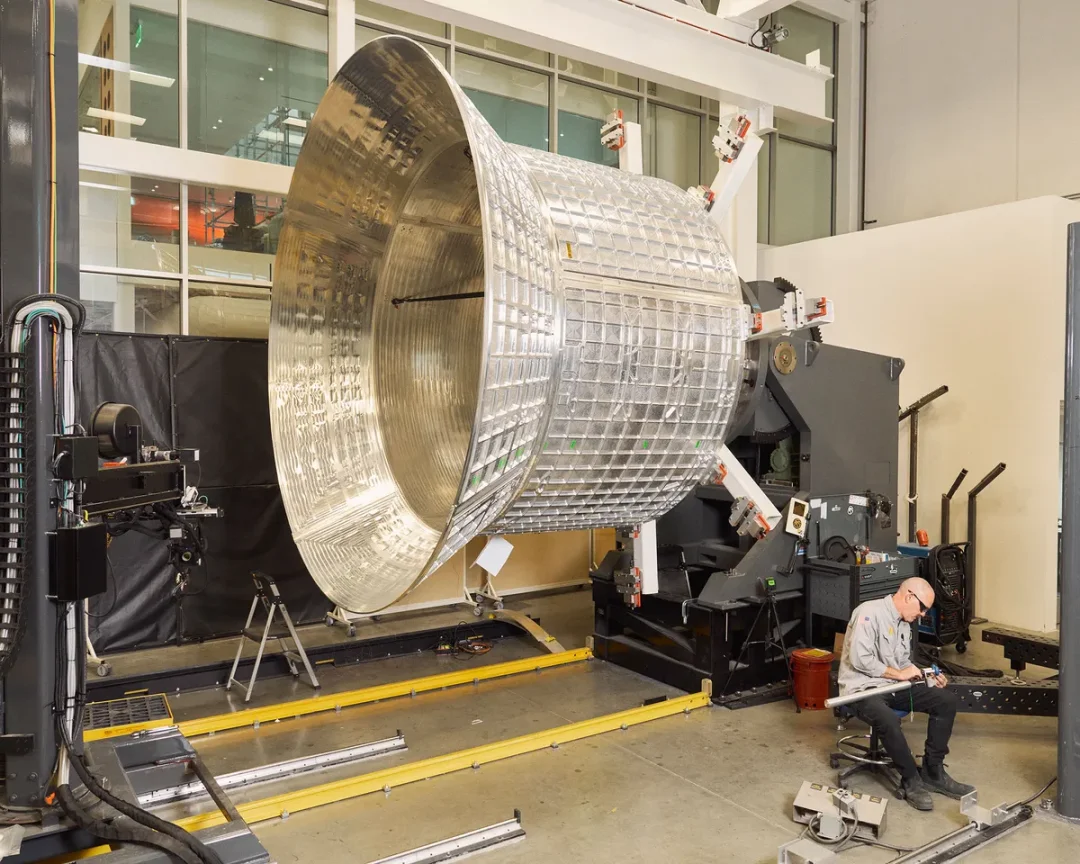
Haven-1 is approximately 33 feet (about 10 meters) tall and 14.5 feet (about 4.4 meters) wide, designed to fit snugly inside the nose cone of the SpaceX Falcon 9 rocket. The living space of the space station is about 1,600 cubic feet (45 cubic meters), which is roughly twice that of a typical RV. It will be equipped with private sleeping pods, a large window, wood paneling, and a table for four.
At least that’s its goal. In January of this year, the company began constructing Haven-1, which is scheduled to launch in May 2026, a delay from the originally planned date of August this year. The company recently tested a prototype to confirm that its structure can withstand internal pressure, and is developing key components for the power system, propulsion devices, and other manned mission tasks. Its shell must be able to withstand the harsh conditions and temperatures of space, while also maintaining the pressure and gases that humans are accustomed to on Earth.
“We are not a real space station company yet,” Haot said, “We are an aspiring space station company.”
! The Space Dream of the Crypto Rich: $1 Billion to Build a Commercial Space Station
The main structure of Haven-1 is awaiting further testing at Vast’s Mojave base, Source: Bloomberg Businessweek
Assuming everything goes smoothly, after the launch of Haven-1, Vast will send four astronauts into space with the Falcon 9 rocket to dock with the space station. If the first launch is successful, Vast plans to launch the first module of the next space station, Haven-2, before 2028. It will serve as the starting point for a larger base, aimed at replacing NASA’s International Space Station.
One of the biggest challenges will be to create an effective life support system. The International Space Station uses a regenerative system that recycles all wastewater into drinking water and converts carbon dioxide into breathable oxygen. Such a system is essential if passengers are to stay on the space station for an extended period, but Haven-1 will not be equipped with it, as it is expected that astronauts will only stay for a short time. Vast plans to eventually equip Haven-2 with such a system, but it is anticipated that the space station will not have long-term occupants in the initial years.
Competitors, including Axiom Space, Blue Origin, and Voyager Space Holdings, are also racing to build their own space stations, but one advantage of Vast is that McCaleb is willing to invest heavily in the project. “Vast is the only company that primarily relies on its own funds and is ready to go,” said Chad Anderson, founder and managing partner of the space-focused investment firm Space Capital. “In that regard, they are an interesting choice.” (Anderson has no financial ties to Vast but has invested in SpaceX.)
Although these competitors have aerospace backgrounds and some launch contracts, they do not have such close partnerships with SpaceX.
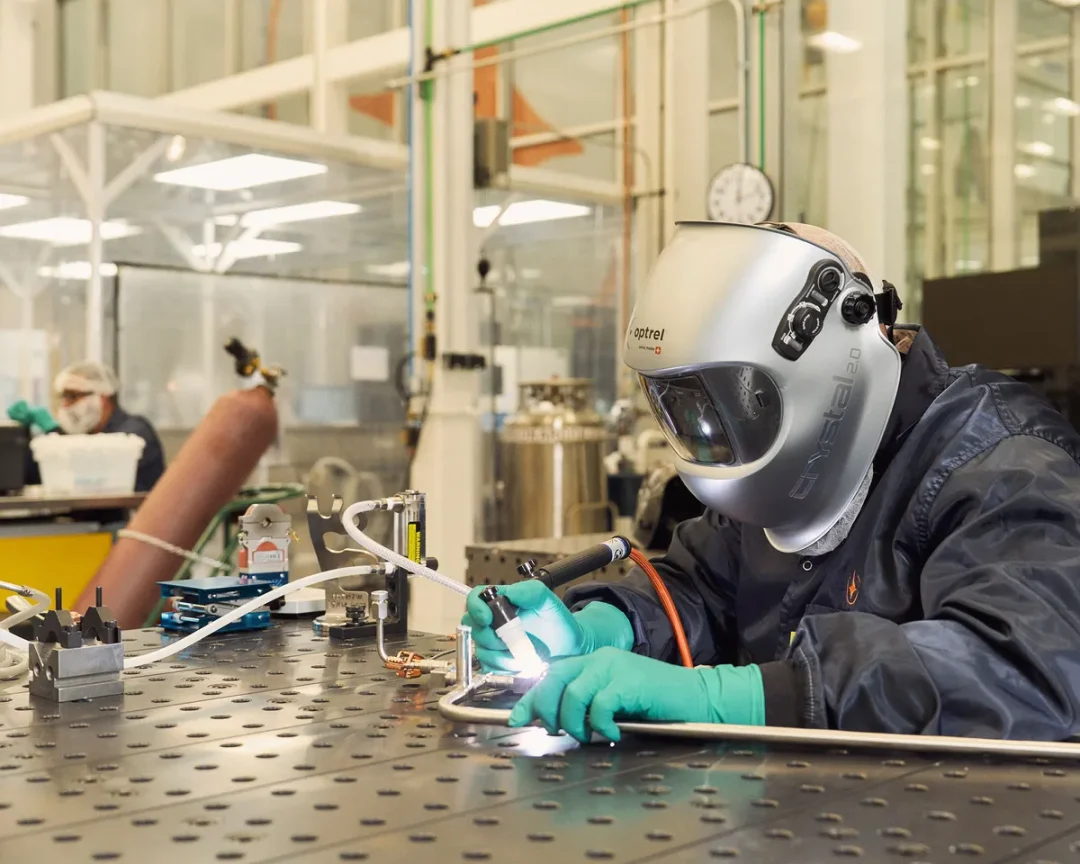
Engineers are researching life support systems in the clean room at Vast headquarters, source: Bloomberg Businessweek
McCaleb is eager to downplay any personal relationship, stating that he has met Musk “a few times, he probably doesn’t remember me,” despite both investing in OpenAI. Although they differ in methods and demeanor, there are many similarities in their respective interests and unconventional paths to wealth: both dropped out of school (Musk dropped out later), started software companies in emerging fields, and turned their love for fantasy and gaming into financial success.
McCaleb’s first project, eDonkey, was one of the earliest file-sharing services on the internet and an early competitor to Napster. The company was founded in 2000 and allowed users to share music and movies for free, generating millions of dollars in revenue annually through advertising. In 2006, to avoid copyright infringement lawsuits, the company agreed to pay the Recording Industry Association of America $30 million and subsequently shut down.
McCaleb’s next success was Mt. Gox, one of the world’s earliest bitcoin exchanges. The website was founded by McCaleb in 2010, and a year later, he sold most of his stake for an undisclosed amount. In February 2014, the exchange went bankrupt, and users lost bitcoins worth over $400 million at the time, which was the largest cryptocurrency disaster in history before the FTX collapse in 2023. Although McCaleb remained a minority shareholder, he faced no sanctions and claimed to have also suffered losses in this disaster.
At that time, McCaleb had already started his next project: XRP, the cryptocurrency on the Ripple protocol, of which he was also a co-founder. McCaleb initially owned 9% of XRP. After a disagreement with the co-founders, he left the company in 2013, but retained his XRP and gradually sold it over the following years. According to analysis from XRPScan, during the cryptocurrency boom at the end of 2017, the value of XRP soared, ultimately inflating to a market capitalization of $130 billion in January 2018. McCaleb netted approximately $3.2 billion from selling XRP and Ripple equity between 2014 and 2022.
“He is one of the ten most important founders in the cryptocurrency space, although very few people really know him,” said Nic Carter, founding partner of the public blockchain-focused investment firm Castle Island Ventures. “Interestingly, most of the other important figures are those who are flamboyant, high-profile, and extravagant.”
Despite achieving great success, McCaleb’s social circle is quite small, mainly collaborating with Yagan and other long-term partners. He has a house in the surfing paradise of Costa Rica, a residence in Berkeley, and owns his own private jet.
McCaleb has provided a stable source of investment for the often volatile aerospace industry. In this field, once-promising startups frequently fail due to lack of funding. Although a former employee has filed a lawsuit accusing Vast of attempting to cut corners, the company does not seem to have the negative press that SpaceX has. Its billionaire CEO spends most of his time at home with his wife and three children rather than trying to fight the federal government.
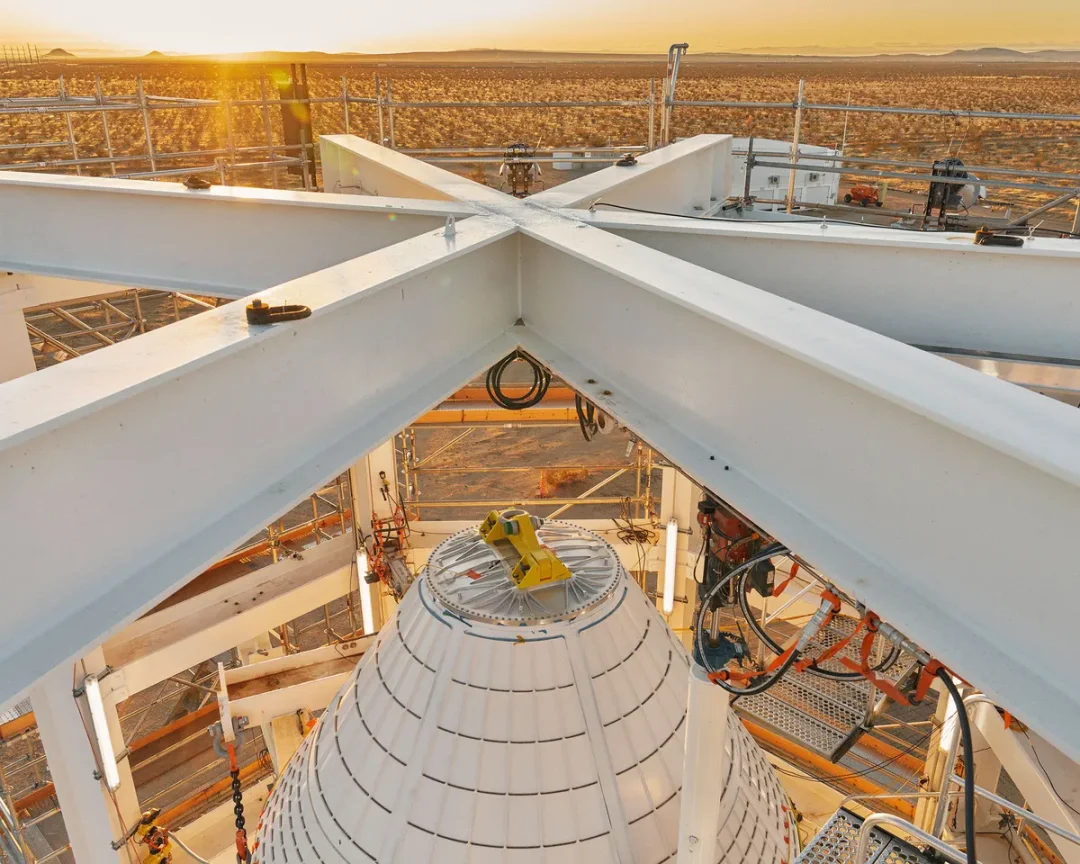
Haven-1 at Vast’s testing facility, Source: Bloomberg Businessweek
If McCaleb’s plan is successful, Vast has already booked multiple crewed missions with SpaceX to send astronauts into orbit. Both McCaleb and Haot have expressed their willingness to take these flights themselves. “As a child, I spent a lot of time outdoors exploring, looking up at the sky and marveling at its wonders,” McCaleb said. But all of this depends first on whether the company can win the final contract for the NASA program, which aims to initiate a commercial space station project that could replace the International Space Station. The plan has a soft guarantee that NASA will purchase time and space on any space station that enters orbit. This contract is expected to be signed by mid-2026.
Haot said that without NASA’s contract, the commercial viability of any space station is questionable. “Winning this competition is a matter of our survival.”