A New Chapter for Web3 Infrastructure
With blockchain technology evolving rapidly, the market demands infrastructure that is not only more efficient and cost-effective but also highly interoperable. Gate Layer is a Layer 2 network engineered for speed, security, and openness. It enhances transaction performance. Gate Layer builds an open ecosystem that supports a wide range of Web3 applications.
Gate Layer aims to be more than a technical solution—it empowers both developers and users to create their own digital economies in a truly open environment.
Technology Foundation Built on OP Stack
Gate Layer leverages the OP Stack architecture. It integrates Gate Chain as its settlement layer, ensuring robust security and scalability. Developers can deploy applications using familiar Ethereum tools like MetaMask, Remix, and Hardhat, without rewriting code, which significantly reduces migration costs.
Key Technical Highlights:
- Full EVM Compatibility: Deploy Ethereum DApps seamlessly and achieve full interoperability.
- Dual Security Mechanism: Combines Gate Chain’s consensus model with GT staking mechanism to secure the chain.
- Ultra-Fast Performance: The network produces blocks every second, achieving peak TPS of up to 5,700.
- Low Gas Fees: Transaction costs are significantly lower than other leading Layer 2 solutions.
- Cross-Chain Support: Integrates LayerZero to connect ETH, BSC, Polygon, and other ecosystems.
This architecture makes Gate Layer exceptionally developer-friendly and secures its technical edge in multi-chain interoperability.
Gas-Free Swap Functionality
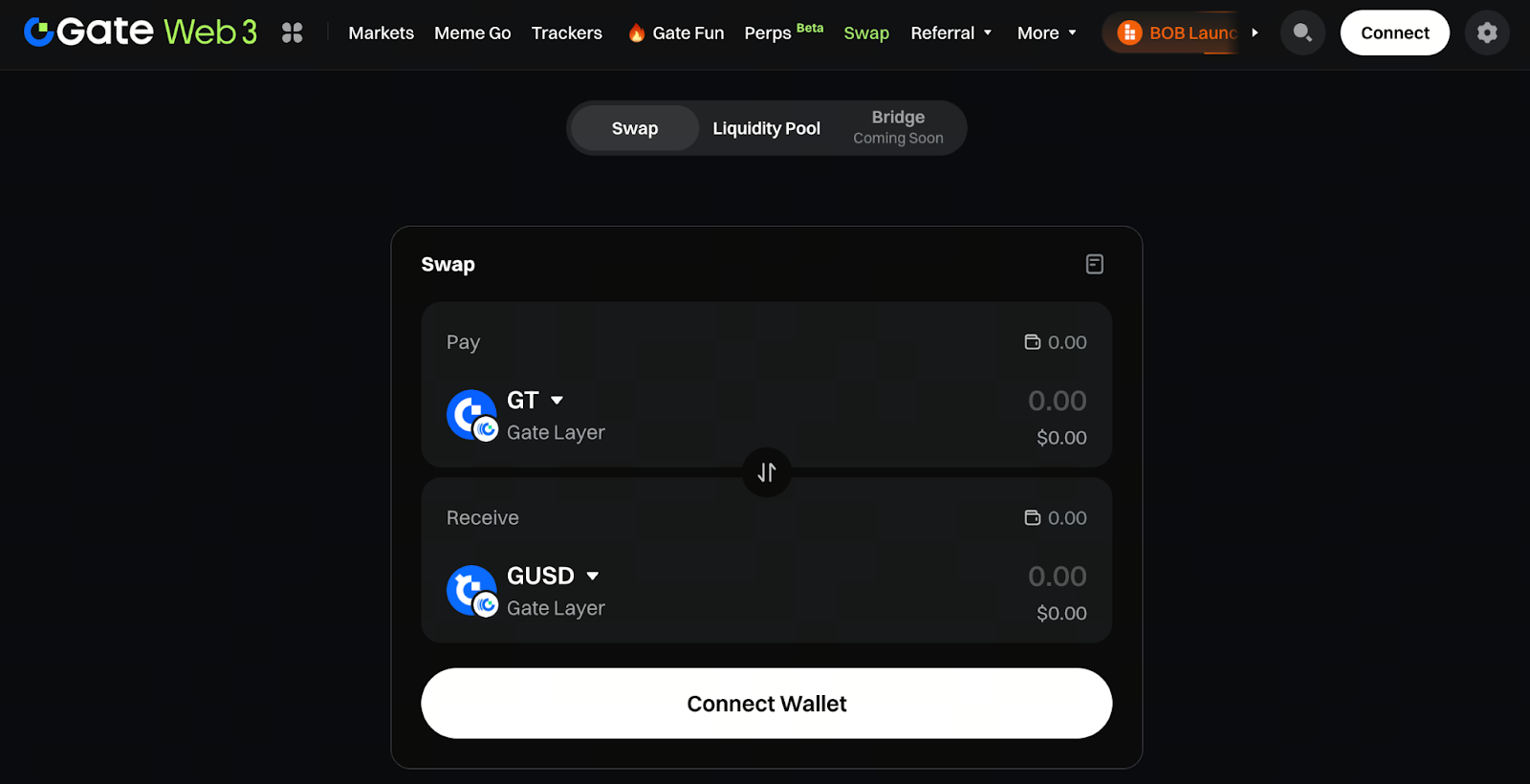
Gate Layer now offers a gas-free mode for Swap transactions. If a user’s wallet lacks the native asset (such as GT), the system automatically deducts gas fees from the payment token, allowing trades to complete without needing extra native tokens.
Traditionally, insufficient gas causes transaction failures. Gate Layer’s gas-free feature delivers a truly seamless and intuitive on-chain experience with smoother transactions. This feature is currently exclusive to Gate Layer, but will expand to additional networks, offering more users the benefits of decentralized efficiency and convenience.
Try Swap now and experience advanced on-chain operations: https://web3.gate.com/en/swap/gt-gatelayer-to-gusd-gatelayer/0xeeeeeeeeeeeeeeeeeeeeeeeeeeeeeeeeeeeeeeee,0xece3f96198a5e6b9b2278edbea8d548f66050d1c
Gate Swap Liquidity Pools Go Live

Gate Swap is an automated market maker (AMM) protocol on Gate Layer, providing on-chain trading and liquidity for the ecosystem. Its core mechanism is community-built liquidity pools. Anyone can become a liquidity provider (LP), add funds to token pairs like GT/USDT, and receive LP tokens as proof of liquidity provision.
Liquidity providers share trading fees proportionally, without additional platform fees, allowing users to receive 100% of the rewards. Gate Swap also allows anyone to create liquidity pools, from choosing tokens and setting initial prices to authorizing funds. All of this is done fully on-chain with maximum flexibility.
The launch of liquidity pools further strengthens Gate Layer’s financial infrastructure, enabling users to participate freely in asset flows and revenue sharing, which drives ecosystem growth and innovation.
Experience Gate Swap liquidity pools now: https://web3.gate.com/en/swap/liquidity
Building a Diverse Ecosystem
Gate Layer is not just a blockchain; it is an open ecosystem developed collaboratively by applications, creators, and users. Current native applications include:
- Perp DEX: A perpetual contract trading platform with low slippage and deep liquidity.
- Gate Fun: A no-code token launch tool empowering creators to build community token economies easily.
- Meme Go: A cross-chain meme coin analytics platform offering real-time trends and market insights.
These applications highlight Gate Layer’s flexibility and its commitment to driving Web3 adoption.
Comprehensive Core Technology Upgrades
Gate Chain has been upgraded to consensus version v1.20 to support larger-scale deployments and ecosystem growth:
- Supports EIP-4844 blob transactions to boost data processing efficiency.
- Upgraded to the EVM Cancun standard for full Ethereum compatibility.
- Integrated several EIPs (2565, 2929, and others) to improve stability and scalability.
- Enhanced RPC response speed for better node and developer experiences.
These upgrades ensure Gate Layer can handle high-frequency trading and large user volumes, laying the groundwork for mass adoption.
Summary
The launch of Gate Layer represents more than a technical leap—it marks a new era for Web3 infrastructure defined by high performance, low cost, and true interoperability. It accelerates developer innovation and provides users with truly seamless blockchain experiences. As the GT economic model and native application ecosystem expand, Gate Layer is fast becoming the driving force behind Web3 adoption and sustainable growth. The future of Web3 will be more open, more free, and more efficient—and Gate Layer stands as the cornerstone of this transformation.







