As IoT devices proliferate, the demand for efficient, scalable, and fee-free blockchain technology continues to rise. IOTA leverages its unique Tangle architecture to overcome traditional blockchain limitations, offering a new approach for seamless connectivity between IoT devices.
A leader in decentralized technology, IOTA holds a pivotal role in the IoT sector. Its zero trading fees, scalability, and high efficiency make it an ideal platform for connecting diverse IoT devices. IOTA's ongoing development not only drives innovation in device interoperability but also opens new frontiers for digital currency and distributed applications.
What Is IOTA and IOTA 2.0
Unlike conventional blockchains, IOTA is designed as the transaction settlement and data transmission layer for the Internet of Things, utilizing a Directed Acyclic Graph (DAG) structure known as Tangle. IOTA addresses the need for high-frequency, low-value transactions between IoT devices, eliminating transaction fees and scalability concerns common in traditional blockchain systems.
IOTA 2.0 is the upgraded protocol version, achieving full decentralization by removing the Coordinator (IOTA Coo). This advancement enhances IOTA's security and scalability, positioning it to support a broader range of IoT devices and future use cases.
How Does IOTA Work? Fast Probabilistic Consensus Mechanism
IOTA employs Fast Probabilistic Consensus (FPC), a consensus mechanism that forgoes traditional miners and validators in favor of mutual verification among users. This approach enables fee-free transactions with exceptional efficiency, making it well-suited for the rapid, frequent exchanges required by IoT devices.
In the IOTA network, each device sending a transaction must also verify the previous two transactions. This self-verification model enables rapid scaling and alleviates the scalability challenges typical of conventional blockchains.
IOTA Tangle System and Its Operating Principle
Tangle is the core technology behind IOTA, distinct from traditional blockchains, and built on a Directed Acyclic Graph (DAG). Each transaction validates its authenticity by referencing two prior transactions. Unlike blockchains that depend on block creation and miner validation, Tangle's transaction verification is collectively performed by every node in the network, ensuring decentralization and operational efficiency.
The Tangle system's design allows IOTA to facilitate large-scale IoT transactions without trading fees. Its scalability is exceptional—network performance increases linearly as the number of nodes grows.
Key Components of the IOTA System: Coordinator (IOTA Coo) and Coordicide (IOTA v2)
Initially, the IOTA network relied on a central Coordinator (IOTA Coo) to secure the network and guarantee transaction finality. This centralized approach introduced certain security risks. To mitigate these, IOTA's Coordicide initiative (IOTA 2.0) aims for full decentralization by eliminating the Coordinator and implementing a new consensus mechanism for decentralized governance.
Coordicide introduces new protocols and consensus algorithms, allowing IOTA to maintain security and efficiency without a Coordinator. This upgrade marks a critical step toward true decentralization.
What Is IOTA EVM
IOTA EVM (Ethereum Virtual Machine) is a technology that enables IOTA to be compatible with Ethereum's virtual machine, allowing developers to deploy Ethereum Smart Contracts on the IOTA network. This interoperability expands IOTA's use cases beyond IoT, supporting decentralized applications (DApps) and Smart Contracts, and enhancing its influence in blockchain and decentralized technology.
With IOTA EVM, IOTA gains greater flexibility in Smart Contract and DApp development, while benefiting from the extensive Ethereum ecosystem.
IOTA Tokenomics: Total Supply, Distribution, and Use Cases
The IOTA token has a total supply of 4.87 billion. Distribution primarily incentivizes network nodes to participate in transaction validation, maintain system security, and provide trading and data services to users.
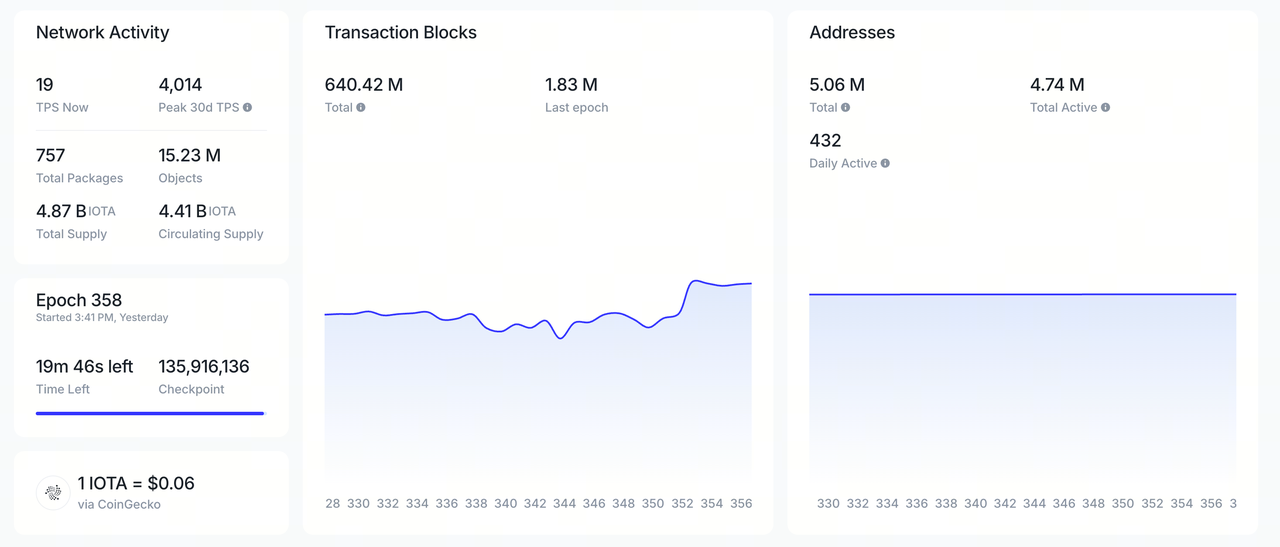 Image source: IOTA Explorer
IOTA's tokenomics are tailored for low-frequency transactions and fee-free requirements among IoT devices. MIOTA tokens are used for transactions and as resources within the network, supporting payments and value transfer between devices.
Key Application Scenarios for IOTA
IOTA technology is widely adopted, especially in IoT, providing robust infrastructure for seamless device connectivity and data transfer. Typical use cases include:
-
Smart Home and Automation: IOTA offers efficient communication protocols for smart home devices, enabling fee-free real-time data transmission and device control.
-
Smart Cities: IOTA facilitates efficient data exchange and collaboration across city infrastructure, traffic management, and utilities, advancing urban intelligence.
-
Automotive Industry: IOTA is integrated into autonomous vehicles and V2X technology, delivering real-time data exchange between vehicles and infrastructure.
-
Supply Chain Management: IOTA's fee-free, efficient data flow is ideal for complex supply chains, improving transparency and tracking.
-
Energy Markets: In distributed energy management and electricity trading, IOTA provides a decentralized platform for transactions between energy suppliers and consumers.
-
Digital Assets and Micropayments: IOTA supports fee-free micropayments, making it suitable for digital currency, tokens, and other decentralized application transactions.
These examples highlight IOTA's vast potential across industries, particularly in building decentralized, high-performance smart ecosystems.
IOTA vs IoTeX: Decentralized IoT Infrastructure Comparison
IOTA and IoTeX are decentralized infrastructure projects for IoT, addressing security, privacy, and efficiency challenges between devices.
IOTA uses Tangle for efficient, fee-free transactions, while IoTeX employs hybrid consensus and privacy-protection technologies to create a flexible, scalable IoT ecosystem.
| Feature |
IOTA |
IoTeX |
| Core Architecture |
Tangle (DAG-based) |
Hybrid Consensus Mechanism (PoS + PoA) |
| Consensus Mechanism |
Fast Probabilistic Consensus (FPC), no miners |
Hybrid Consensus: Proof of Stake (PoS) and Proof of Authority (PoA) |
| Trading Fee |
Fee-free transactions |
Supports low trading fees, privacy-focused |
| Scalability |
Highly scalable, performance improves with node count |
Highly scalable, supports large-scale IoT applications |
| Decentralization |
Fully decentralized, Coordinator (IOTA Coo) removed |
Partially decentralized, relies on validator nodes |
| Application Scenarios |
IoT device data exchange, high-frequency transactions, smart cities, supply chain management |
Diverse IoT devices, health management, smart home, wearables |
| IoT Support |
High-frequency, low-cost, device-to-device micropayments |
Privacy protection, efficient communication, broader device and use case support |
Limitations and Risks of IOTA
Despite IOTA's strong potential in IoT, it faces certain limitations and risks. The reliance on Fast Probabilistic Consensus can lead to node instability. While Coordicide enhances security, it also increases system complexity and implementation risk.
IOTA may encounter challenges in high-frequency, large-scale enterprise deployments, particularly concerning system stability and scalability.
Summary
IOTA is a pioneering decentralized technology with extensive prospects in IoT. Its distinctive Tangle architecture and decentralized consensus mechanism deliver low-cost, high-efficiency transaction solutions for IoT devices. The rollout of IOTA 2.0 will further strengthen security and scalability. Nonetheless, IOTA must continuously refine its architecture to meet evolving technical and market demands.
FAQs
How Is IOTA Used in IoT?
IOTA enables seamless data transmission and payments for IoT devices. For example, smart home devices can interact via the IOTA network, exchanging sensor data and automating transactions through micropayments. Its low latency and fee-free structure make IOTA particularly advantageous in IoT environments.
How Does IOTA Ensure Security?
IOTA utilizes a Tangle-based consensus mechanism, where each transaction validates the previous one, ensuring security. Cryptographic algorithms protect transaction data confidentiality and integrity. IOTA also implements safeguards against 51% attacks and maintains decentralization and scalability.
How Does IOTA Address Payments Between IoT Devices?
IOTA's micropayment feature allows IoT devices to transact directly, bypassing traditional financial institutions. For instance, an autonomous vehicle can pay a charging station for electricity using IOTA, or smart home devices can automatically pay for services based on user needs. Zero trading fees make these micropayments viable.
Does IOTA Support Smart Contracts?
Yes, IOTA is developing Smart Contract functionality (IOTA Smart Contracts). This will enable users to deploy and execute Smart Contracts on the IOTA network, expanding its use cases—especially for automated, self-executing contracts in IoT scenarios.