In the traditional digital advertising model, ad budgets are usually distributed by centralized advertising platforms. After advertisers pay, the platform handles ad delivery and traffic distribution, but most of the revenue is captured by the platform. Users and content creators, who actually contribute attention value, often receive little or no corresponding return. This revenue structure has kept the advertising ecosystem in a long term state of uneven value distribution.
Beyond revenue distribution, traditional advertising models also face challenges such as excessive collection of user privacy data, ad fraud, and low delivery efficiency. As users increasingly demand stronger privacy protection and fairer revenue mechanisms, the digital advertising industry has begun exploring more transparent and efficient ways to distribute value. The BAT reward mechanism is one of the most important examples of this shift.
What Is the Basic Principle Behind the BAT Reward Mechanism?
Within the Brave browser ecosystem, the BAT reward mechanism plays a central role in the flow of advertising value. Advertisers purchase ad services to gain user attention, while BAT serves as the settlement medium that distributes ad budgets to users and content creators, creating a complete incentive loop.
The core logic of the BAT reward mechanism is simple: advertisers pay for ads, users earn rewards by viewing those ads, and content creators receive income through user interaction. BAT acts as the medium of value exchange throughout this process, allowing advertising revenue to move transparently among multiple participants.
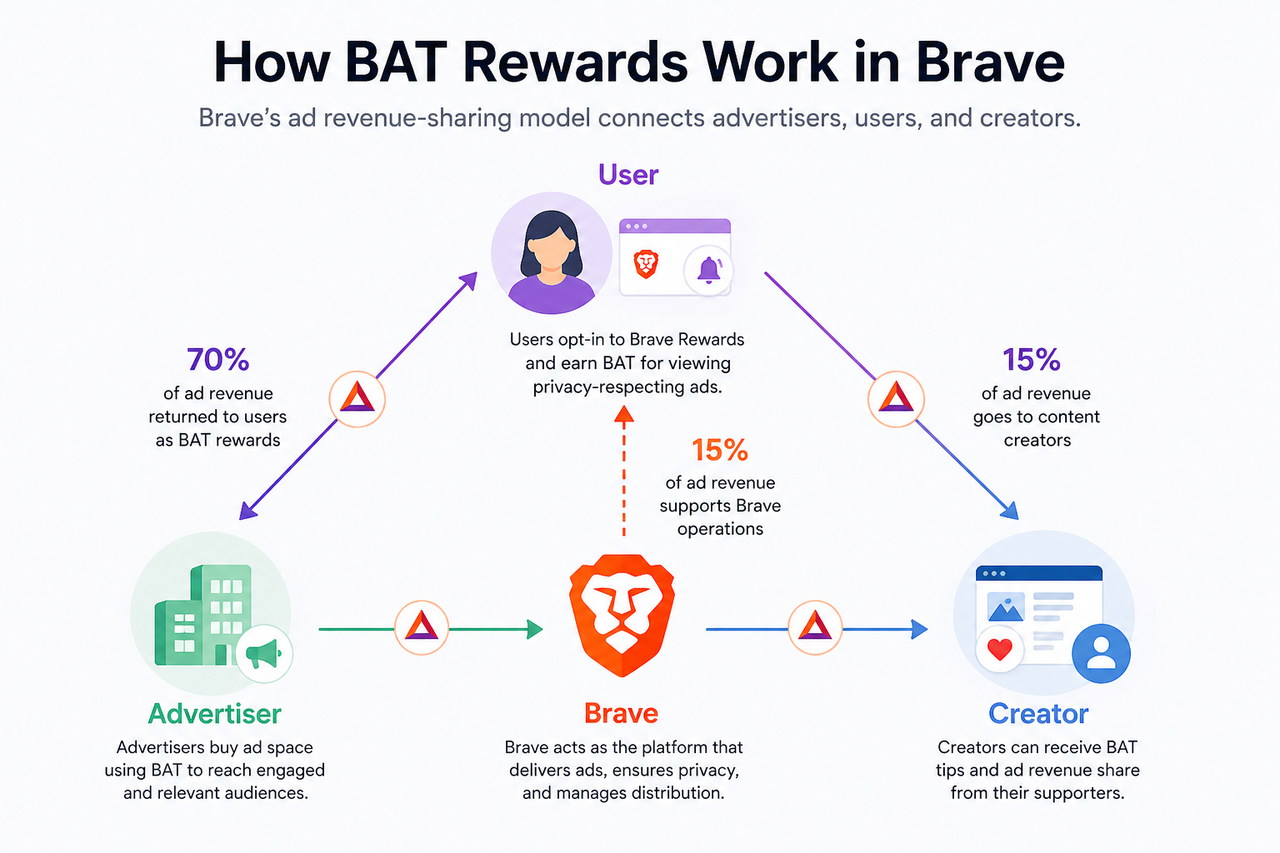
Brave browser displays ads to users through a local ad matching system, and users can choose whether to receive ads. After a user views an ad, part of the BAT paid by the advertiser is distributed to the user, while another portion is used to reward content creators and support platform operations. This model allows advertising value to reach the entire chain of ecosystem participants.
How Do Advertisers Participate in the BAT Reward Mechanism?
Advertisers are the value input side of the BAT reward mechanism. When companies purchase advertising services on the Brave Ads platform, they allocate BAT as their ad budget. Advertisers can set ad delivery strategies based on their target audience, while Brave matches ads according to users’ local browsing behavior.
Unlike traditional advertising platforms, Brave does not rely on large scale centralized data collection. Instead, it uses local algorithms to match ads, improving privacy protection. The BAT paid by advertisers is distributed based on ad impressions and interactions, helping ensure that ad budgets flow into an ecosystem of real users and creators.
How Do Users Earn BAT Through Brave Ads?
Users can participate in the BAT reward mechanism by enabling Brave Rewards. Once enabled, the browser sends users ad notifications that match their interests, and users can earn BAT rewards after viewing those ads. Ads are usually shown as notifications or new tab page ads, so they do not interfere with normal browsing.
This mechanism turns user attention into measurable value. Unlike traditional advertising models, where users contribute browsing behavior without compensation, Brave allows users to directly share in advertising revenue, making “earning income by viewing ads” part of the digital advertising ecosystem.
How Do Content Creators Earn BAT Revenue?
In addition to user rewards, the BAT reward mechanism also covers content creators. Website publishers, video creators, and others can register as Brave Verified Creators to receive BAT tips or ad revenue shares. Users may allocate the BAT rewards they earn to the content creators they support.
This model gives content creators more diversified revenue sources, rather than forcing them to rely entirely on platform based ad sharing systems. Creators can receive BAT directly through user support, reducing their dependence on centralized platform revenue models.
How Does the BAT Reward Mechanism Improve Ad Revenue Distribution?
The BAT reward mechanism uses token distribution to reallocate advertising revenue among advertisers, users, and creators. Ad budgets are no longer concentrated mainly on the platform. Instead, they are distributed according to user attention contribution and content value. This makes advertising value distribution more transparent and increases participant engagement.
For advertisers, this mechanism reduces the loss of ad budgets through intermediary layers. For users and creators, it allows them to earn directly from advertising activity, creating a fairer model for the flow of value.
What Are the Advantages of the BAT Reward Mechanism?
The first major advantage of the BAT reward mechanism is transparent revenue distribution. The flow of ad budget value becomes clearer, users and creators can receive direct returns, and the problem of value concentration in traditional advertising models is reduced.
The second advantage is privacy protection. Brave browser reduces user data uploads through local ad matching, avoiding the centralized collection of user behavior data common among traditional advertising platforms. The mechanism also improves ad efficiency by allowing ad budgets to reach users more precisely.
What Limitations Does the BAT Reward Mechanism Face?
Although the BAT reward mechanism improves the way ad revenue is distributed, its effectiveness depends heavily on the scale of the Brave browser ecosystem. When the user base is limited, advertiser demand is also constrained, which can affect BAT circulation efficiency and reward levels.
In addition, compared with traditional advertising platforms, Brave’s advertising network still has a smaller market reach. Whether the BAT reward mechanism can expand its influence depends on the growth rate of the Brave ecosystem and advertisers’ acceptance of Web3 advertising models.
Conclusion
The BAT reward mechanism builds a more transparent and fair digital advertising value flow system by redistributing ad revenue among advertisers, users, and content creators. Users earn BAT rewards by viewing ads, creators receive income through user support, and advertisers can reach target audiences more efficiently.
This mechanism not only improves the efficiency of ad revenue distribution, but also demonstrates the application potential of Web3 in the digital advertising industry. Although the development of the BAT reward mechanism is still limited by the scale of the Brave ecosystem, its “attention as value” model offers a new direction for digital advertising innovation.
FAQs
What is the core purpose of the BAT reward mechanism?
The core purpose of the BAT reward mechanism is to redistribute advertising revenue, allowing part of the budget paid by advertisers to go to users and content creators.
How do users earn BAT rewards?
After enabling Brave Rewards, users can earn BAT rewards by viewing ads in the Brave browser.
Why do advertisers use BAT for advertising?
Advertisers use BAT for advertising because it can improve ad budget transparency and enable targeted ad delivery while protecting user privacy.
How do content creators participate in BAT revenue distribution?
Content creators can register as Brave Verified Creators and earn BAT through user tips and ad revenue sharing.
How is the BAT reward mechanism different from traditional ad revenue models?
Traditional ad revenue is mainly concentrated on platforms, while the BAT reward mechanism distributes ad revenue among users, creators, and the platform, creating a fairer flow of value.