2025 MANTA Price Prediction: Expert Analysis and Market Forecast for the Coming Year

Introduction: Market Position and Investment Value of MANTA
Manta Network (MANTA) stands as the modular blockchain for zero-knowledge (ZK) applications, establishing itself as a critical infrastructure layer in the Web3 ecosystem since its launch in January 2024. As of December 2025, MANTA has achieved a market capitalization of approximately $72.36 million, with a circulating supply of around 453.65 million tokens trading at $0.07236 per unit. This innovative asset, recognized as a "ZK-as-a-Service pioneer," is increasingly playing a vital role in enabling low-cost, high-performance blockchain applications across the decentralized finance and Web3 sectors.
This comprehensive analysis will examine MANTA's price trajectory from 2025 through 2030, integrating historical performance patterns, market supply-demand dynamics, ecosystem development, and macroeconomic factors to deliver professional price forecasts and practical investment strategies for discerning investors.
Manta Network (MANTA) Market Analysis Report
I. MANTA Price History Review and Current Market Status
MANTA Historical Price Movement Trajectory
-
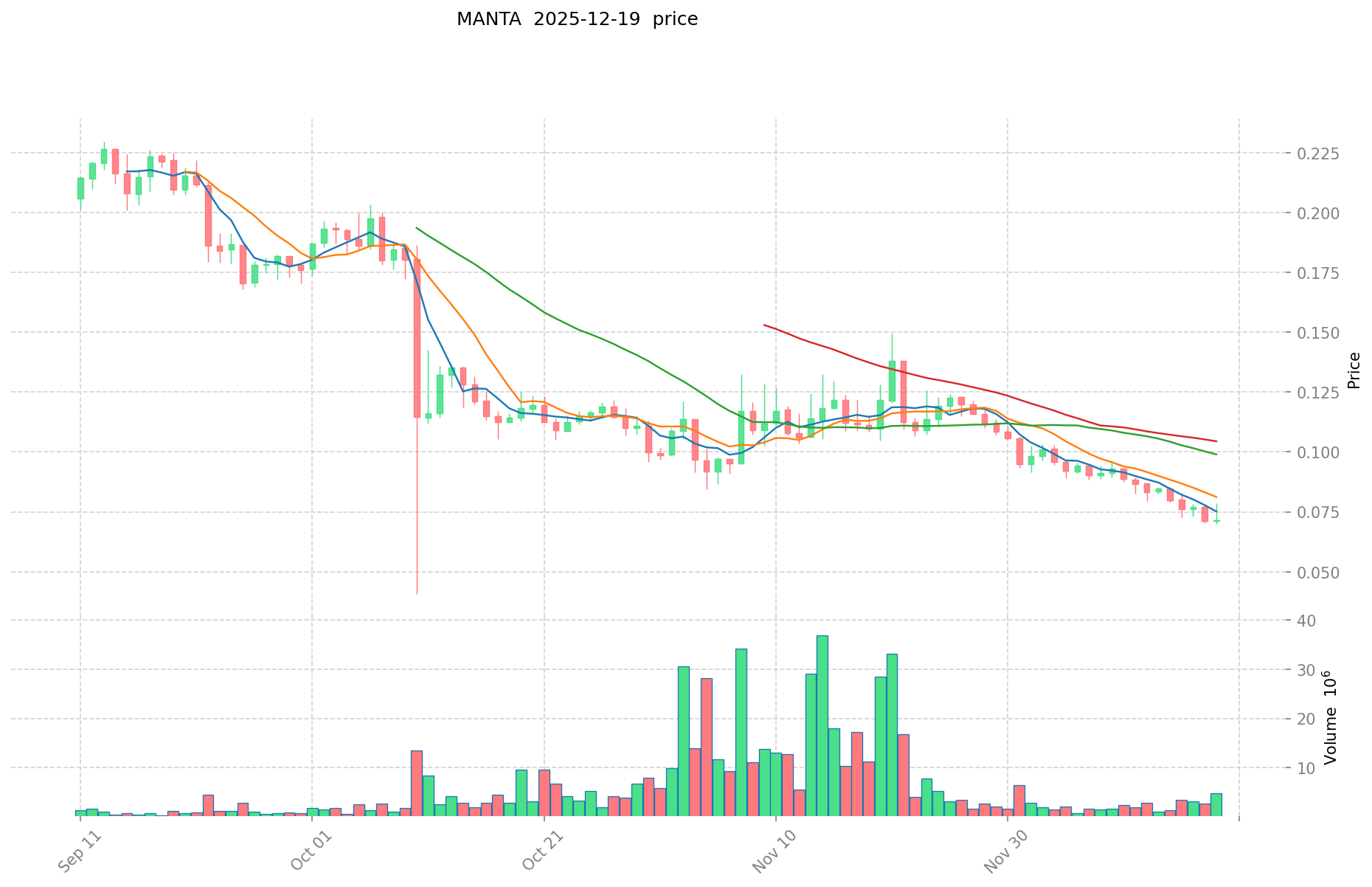
January 2024: MANTA reached its all-time high (ATH) of $10.4405 on January 18, 2024, marking the peak of the token's valuation since launch.
-
2024-2025: Following the ATH, MANTA entered a significant downtrend, experiencing substantial price depreciation throughout the year.
-
October 2025: MANTA hit its all-time low (ATL) of $0.0405 on October 10, 2025, representing a decline of approximately 99.61% from its peak value.
MANTA Current Market Stance
As of December 19, 2025, MANTA is trading at $0.07236, with a 24-hour trading volume of $365,481.35. The token has demonstrated modest short-term recovery, gaining 1.78% over the past 24 hours and 2.02% in the last hour, suggesting limited bullish momentum.
The current market capitalization stands at approximately $32.83 million, with a fully diluted valuation (FDV) of $72.36 million. MANTA maintains a circulating supply of 453.65 million tokens out of a total supply of 1 billion tokens, representing a circulation ratio of 45.37%.
Price performance metrics reveal continued bearish pressure across longer timeframes: the token has declined 16.05% over the past 7 days, 32.66% over the past 30 days, and 92.04% over the past year. The 24-hour trading range shows a low of $0.06939 and a high of $0.07865, indicating limited volatility in the current session.
From a market position perspective, MANTA ranks 655th by market capitalization, with a dominance ratio of 0.0022% in the broader cryptocurrency market. The token is listed on 31 exchanges, facilitating reasonable liquidity for trading activities.
Click to view current MANTA market price
MANTA Market Sentiment Indicator
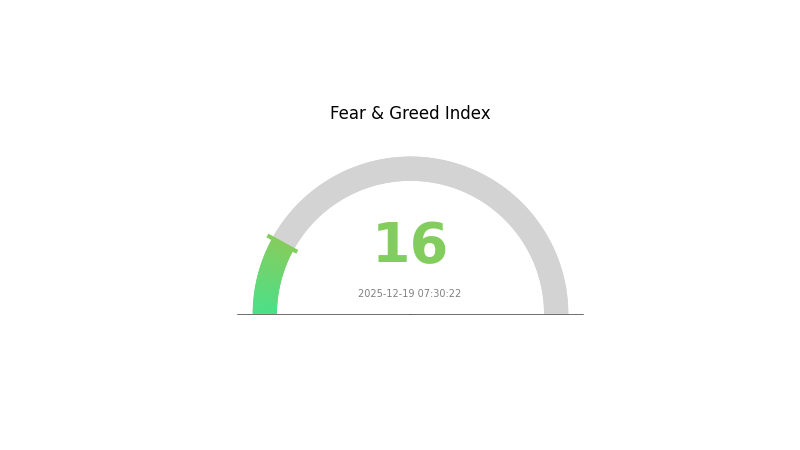
2025-12-19 Fear and Greed Index: 16 (Extreme Fear)
Click to view current Fear & Greed Index
The MANTA market is currently experiencing extreme fear, with the Fear and Greed Index dropping to 16. This indicates significant negative sentiment among investors, reflecting heightened market anxiety and risk aversion. During such periods of extreme fear, markets often present contrarian opportunities for long-term investors. However, caution is warranted as further downside risks may persist. Monitor key support levels closely and consider dollar-cost averaging strategies to mitigate volatility impact on your portfolio.
MANTA Holdings Distribution
Click to view current MANTA holdings distribution
The address holdings distribution chart provides a comprehensive view of how MANTA tokens are dispersed across the network's wallet addresses. This metric serves as a critical indicator of token concentration, revealing the degree to which ownership is distributed among participants. By analyzing the top addresses and their respective holdings percentages, analysts can assess the decentralization level of the protocol, identify potential whale accumulation patterns, and evaluate the overall health of the token's market microstructure.
Currently, the MANTA token distribution data reveals limited large-scale holder concentration at the top tier. The absence of dominant whale positions suggests a relatively balanced ownership structure, which reduces the immediate risk of coordinated sell-offs or price manipulation by individual actors. This distributional pattern indicates that MANTA has achieved a reasonable degree of decentralization in its holder base, with token ownership spread across a broader pool of participants rather than concentrated in a small number of addresses.
The current address distribution architecture demonstrates favorable characteristics for market stability and resilience. With holdings dispersed across multiple addresses without excessive concentration, the token exhibits lower vulnerability to sudden liquidity shocks or orchestrated market movements. This structural balance supports a more resilient on-chain ecosystem and suggests that price discovery mechanisms operate with reduced interference from large concentrated positions. The distribution pattern reflects a maturing token economy where individual holders maintain proportionally modest stakes, thereby reinforcing the decentralized nature of the network's governance and market participation.

| Top | Address | Holding Qty | Holding (%) |
|---|
II. Core Factors Affecting MANTA's Future Price
Supply Mechanism
-
Limited Token Supply: Manta Network features a constrained supply model, where limited supply combined with increasing demand typically drives price appreciation. Conversely, excessive supply or declining demand exerts downward pressure on the token's value.
-
Current Impact: As demand for privacy-enhanced and scalable decentralized applications grows, the supply constraints position MANTA to potentially benefit from positive price momentum in bullish market cycles.
Community Strength and Market Sentiment
-
Community Scale: Manta Network demonstrates strong market performance with community users exceeding one million across various platforms, positioning it among the leading Layer 2 solutions. This substantial community foundation serves as an important catalyst for driving upward price momentum.
-
Investor Sentiment: Market sentiment and investor psychology play crucial roles in price movements. Post-launch price dynamics are significantly influenced by market supply-demand conditions and overall investor confidence in the project.
Ecosystem Development
-
Privacy and Scalability Enhancement: Manta Network's core design architecture emphasizes enhanced privacy protection and scalability features, serving as foundational infrastructure for decentralized applications. The development of this privacy-focused ecosystem creates inherent value proposition for the MANTA token.
-
Ecosystem Construction: The token's core value derives from building a decentralized privacy-protection ecosystem. Continued ecosystem development and adoption of privacy-enhanced applications directly support long-term price sustainability.
III. MANTA Price Forecast for 2025-2030
2025 Outlook
- Conservative Forecast: $0.0506 - $0.0723
- Neutral Forecast: $0.0723
- Bullish Forecast: $0.07592 (requires sustained ecosystem development and market adoption)
2026-2028 Mid-term Outlook
- Market Stage Expectation: Gradual accumulation phase with incremental adoption of Manta Network's privacy-focused solutions and expansion of DeFi applications
- Price Range Forecast:
- 2026: $0.04743 - $0.09634
- 2027: $0.08181 - $0.09715
- 2028: $0.06839 - $0.10943
- Key Catalysts: Protocol upgrades, institutional adoption of privacy infrastructure, integration with major platforms, and expansion of cross-chain compatibility
2029-2030 Long-term Outlook
- Base Case Scenario: $0.07423 - $0.14043 (assumes moderate mainstream adoption of privacy technologies and steady ecosystem growth)
- Bullish Scenario: $0.10031 - $0.14043 (assumes accelerated institutional investment and regulatory clarity favoring privacy solutions)
- Transformational Scenario: $0.12759+ (assumes Manta Network becomes industry standard for privacy-preserving DeFi and Web3 applications)
- 2030-12-19: MANTA at $0.12759 (represents peak valuation potential under favorable market conditions)
| 年份 | 预测最高价 | 预测平均价格 | 预测最低价 | 涨跌幅 |
|---|---|---|---|---|
| 2025 | 0.07592 | 0.0723 | 0.05061 | 0 |
| 2026 | 0.09634 | 0.07411 | 0.04743 | 2 |
| 2027 | 0.09715 | 0.08522 | 0.08181 | 17 |
| 2028 | 0.10943 | 0.09119 | 0.06839 | 26 |
| 2029 | 0.14043 | 0.10031 | 0.07423 | 38 |
| 2030 | 0.12759 | 0.12037 | 0.0963 | 66 |
Manta Network (MANTA) Professional Investment Strategy and Risk Management Report
I. Executive Summary
Manta Network is a modular blockchain designed for zero-knowledge (ZK) applications. As of December 19, 2025, MANTA is trading at $0.07236, with a market capitalization of $32.83 million and a circulating supply of 453.65 million tokens. The token has experienced significant volatility, with a year-to-date decline of 92.04%, reflecting broader market pressures and project execution challenges.
Key Metrics:
- Current Price: $0.07236
- 24H Change: +1.78%
- 7D Change: -16.05%
- Market Cap: $32.83M
- All-Time High: $10.4405 (January 18, 2024)
- All-Time Low: $0.0405 (October 10, 2025)
II. Project Overview and Value Proposition
Technology Foundation
Manta Network operates as a modular Layer 2 ecosystem tailored for EVM-native zero-knowledge applications and dApps. The protocol leverages several key technological components:
Universal Circuits Technology: Manta implements ZK-as-a-Service (ZK-as-a-Service) through its proprietary Universal Circuits framework, enabling developers to integrate zero-knowledge proofs without requiring specialized cryptographic expertise.
Modular Architecture: By integrating Celestia's data availability layer, Manta Pacific achieves significant gas fee reduction while maintaining scalability. This modular design allows the ecosystem to focus computational resources on ZK-specific optimizations rather than consensus mechanisms.
Low Gas Fee Environment: The combination of ZK-as-a-Service and modular data availability creates cost-efficient conditions for privacy-enhanced applications and dApps seeking optimal user experience.
Project Background
Manta Network was established by a team of experienced founders from prestigious institutions including Harvard University, MIT, and Algorand. The project has secured investment from prominent web3 investment firms, including allocations from established venture capital funds. The team has participated in major web3 accelerators, including Alliance DAO and Berkeley Blockchain Xcelerator.
III. Market Position and Competitive Landscape
Current Market Standing
Manta Network ranks 655th in the global cryptocurrency market by market capitalization. With a market dominance of 0.0022%, the project occupies a niche position within the broader blockchain ecosystem, particularly focused on ZK-enabled applications.
Market Metrics:
- Market Cap (Current): $32.83M
- Fully Diluted Valuation: $72.36M
- Circulating Supply Ratio: 45.37%
- 24H Trading Volume: $365,481.35
- Exchange Listings: 31 exchanges
Price Performance Analysis
The token has demonstrated extreme volatility:
| Period | Change | Amount |
|---|---|---|
| 1 Hour | +2.02% | +$0.00143 |
| 24 Hours | +1.78% | +$0.00127 |
| 7 Days | -16.05% | -$0.01383 |
| 30 Days | -32.66% | -$0.03509 |
| 1 Year | -92.04% | -$0.83669 |
The significant year-over-year decline reflects challenges in achieving market adoption and the broader market sentiment affecting emerging Layer 2 solutions.
IV. MANTA Professional Investment Strategy and Risk Management
MANTA Investment Methodology
(1) Long-Term Holding Strategy
Target Investors: Technology-focused investors with high risk tolerance, those believing in ZK technology's future prominence, and investors with extended time horizons (3+ years).
Operational Recommendations:
-
Position Sizing: Allocate only a percentage of your portfolio that you can afford to lose completely. Given the 92% year-to-date decline, this asset should be considered highly speculative.
-
Dollar-Cost Averaging (DCA): Rather than entering at once, consider purchasing MANTA in fixed amounts over extended periods to mitigate timing risk. This approach reduces exposure to short-term price volatility.
-
Storage Solution: For long-term holdings, utilize Gate Web3 Wallet for secure self-custody of MANTA tokens. Ensure private keys are stored securely offline, with backup recovery phrases stored in multiple secure locations. Alternatively, maintain holdings on Gate.com if you prefer exchange custody with enhanced security protocols.
(2) Active Trading Strategy
Technical Analysis Tools:
-
Relative Strength Index (RSI): Monitor RSI levels to identify oversold conditions (below 30) that may present accumulation opportunities, and overbought conditions (above 70) that may indicate exit points. Given MANTA's high volatility, RSI readings require careful interpretation.
-
Moving Average Crossovers: Track 20-day and 50-day moving averages on hourly and daily charts. Crossover signals can indicate momentum shifts, though false signals are common in highly volatile assets.
Wave Action Points:
-
Support Levels: Current support appears near $0.06939 (24-hour low). Additional support exists near the recent low of $0.0405. Traders should avoid buying significantly above these levels without clear technical confirmation.
-
Resistance Identification: Resistance remains substantial above $0.08, with major resistance at $0.10 level representing a critical technical ceiling. Breaking above $0.10 would represent significant bullish confirmation.
MANTA Risk Management Framework
(1) Asset Allocation Principles
Given MANTA's extreme volatility and the 92% year-to-date decline, conventional portfolio allocation models require substantial modifications:
-
Conservative Investors: 0-2% portfolio allocation maximum. Limit any exposure to MANTA to capital that can be entirely lost without affecting financial security.
-
Aggressive Investors: 3-8% portfolio allocation. This level of allocation acknowledges the speculative nature while maintaining portfolio stability. Only employ this allocation if you can tolerate a total loss of the allocated capital.
-
Professional Investors: 5-15% allocation within dedicated venture/emerging technology portfolios. Professional investors with crypto-specialized portfolios may justify higher allocations, though this should never constitute core holdings.
(2) Risk Hedging Strategies
-
Inverse Position Hedging: Establish short positions or put options on MANTA equivalent to 25-50% of long holdings to cap downside exposure. However, this requires accessing derivatives markets and adds complexity.
-
Stablecoin Reserves: Maintain 40-50% of allocated capital in stablecoins (USDT, USDC) rather than immediately deploying all capital. This approach provides dry powder for purchasing opportunities during price declines while protecting against catastrophic loss.
(3) Secure Storage Solutions
-
Hot Wallet Recommendation: Gate Web3 Wallet provides secure custody with multi-signature capabilities for self-managed storage. This solution balances accessibility with security for active traders.
-
Cold Storage Approach: For long-term holdings exceeding 12 months, consider offline storage methods with hardware authentication. Store recovery seeds in geographically diverse, secure locations.
-
Security Precautions: Enable two-factor authentication on all exchange and wallet accounts. Never share private keys or recovery phrases. Verify all addresses before transactions, as phishing remains prevalent in the crypto space. Conduct small test transfers before moving significant amounts.
V. Potential Risks and Challenges
MANTA Market Risks
-
Extreme Volatility: MANTA has experienced a 92% decline over 12 months, indicating extreme price instability. Such volatility can result in rapid liquidation of leveraged positions and severe losses for unprepared investors.
-
Illiquidity Risk: With only 31 exchange listings and modest 24-hour trading volume of $365,481, MANTA demonstrates limited liquidity. Large trades can significantly impact prices, and selling during downturns may prove difficult at acceptable prices.
-
Market Capitalization Decline: The token's market cap has compressed to $32.83M, suggesting reduced institutional confidence. Small market caps are vulnerable to pump-and-dump schemes and manipulation.
MANTA Regulatory Risks
-
Regulatory Uncertainty: Privacy-focused technologies, including zero-knowledge proofs, face increasing regulatory scrutiny globally. Jurisdictions may impose restrictions on ZK applications or their native tokens.
-
Compliance Changes: Regulatory frameworks for Layer 2 solutions and privacy technology continue evolving. Adverse regulatory decisions could dramatically impact protocol viability and token utility.
-
Enforcement Actions: Government agencies worldwide are intensifying cryptocurrency oversight. New enforcement actions targeting privacy technologies could negatively affect MANTA's market position and ecosystem development.
MANTA Technology Risks
-
Adoption Risk: Despite technological sophistication, ZK-as-a-Service adoption remains unproven at scale. Limited developer adoption and user base create network effects risks.
-
Technical Implementation Risk: Complex cryptographic systems like zero-knowledge proofs carry inherent implementation risks. Undiscovered vulnerabilities in the Universal Circuits architecture could compromise protocol security and user funds.
-
Competition Risk: Other Layer 2 solutions and privacy protocols continue advancing, potentially rendering Manta Pacific's technical advantages obsolete. Established competitors with larger capital bases and user bases pose significant competitive threats.
VI. Conclusion and Action Recommendations
MANTA Investment Value Assessment
Manta Network presents a high-risk, speculative investment opportunity focused on emerging zero-knowledge technology infrastructure. The 92% decline from all-time highs suggests significant market skepticism regarding near-term adoption prospects. However, the project's technological foundation and institutional backing provide potential for recovery if ZK applications achieve mainstream adoption.
The modular architecture leveraging Celestia's data availability represents thoughtful technical design, though execution risk remains substantial. The limited market capitalization and liquidity present both opportunity and danger—potential for explosive upside if sentiment shifts, combined with risks of market abandonment if adoption stalls.
MANTA Investment Recommendations
✅ Newcomers: Begin with minimal exposure (1% or less of total portfolio) using dollar-cost averaging over 6-12 months. Focus on understanding the technology before allocating capital. This approach limits potential losses while allowing gradual skill development in analyzing ZK infrastructure projects.
✅ Experienced Investors: Consider 3-5% allocation if you maintain conviction in zero-knowledge technology's long-term importance. Implement technical analysis-driven entry strategies during support level rebounds. Maintain strict stop-losses and position exit targets. Actively monitor regulatory developments affecting privacy technologies.
✅ Institutional Investors: Allocate 5-15% within dedicated emerging technology or venture portfolios only after comprehensive technical and regulatory due diligence. Establish governance protocols for position management and risk monitoring. Document investment thesis and review quarterly against technological progress and regulatory landscape changes.
MANTA Trading Participation Methods
-
Direct Purchase: Acquire MANTA directly through Gate.com, which supports multiple trading pairs and provides the deepest liquidity among major exchanges. Use limit orders to achieve favorable entry prices.
-
Staking/Farming (if available): Participate in potential protocol incentive programs that reward liquidity provision or staking. Verify rewards mechanisms and yields before participation.
-
Dollar-Cost Averaging: Execute small, periodic purchases over extended periods using automated orders on Gate.com. This approach reduces timing risk and provides psychological benefits through gradual position building.
Cryptocurrency investment carries extreme risk. This report does not constitute investment advice. Investors must make decisions based on individual risk tolerance and financial circumstances. We strongly recommend consulting professional financial advisors before committing capital. Never invest more than you can afford to lose entirely.
FAQ
Will manta coin recover?
Manta coin's recovery depends on market conditions and project developments. While it has recently hit new lows, a slow recovery is possible if the project continues to deliver on its roadmap and gains market adoption. However, a quick rebound is unlikely in the near term.
Can mana reach $10?
Based on current market analysis, MANA reaching $10 seems unlikely in the near term. Projections suggest a potential high of around $5.15 by 2030. However, sustained growth in virtual world adoption and ecosystem development could support higher valuations over the long term.
Does Mina crypto have a future?
Yes. Mina is enhancing liquidity through wUSDC bridge integration and recent protocol updates. With growing DeFi adoption and ecosystem development, Mina demonstrates strong potential for future growth and market expansion.
Will Mana reach $20?
MANA reaching $20 is possible but requires substantial market growth and adoption. Currently trading under $1, this would demand significant ecosystem expansion, increased user engagement, and favorable market conditions over time.
Share
Content
Introduction: Market Position and Investment Value of MANTA
I. MANTA Price History Review and Current Market Status
II. Core Factors Affecting MANTA's Future Price
III. MANTA Price Forecast for 2025-2030
I. Executive Summary
II. Project Overview and Value Proposition
III. Market Position and Competitive Landscape
IV. MANTA Professional Investment Strategy and Risk Management
V. Potential Risks and Challenges
VI. Conclusion and Action Recommendations
FAQ
How to Buy Cryptocurrency


Trending Cryptocurrencies



Viction's Whitepaper Logic: Driving 75.6% Growth with Zero-Gas Innovations in 2025
2025 LUMIA Price Prediction: Future Value Analysis and Market Trends for Investors

2025 SPrice Prediction: Analyzing Future Market Trends and Investment Opportunities

2025 LRC Price Prediction: Analyzing Market Trends, Tokenomics and Growth Potential in the Layer 2 Ecosystem

What is LA: The Ultimate Guide to Los Angeles' Culture and Attractions

How Does Sui's On-Chain Data Analysis Reveal Its Growth in 2025?
How Does VTHO Compare to GRT as a Gas Token: Performance, Market Cap, and User Adoption Analysis

Discover the Cross-Chain Prediction Market Platform with Generous Staking Rewards

What is VTHO token: VeChain's dual-token model explained with supply chain use cases

Beginner's Guide to Decentralized Token Swapping Platforms

How to Sell Pi Coin: A Comprehensive Guide for 2025