# VolatileMarketTradingStrategy

8.61K
#CryptoMarketSeesVolatility
Weekend Crypto Survival Blueprint: Mastering Volatility with Precision and Patience
#VolatileMarketTradingStrategy #HarborPlan
The cryptocurrency market never sleeps—but that doesn’t mean every moment is worth trading.
Weekend sessions represent one of the most misunderstood phases in crypto markets. Many traders approach Saturdays and Sundays with the same aggression they apply during high-liquidity weekday sessions. This mismatch in strategy often leads to unnecessary losses, emotional decisions, and broken discipline.
The truth is simple: weekend markets operate
post-image
  • Reward
  • Comment
  • Repost
  • Share
#加密市场行情震荡
Gate Plaza Weekend Session: #VolatileMarketTradingStrategy
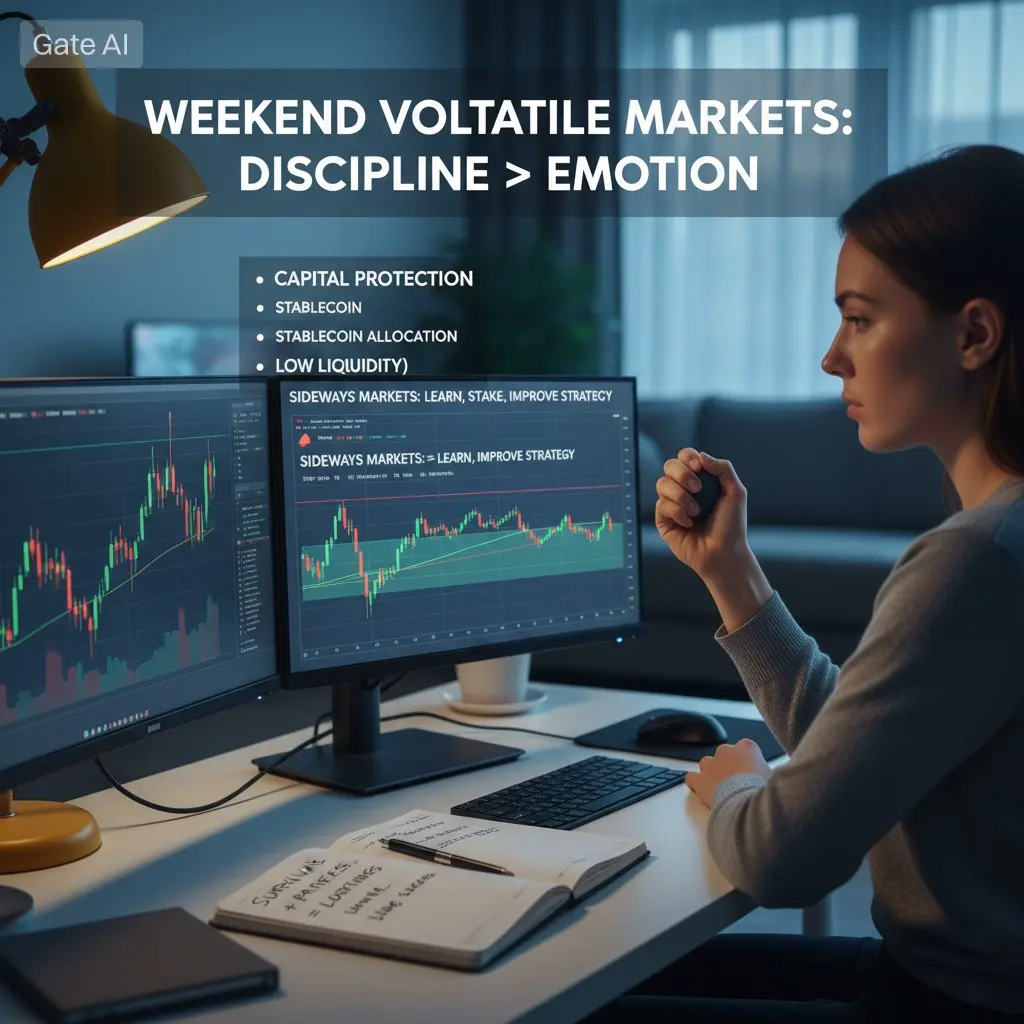
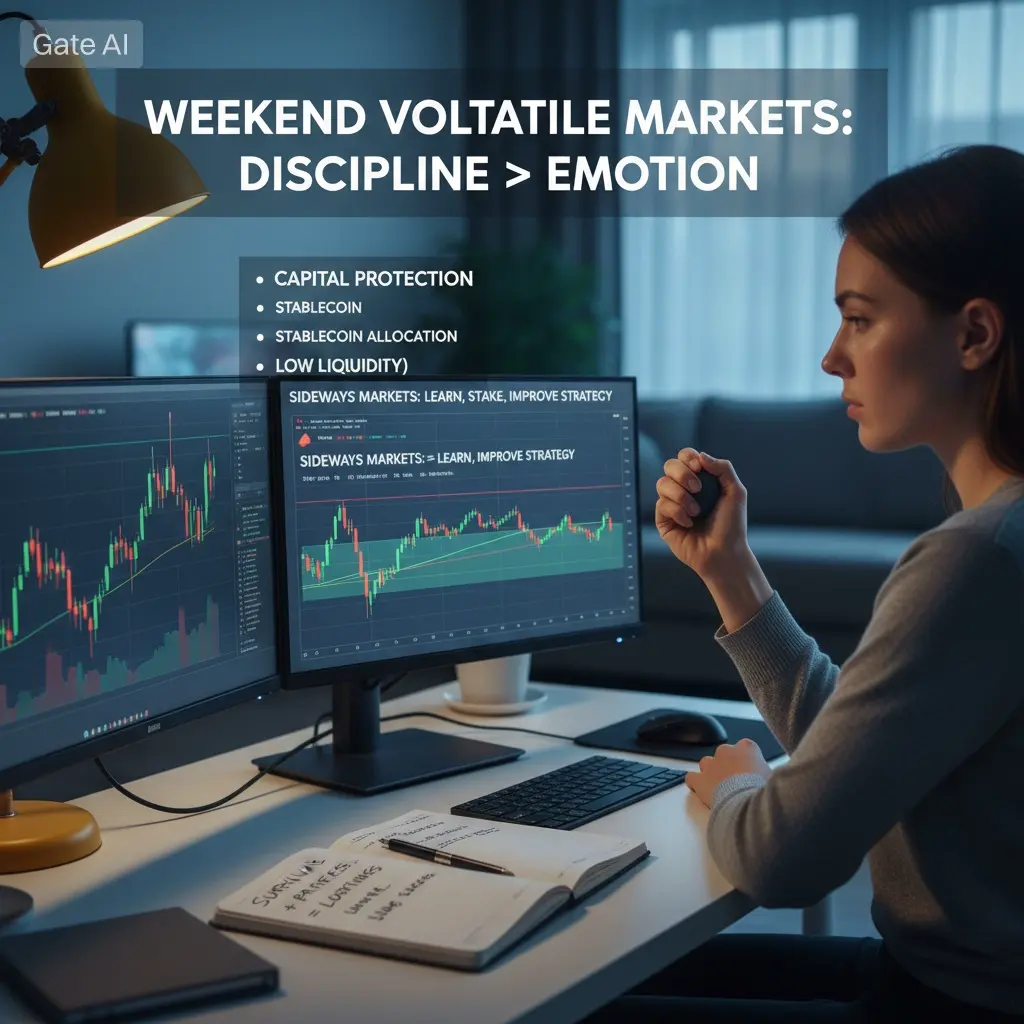
1️⃣ Defense Position During Weekend Volatility
My weekend defense position centers on the "Liquidity Gap Framework." Research shows that weekend crypto markets experience significant liquidity drops as institutional traders exit, leaving retail participants to absorb volatility. My specific defense setup includes:
- Position sizing reduction: I reduce my exposure by 40-50% before Friday market close, keeping only core long-term holds
- Wider stop-loss buffers: Weekend volatility can trigger normal stops prematurely, so I ex
BTC0.56%
ETH1%
Falcon_Official
#加密市场行情震荡
Gate Plaza Weekend Session: #VolatileMarketTradingStrategy
1️⃣ Defense Position During Weekend Volatility
My weekend defense position centers on the "Liquidity Gap Framework." Research shows that weekend crypto markets experience significant liquidity drops as institutional traders exit, leaving retail participants to absorb volatility. My specific defense setup includes:
- Position sizing reduction: I reduce my exposure by 40-50% before Friday market close, keeping only core long-term holds
- Wider stop-loss buffers: Weekend volatility can trigger normal stops prematurely, so I expand my stop ranges by 1.5x normal levels
- Stablecoin reserves: I maintain 30% of portfolio in USDT/USDC to capitalize on weekend dips without needing external transfers
- No new leverage: I avoid opening new leveraged positions from Friday 8 PM to Monday 6 AM UTC, as fragmented liquidity amplifies liquidation cascades
The key insight is that weekend markets are not just "slower" versions of weekday markets they are structurally different with thinner order books and higher execution slippage.
2️⃣ Avoiding Weekend Spikes and Drops
My most valuable lesson came from February 2026, when Bitcoin dropped below critical support during a Sunday evening liquidity vacuum. Since then, I implemented these protective measures:
- Pre-weekend analysis ritual: Every Friday, I identify key support and resistance levels, then set alerts rather than automatic orders. This prevents emotional reactions to weekend noise
- Correlation monitoring: I track BTC-ETH correlation divergence. When correlations break down during weekends, it often signals upcoming volatility
- News embargo discipline: I avoid trading based on weekend social media rumors. Major announcements rarely happen on weekends, so most "breaking news" is speculation
- Range-bound strategy: In sideways conditions, I use grid trading bots with 2-3% spacing rather than directional bets, capturing micro-movements without predicting breakouts
The critical realization: weekend volatility is often mean-reverting. The spike that looks like a trend start is frequently just low-liquidity distortion that corrects Monday morning.
3️⃣ Non-Trading Anxiety Relief Methods
When markets are sideways and my fingers itch to trade, I employ three proven distraction techniques:
- Educational immersion: I use weekend quiet time to study on-chain metrics, protocol documentation, or macroeconomic reports. This transforms anxiety into knowledge accumulation
- Physical exercise protocol: A 45-minute workout before market open resets cortisol levels and reduces impulsive trading urges. Studies show physical activity improves decision-making under uncertainty
- Portfolio audit and rebalancing: Instead of active trading, I conduct weekly portfolio health checks reviewing asset allocations, checking for dust positions to convert, and updating my watchlist for the week ahead
The psychological principle here is "structured disengagement." Creating deliberate non-trading rituals prevents the dopamine-seeking behavior that destroys capital during low-probability conditions.
The Harbor Plan Philosophy
This weekend session's "Harbor Plan" concept resonates deeply. In sailing, harbors exist not because sailors fear the ocean, but because they respect its power. Similarly, weekend risk management isn't about pessimism it's about recognizing when conditions favor survival over expansion.
The traders who survive long-term are not those who capture every move, but those who avoid catastrophic losses during unfavorable conditions. Weekend sideways action is the market's way of testing our patience. Those who pass this test position themselves to capitalize when institutional liquidity returns Monday morning.
Looking forward to learning from fellow traders' experiences this weekend. May your harbors be calm and your preparations thorough.
#VolatileMarketTradingStrategy
repost-content-media
  • Reward
  • 1
  • Repost
  • Share
HighAmbition:
thnxx for the update good 👍
#加密市场行情震荡
Gate Plaza Weekend Session: #VolatileMarketTradingStrategy
1️⃣ Defense Position During Weekend Volatility
My weekend defense position centers on the "Liquidity Gap Framework." Research shows that weekend crypto markets experience significant liquidity drops as institutional traders exit, leaving retail participants to absorb volatility. My specific defense setup includes:
- Position sizing reduction: I reduce my exposure by 40-50% before Friday market close, keeping only core long-term holds
- Wider stop-loss buffers: Weekend volatility can trigger normal stops prematurely, so I ex
BTC0.56%
post-image
post-image
  • Reward
  • 4
  • Repost
  • Share
HighAmbition:
To The Moon 🌕
View More
#VolatileMarketTradingStrategy
Weekend Volatile Market Trading Strategy: The Harbor Plan
Weekend crypto trading is not about chasing opportunities—it is about surviving uncertainty with discipline. Unlike weekdays, where institutional liquidity provides structure and stability, weekends often become a battlefield of reduced volume, unpredictable spikes, and emotional decision-making.
The Harbor Plan is built on a simple principle:
Capital preservation always comes before capital expansion.
It is not designed for aggressive profit hunting, but for controlled survival in unstable conditions, wh
BTC0.56%
ETH1%
HighAmbition
#VolatileMarketTradingStrategy
Weekend Volatile Market Trading Strategy: The Harbor Plan
Weekend crypto trading is not about chasing opportunities—it is about surviving uncertainty with discipline. Unlike weekdays, where institutional liquidity provides structure and stability, weekends often become a battlefield of reduced volume, unpredictable spikes, and emotional decision-making.
The Harbor Plan is built on a simple principle:
Capital preservation always comes before capital expansion.
It is not designed for aggressive profit hunting, but for controlled survival in unstable conditions, where market behavior can shift rapidly without warning.
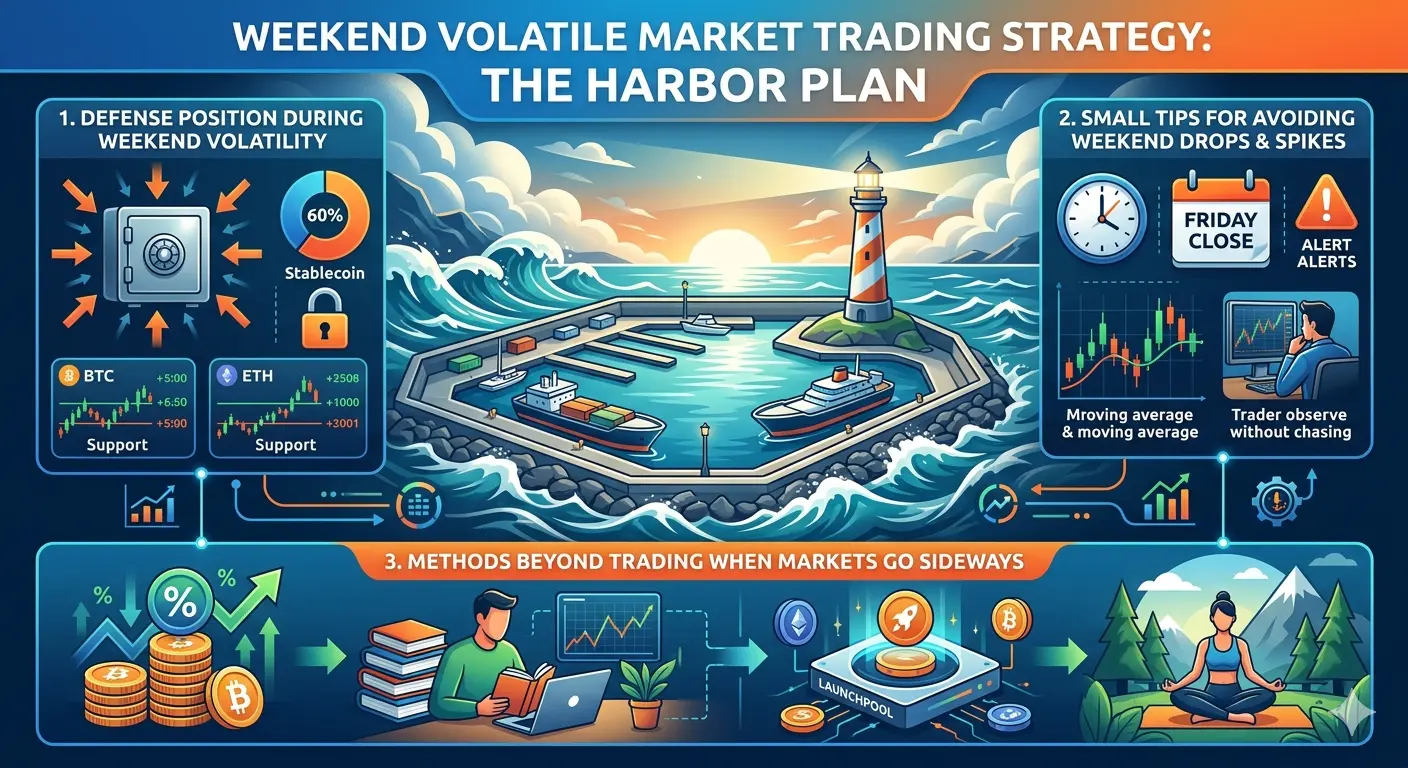
1. Defense Position During Weekend Volatility
My weekend strategy is built on three core pillars: capital protection, adaptive positioning, and controlled exposure.
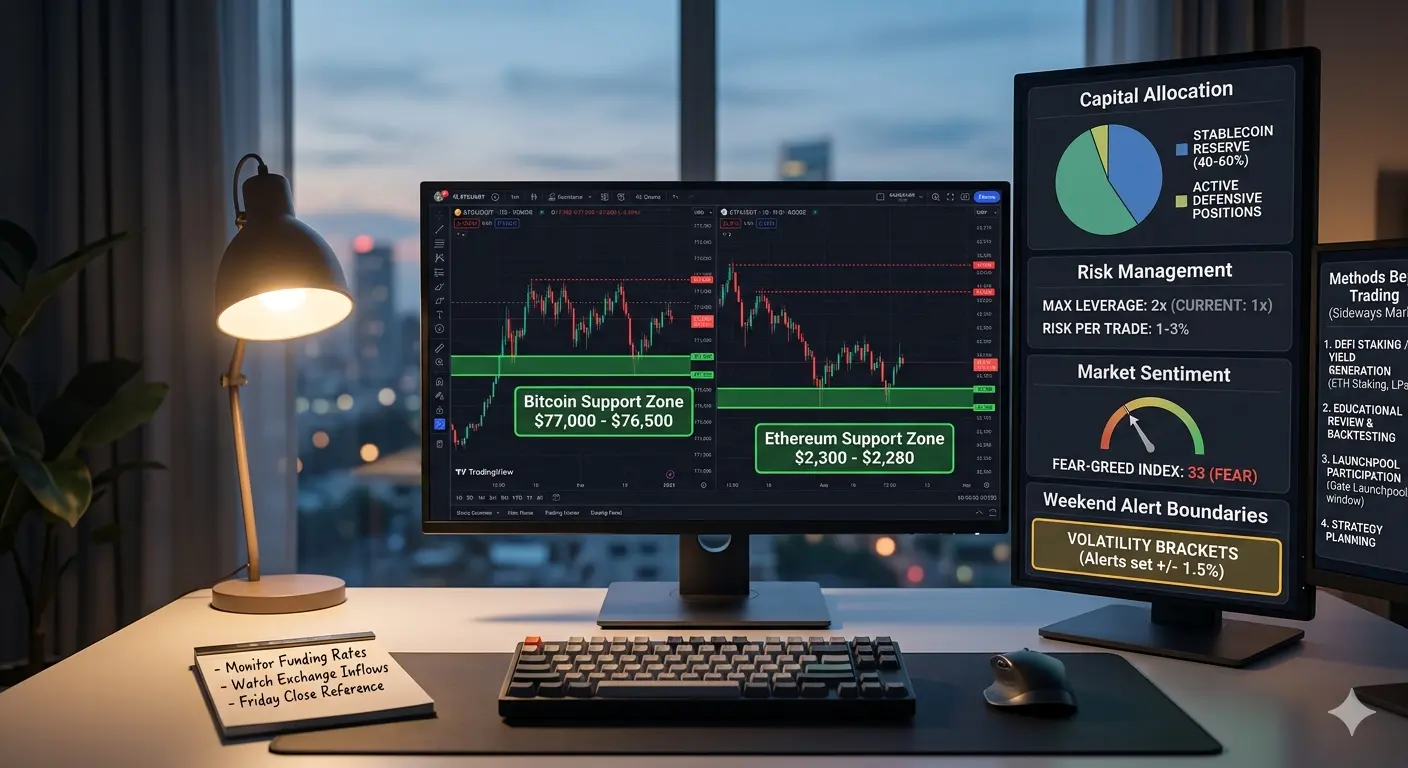
In the current market environment, Bitcoin trades around $77,500 with a relatively tight intraday range, while Ethereum remains near $2,300+ levels, yet these calm-looking ranges often hide sudden volatility expansions that can trigger fast liquidations.
To manage this environment:
I maintain a high stablecoin allocation (40–60%), which serves two purposes:
Psychological stability during uncertain price action
Tactical liquidity for selective opportunities
When market sentiment leans toward fear, having liquidity available becomes more valuable than being fully exposed to price movement.
I also use small, controlled spot positions in major assets like Bitcoin and Ethereum, always backed by strict risk limits. Position sizing is kept extremely conservative—typically no more than 2–3% risk per trade, ensuring that even multiple losses cannot significantly damage overall capital structure.
Leverage is either completely avoided or kept at minimal levels, because weekend liquidity conditions often exaggerate price movements, leading to unpredictable swings that can trap over-leveraged positions very quickly.
On the analytical side, I monitor:
Exchange inflow/outflow behavior
Whale wallet activity
Funding rate shifts in derivatives markets
These metrics help identify early signs of volatility before it becomes visible on price charts.
2. Avoiding Weekend Market Traps
The most important skill in weekend trading is timing discipline combined with liquidity awareness.
Weekend markets behave differently because participation is uneven across global regions, leading to fragmented liquidity cycles. This creates false breakouts and sudden reversals that often trap emotional traders.
One practical approach is analyzing the Friday closing range, which often acts as a psychological boundary for weekend price action. Strong Friday closes tend to stabilize weekend structure, while weak closes often lead to unpredictable movement.
Another effective method is volatility bracketing, where expected price boundaries are calculated using recent market volatility. Instead of reacting emotionally, traders pre-define zones where action is valid—and outside of which, they simply stay inactive.
The most important discipline, however, is avoiding impulse trading during low-liquidity hours, where even small orders can create exaggerated price movement. Many weekend losses come not from wrong analysis—but from poor timing and emotional execution.
Sometimes the best trade is simply no trade at all.
3. What to Do When Markets Go Sideways
Sideways markets are not dead markets—they are preparation zones.
Instead of forcing trades, I shift focus to productivity and system improvement:
A. Yield & Passive Strategies
Capital can be temporarily allocated into staking or yield-generating instruments, allowing assets to remain productive during low volatility phases.
This turns inactive market periods into steady accumulation phases, rather than wasted time.
B. Strategy Development & Review
Sideways conditions are ideal for:
Reviewing past trades
Identifying behavioral mistakes
Backtesting strategies
Improving decision-making systems
This is where long-term trading edge is actually built—not during fast-moving markets.
C. Simulation & Paper Trading
Hypothetical trade tracking helps refine strategy logic without financial pressure. It exposes emotional biases and improves execution discipline over time.
D. Market Observation Without Pressure
Engaging with market data, community discussions, and macro trends helps maintain awareness without overexposure. However, emotional noise must be filtered carefully to avoid crowd-driven decision errors.
E. Mental Reset and Discipline Building
Trading performance is heavily dependent on psychology. Weekend markets provide the perfect opportunity to:
Reduce screen time
Improve physical routine
Reset emotional pressure
Avoid burnout cycles
A disciplined trader is not the one who trades constantly—but the one who knows when not to trade.
Final Conclusion
The Harbor Plan is not a strategy for maximizing every market movement—it is a framework for surviving unpredictable environments while protecting long-term capital structure.
Weekend volatility rewards patience more than aggression, discipline more than prediction, and restraint more than reaction.
In trading, survival is not just part of the game—it is the foundation of every future opportunity.
Because ultimately:
The most powerful position in any volatile market is not the one that makes the most profit—but the one that ensures you are still in the game when the next opportunity arrives.
repost-content-media
  • Reward
  • Comment
  • Repost
  • Share
#CryptoMarketSeesVolatility
🌊 Gate Plaza Weekend Session: #VolatileMarketTradingStrategy — The Harbor Plan
The weekend market doesn't pause — it tests your discipline.
Right now, BTC is hovering around $77,410 with a 24h change of just -0.2%, and ETH sits at $2,312 barely moving (-0.17%). The 24h ranges are painfully tight: BTC between $77,151 and $77,880, ETH between $2,301 and $2,323. This is the classic weekend squeeze — thin liquidity, shallow order books, and a market that seems asleep but can snap awake in seconds.
That's exactly why this weekend's Harbor Plan isn't about chasing moons
post-image
  • Reward
  • 1
  • Repost
  • Share
HighAmbition:
2026 GOGOGO 👊
#VolatileMarketTradingStrategy
Weekend Volatile Market Trading Strategy: The Harbor Plan
Weekend crypto trading is not about chasing opportunities—it is about surviving uncertainty with discipline. Unlike weekdays, where institutional liquidity provides structure and stability, weekends often become a battlefield of reduced volume, unpredictable spikes, and emotional decision-making.
The Harbor Plan is built on a simple principle:
Capital preservation always comes before capital expansion.
It is not designed for aggressive profit hunting, but for controlled survival in unstable conditions, wh
BTC0.56%
ETH1%
HighAmbition
#VolatileMarketTradingStrategy
Weekend Volatile Market Trading Strategy: The Harbor Plan
Weekend crypto trading is not about chasing opportunities—it is about surviving uncertainty with discipline. Unlike weekdays, where institutional liquidity provides structure and stability, weekends often become a battlefield of reduced volume, unpredictable spikes, and emotional decision-making.
The Harbor Plan is built on a simple principle:
Capital preservation always comes before capital expansion.
It is not designed for aggressive profit hunting, but for controlled survival in unstable conditions, where market behavior can shift rapidly without warning.
1. Defense Position During Weekend Volatility
My weekend strategy is built on three core pillars: capital protection, adaptive positioning, and controlled exposure.
In the current market environment, Bitcoin trades around $77,500 with a relatively tight intraday range, while Ethereum remains near $2,300+ levels, yet these calm-looking ranges often hide sudden volatility expansions that can trigger fast liquidations.
To manage this environment:
I maintain a high stablecoin allocation (40–60%), which serves two purposes:
Psychological stability during uncertain price action
Tactical liquidity for selective opportunities
When market sentiment leans toward fear, having liquidity available becomes more valuable than being fully exposed to price movement.
I also use small, controlled spot positions in major assets like Bitcoin and Ethereum, always backed by strict risk limits. Position sizing is kept extremely conservative—typically no more than 2–3% risk per trade, ensuring that even multiple losses cannot significantly damage overall capital structure.
Leverage is either completely avoided or kept at minimal levels, because weekend liquidity conditions often exaggerate price movements, leading to unpredictable swings that can trap over-leveraged positions very quickly.
On the analytical side, I monitor:
Exchange inflow/outflow behavior
Whale wallet activity
Funding rate shifts in derivatives markets
These metrics help identify early signs of volatility before it becomes visible on price charts.
2. Avoiding Weekend Market Traps
The most important skill in weekend trading is timing discipline combined with liquidity awareness.
Weekend markets behave differently because participation is uneven across global regions, leading to fragmented liquidity cycles. This creates false breakouts and sudden reversals that often trap emotional traders.
One practical approach is analyzing the Friday closing range, which often acts as a psychological boundary for weekend price action. Strong Friday closes tend to stabilize weekend structure, while weak closes often lead to unpredictable movement.
Another effective method is volatility bracketing, where expected price boundaries are calculated using recent market volatility. Instead of reacting emotionally, traders pre-define zones where action is valid—and outside of which, they simply stay inactive.
The most important discipline, however, is avoiding impulse trading during low-liquidity hours, where even small orders can create exaggerated price movement. Many weekend losses come not from wrong analysis—but from poor timing and emotional execution.
Sometimes the best trade is simply no trade at all.
3. What to Do When Markets Go Sideways
Sideways markets are not dead markets—they are preparation zones.
Instead of forcing trades, I shift focus to productivity and system improvement:
A. Yield & Passive Strategies
Capital can be temporarily allocated into staking or yield-generating instruments, allowing assets to remain productive during low volatility phases.
This turns inactive market periods into steady accumulation phases, rather than wasted time.
B. Strategy Development & Review
Sideways conditions are ideal for:
Reviewing past trades
Identifying behavioral mistakes
Backtesting strategies
Improving decision-making systems
This is where long-term trading edge is actually built—not during fast-moving markets.
C. Simulation & Paper Trading
Hypothetical trade tracking helps refine strategy logic without financial pressure. It exposes emotional biases and improves execution discipline over time.
D. Market Observation Without Pressure
Engaging with market data, community discussions, and macro trends helps maintain awareness without overexposure. However, emotional noise must be filtered carefully to avoid crowd-driven decision errors.
E. Mental Reset and Discipline Building
Trading performance is heavily dependent on psychology. Weekend markets provide the perfect opportunity to:
Reduce screen time
Improve physical routine
Reset emotional pressure
Avoid burnout cycles
A disciplined trader is not the one who trades constantly—but the one who knows when not to trade.
Final Conclusion
The Harbor Plan is not a strategy for maximizing every market movement—it is a framework for surviving unpredictable environments while protecting long-term capital structure.
Weekend volatility rewards patience more than aggression, discipline more than prediction, and restraint more than reaction.
In trading, survival is not just part of the game—it is the foundation of every future opportunity.
Because ultimately:
The most powerful position in any volatile market is not the one that makes the most profit—but the one that ensures you are still in the game when the next opportunity arrives.
repost-content-media
  • Reward
  • Comment
  • Repost
  • Share
#VolatileMarketTradingStrategy
Weekend Volatile Market Trading Strategy: The Harbor Plan
Weekend crypto trading is not about chasing opportunities—it is about surviving uncertainty with discipline. Unlike weekdays, where institutional liquidity provides structure and stability, weekends often become a battlefield of reduced volume, unpredictable spikes, and emotional decision-making.
The Harbor Plan is built on a simple principle:
Capital preservation always comes before capital expansion.
It is not designed for aggressive profit hunting, but for controlled survival in unstable conditions, wh
BTC0.56%
ETH1%
HighAmbition
#VolatileMarketTradingStrategy
Weekend Volatile Market Trading Strategy: The Harbor Plan
Weekend crypto trading is not about chasing opportunities—it is about surviving uncertainty with discipline. Unlike weekdays, where institutional liquidity provides structure and stability, weekends often become a battlefield of reduced volume, unpredictable spikes, and emotional decision-making.
The Harbor Plan is built on a simple principle:
Capital preservation always comes before capital expansion.
It is not designed for aggressive profit hunting, but for controlled survival in unstable conditions, where market behavior can shift rapidly without warning.
1. Defense Position During Weekend Volatility
My weekend strategy is built on three core pillars: capital protection, adaptive positioning, and controlled exposure.
In the current market environment, Bitcoin trades around $77,500 with a relatively tight intraday range, while Ethereum remains near $2,300+ levels, yet these calm-looking ranges often hide sudden volatility expansions that can trigger fast liquidations.
To manage this environment:
I maintain a high stablecoin allocation (40–60%), which serves two purposes:
Psychological stability during uncertain price action
Tactical liquidity for selective opportunities
When market sentiment leans toward fear, having liquidity available becomes more valuable than being fully exposed to price movement.
I also use small, controlled spot positions in major assets like Bitcoin and Ethereum, always backed by strict risk limits. Position sizing is kept extremely conservative—typically no more than 2–3% risk per trade, ensuring that even multiple losses cannot significantly damage overall capital structure.
Leverage is either completely avoided or kept at minimal levels, because weekend liquidity conditions often exaggerate price movements, leading to unpredictable swings that can trap over-leveraged positions very quickly.
On the analytical side, I monitor:
Exchange inflow/outflow behavior
Whale wallet activity
Funding rate shifts in derivatives markets
These metrics help identify early signs of volatility before it becomes visible on price charts.
2. Avoiding Weekend Market Traps
The most important skill in weekend trading is timing discipline combined with liquidity awareness.
Weekend markets behave differently because participation is uneven across global regions, leading to fragmented liquidity cycles. This creates false breakouts and sudden reversals that often trap emotional traders.
One practical approach is analyzing the Friday closing range, which often acts as a psychological boundary for weekend price action. Strong Friday closes tend to stabilize weekend structure, while weak closes often lead to unpredictable movement.
Another effective method is volatility bracketing, where expected price boundaries are calculated using recent market volatility. Instead of reacting emotionally, traders pre-define zones where action is valid—and outside of which, they simply stay inactive.
The most important discipline, however, is avoiding impulse trading during low-liquidity hours, where even small orders can create exaggerated price movement. Many weekend losses come not from wrong analysis—but from poor timing and emotional execution.
Sometimes the best trade is simply no trade at all.
3. What to Do When Markets Go Sideways
Sideways markets are not dead markets—they are preparation zones.
Instead of forcing trades, I shift focus to productivity and system improvement:
A. Yield & Passive Strategies
Capital can be temporarily allocated into staking or yield-generating instruments, allowing assets to remain productive during low volatility phases.
This turns inactive market periods into steady accumulation phases, rather than wasted time.
B. Strategy Development & Review
Sideways conditions are ideal for:
Reviewing past trades
Identifying behavioral mistakes
Backtesting strategies
Improving decision-making systems
This is where long-term trading edge is actually built—not during fast-moving markets.
C. Simulation & Paper Trading
Hypothetical trade tracking helps refine strategy logic without financial pressure. It exposes emotional biases and improves execution discipline over time.
D. Market Observation Without Pressure
Engaging with market data, community discussions, and macro trends helps maintain awareness without overexposure. However, emotional noise must be filtered carefully to avoid crowd-driven decision errors.
E. Mental Reset and Discipline Building
Trading performance is heavily dependent on psychology. Weekend markets provide the perfect opportunity to:
Reduce screen time
Improve physical routine
Reset emotional pressure
Avoid burnout cycles
A disciplined trader is not the one who trades constantly—but the one who knows when not to trade.
Final Conclusion
The Harbor Plan is not a strategy for maximizing every market movement—it is a framework for surviving unpredictable environments while protecting long-term capital structure.
Weekend volatility rewards patience more than aggression, discipline more than prediction, and restraint more than reaction.
In trading, survival is not just part of the game—it is the foundation of every future opportunity.
Because ultimately:
The most powerful position in any volatile market is not the one that makes the most profit—but the one that ensures you are still in the game when the next opportunity arrives.
repost-content-media
  • Reward
  • Comment
  • Repost
  • Share
#VolatileMarketTradingStrategy
Weekend Volatile Market Trading Strategy: The Harbor Plan
Weekend crypto trading is not about chasing opportunities—it is about surviving uncertainty with discipline. Unlike weekdays, where institutional liquidity provides structure and stability, weekends often become a battlefield of reduced volume, unpredictable spikes, and emotional decision-making.
The Harbor Plan is built on a simple principle:
Capital preservation always comes before capital expansion.
It is not designed for aggressive profit hunting, but for controlled survival in unstable conditions, wh
BTC0.56%
ETH1%
post-image
post-image
post-image
post-image
  • Reward
  • 12
  • Repost
  • Share
GateUser-68291371:
Jump in 🚀
View More
✨ Surviving in Volatile Markets: Strategy is the Game Itself
✨ Periods when the market is directionless and sharp up-and-down movements become frequent are the most challenging testing grounds for traders. #VolatileMarketTradingStrategy and #TradingStrategiesInChoppyMarkets require understanding these kinds of environments correctly.
✨ In these "choppy" markets, classic trend following is often misleading. Instead, shorter-term, disciplined, and reaction-based strategies come to the forefront.
✨ The main assets I follow
🔹Bitcoin
🔹Ethereum
🔹XRP
🔹Solana
🔹Chainlink
🔹GT
exhibit different b
BTC0.56%
ETH1%
SOL0.18%
post-image
  • Reward
  • 8
  • Repost
  • Share
HighAmbition:
good 👍
View More
✨ Surviving in Volatile Markets: Strategy is the Game Itself
✨ Periods when the market is directionless and sharp up-and-down movements become frequent are the most challenging testing grounds for traders. #VolatileMarketTradingStrategy and #TradingStrategiesInChoppyMarkets require understanding these kinds of environments correctly.
✨ In these "choppy" markets, classic trend following is often misleading. Instead, shorter-term, disciplined, and reaction-based strategies come to the forefront.
✨ The main assets I follow
🔹Bitcoin
🔹Ethereum
🔹XRP
🔹Solana
🔹Chainlink
🔹GT
exhibit different b
BTC0.56%
ETH1%
SOL0.18%
User_any
✨ Surviving in Volatile Markets: Strategy is the Game Itself
✨ Periods when the market is directionless and sharp up-and-down movements become frequent are the most challenging testing grounds for traders. #VolatileMarketTradingStrategy and #TradingStrategiesInChoppyMarkets require understanding these kinds of environments correctly.
✨ In these "choppy" markets, classic trend following is often misleading. Instead, shorter-term, disciplined, and reaction-based strategies come to the forefront.
✨ The main assets I follow
🔹Bitcoin
🔹Ethereum
🔹XRP
🔹Solana
🔹Chainlink
🔹GT
exhibit different behavioral patterns in these markets.
✨ For example, BTC and ETH are generally direction-setting, while assets like SOL and LINK tend to amplify volatility. XRP, on the other hand, can often show sudden and independent movements based on news flow.
✨ The fundamental approach that can be applied in this environment is: range trading. Clear support and resistance levels are determined, and the buy-sell cycle is repeated as long as the price remains within this range.
✨ Another critical strategy: position reduction and leverage control. In volatile markets, smaller, more flexible entries instead of large positions are crucial for protecting capital.
✨ Monitoring liquidity flow is also important. Sudden increases in volume often produce fake breakouts. Therefore, taking aggressive positions without confirmation of a breakout is risky.
✨ Alternatively, portfolio diversification provides balance. Gold-based assets like PAX Gold and silver-based XAG/USDT pairs can stand out as hedging tools during risky periods.
✨ These types of assets can reduce portfolio volatility by behaving more stably against crypto volatility.
✨ The most critical point is psychology: In choppy markets, the biggest losses come from overtrading and impatience. Not every move needs to be traded.
✨ For a disciplined trader, these markets are an opportunity, not chaos — but only with proper risk management.
✨ In conclusion: In environments where the trend is unclear, the winners are not those who predict direction, but those who manage risk.
#Gate广场 #创作者狂欢 #内容挖矿
repost-content-media
  • Reward
  • 12
  • Repost
  • Share
ShainingMoon:
To The Moon 🌕
View More
Load More