wrapped eth

Ethereum is a decentralized, open-source blockchain platform with Ether (ETH) as its native asset. ETH is used to pay for gas fees and to help secure the network. Ethereum enables code to execute automatically on-chain through smart contracts, supporting a wide range of decentralized applications (DApps), including decentralized finance (DeFi), non-fungible tokens (NFTs), and decentralized autonomous organizations (DAOs). It provides the essential infrastructure for digital asset issuance, settlement, and collaboration.
Abstract
1.
Positioning: Ethereum is a leading smart contract platform positioned as the "world computer." Beyond supporting cryptocurrencies, it enables decentralized applications (DApps) and smart contracts, serving as the foundational infrastructure for DeFi, NFT, and Web3 ecosystems.
2.
Mechanism: Ethereum uses PoS (Proof of Stake) consensus mechanism. Validators stake ETH to earn the right to package transactions and validate blocks, with rewards automatically distributed based on staking amount and performance. PoS is more energy-efficient than PoW mining with lower participation barriers.
3.
Supply: Ethereum has no fixed maximum supply and can theoretically be minted indefinitely. Current circulating supply is approximately 120.7 million ETH. The EIP-1559 mechanism burns base fees from transactions, partially offsetting inflation. Validator staking rewards are the primary source of new supply.
4.
Cost & Speed: Transaction Speed: Relatively fast. Average block time on Ethereum mainnet is approximately 12 seconds, with single transactions confirmed within seconds to minutes. Transaction Fees: Depend on network congestion; can be expensive during peak hours and cheaper during low-traffic periods. Users can achieve faster and cheaper transactions via Layer 2 solutions (e.g., Arbitrum, Optimism).
5.
Ecosystem Highlights: Wallet Ecosystem: MetaMask (most popular), Ledger, Trezor, and other hardware wallets. Representative Applications: Uniswap (DEX), Aave (lending), OpenSea (NFT marketplace), MakerDAO (stablecoin), etc. Scaling Solutions: Layer 2 solutions like Arbitrum and Optimism significantly reduce fees; cross-chain bridges such as Stargate and Across. Ethereum has the largest number of ecosystem applications globally and is the primary hub for Web3 innovation.
6.
Risk Warning: Price Volatility: As a major cryptocurrency, ETH exhibits significant price fluctuations; investment requires caution. Smart Contract Risk: DApps may contain code vulnerabilities or face attacks, potentially resulting in user fund losses. Network Congestion Risk: Transaction fees spike during peak periods, degrading user experience. Regulatory Risk: Global regulatory policies on cryptocurrencies continue to evolve and may impact ETH usage and value. Technical Risk: While Ethereum technology is mature, unknown security vulnerabilities may exist.
wrapped eth

What Is Ethereum?

Ethereum is an open-source, decentralized blockchain platform that enables developers to deploy smart contracts—self-executing code that runs automatically based on preset conditions—directly on-chain. Ether (ETH) is the native asset of Ethereum, used to pay transaction fees (gas fees) and reward participants who help secure the network.

Smart contracts power decentralized applications (DApps), allowing them to operate without centralized intermediaries. On Ethereum, users can trade assets, lend and borrow, issue tokens, participate in governance voting, and much more.

What Are Ethereum’s (ETH) Current Price, Market Cap, and Circulating Supply?

As of December 31, 2025, the latest market data indicates:

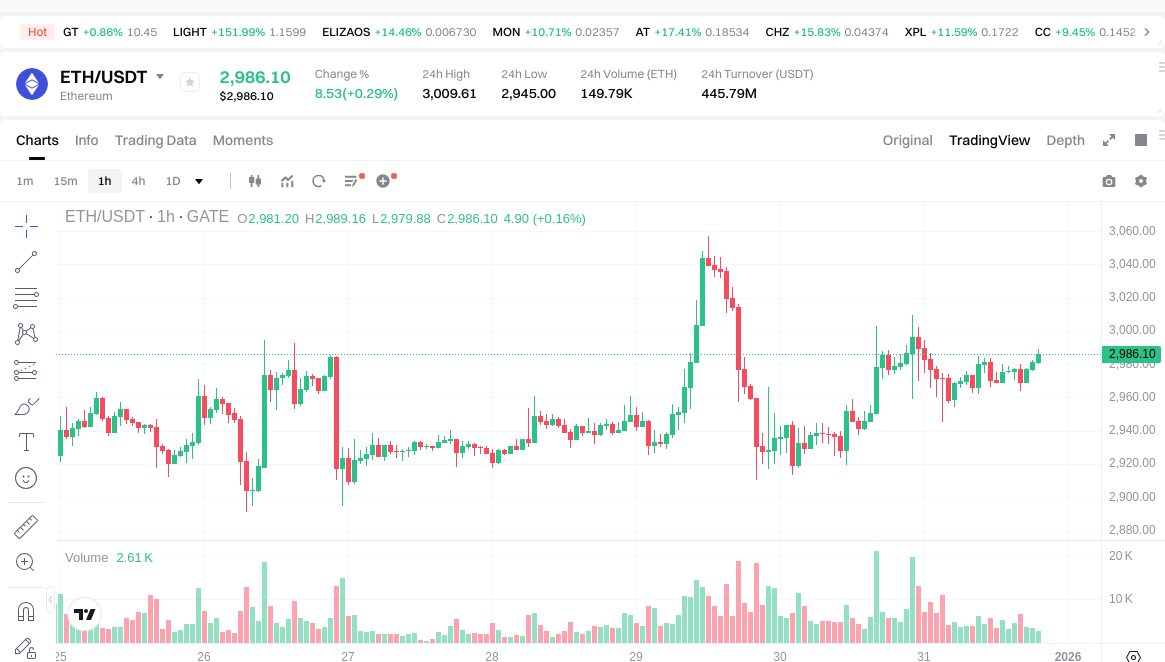
  • Latest price: $2,984.13
  • Circulating supply: 120,694,917.357762 ETH
  • Total supply: 120,694,917.357762 ETH
  • Maximum supply: ∞ ETH (no fixed upper limit)
  • Circulating market capitalization: $360,169,323,734.82
  • Fully diluted market cap: $360,169,323,734.82
  • Market cap dominance: 11.26%

Token Price

Click to view ETH/USDT Price

  • 24h trading volume: $441,539,574.32
  • 1-hour price change: +0.16%
  • 24-hour price change: +0.26%
  • 7-day price change: +1.89%
  • 30-day price change: +4.91%

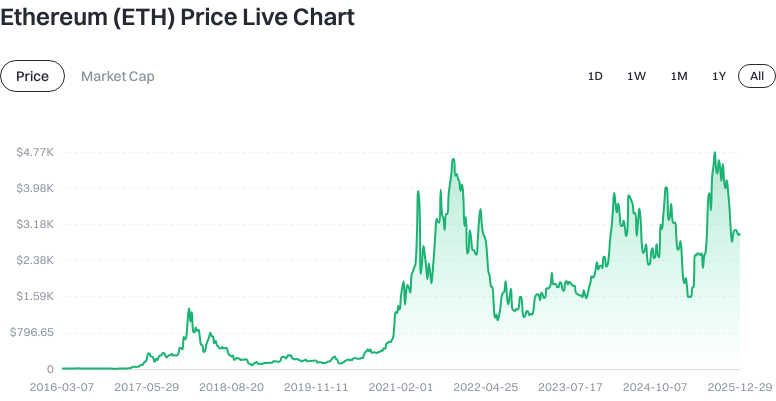
Token Price Trend

Click to view Latest ETH Price Data

Here, “market cap” is calculated as price multiplied by circulating supply. “Fully diluted market cap” estimates the value if all possible tokens are in circulation. “Market cap dominance” shows Ethereum’s share of the total cryptocurrency market value.

Who Created Ethereum (ETH), and When?

Ethereum was proposed by Vitalik Buterin, with early core contributors including Gavin Wood and Joseph Lubin.

Top Crypto Market Cap Dominance

Click to view Top Crypto Market Cap Dominance

Ethereum held a public crowdsale in 2014 and launched its mainnet in 2015. In 2022, it completed “The Merge,” transitioning from Proof of Work (PoW) to Proof of Stake (PoS).

Key timeline based on public sources (as of Dec 2025):

  • Ethereum whitepaper released: 2013
  • Crowdsale: 2014
  • Mainnet launch: 2015
  • EIP-1559 introducing fee burning: 2021
  • Transition to PoS consensus: 2022

Sources: ethereum.org and Wikipedia.

How Does Ethereum (ETH) Work?

Ethereum operates using a Proof of Stake (PoS) consensus mechanism. In PoS, participants stake ETH to become validators who propose and confirm new blocks according to protocol rules, earning rewards for their service. Unlike PoW, this process does not require energy-intensive mining.

Smart contracts run on the Ethereum Virtual Machine (EVM), which serves as the execution environment for Ethereum. Solidity is the most common programming language for writing these contracts. Every transaction incurs a gas fee, compensating for network resource usage. With EIP-1559, a portion of gas fees are burned, so when network activity is high, ETH supply can decrease.

To improve scalability and reduce costs, Ethereum utilizes Layer 2 solutions. Layer 2 refers to technologies that process transactions off the main chain before bundling them onto it—common types include Optimistic and Zero-Knowledge (ZK) rollups—helping lower transaction costs and increase throughput.

What Can You Do with Ethereum (ETH)?

Ethereum supports a wide range of use cases:

  • Decentralized Finance (DeFi): On-chain lending, trading, and yield management with no traditional intermediaries; users interact directly with protocols via smart contracts.
  • Non-Fungible Tokens (NFTs): Digital ownership of unique items such as art or in-game assets; all transactions are verifiable on-chain.
  • Decentralized Autonomous Organizations (DAOs): Community governance via token-based voting systems; rules are enforced by smart contracts.
  • Stablecoins & Payments: Numerous stablecoins are issued and circulated on Ethereum for cross-border settlements and on-chain payments.

In many DeFi protocols that interact with ERC-20 tokens, Wrapped Ether (WETH) is used. WETH is a tokenized version of ETH adhering to the ERC-20 standard, enabling smooth interactions with other ERC-20 tokens and smart contracts.

What Wallets and Scaling Solutions Exist in the Ethereum (ETH) Ecosystem?

Wallets fall into two categories: custodial and non-custodial. Custodial wallets are managed by third-party platforms for ease of use; non-custodial wallets give users full control of their private keys and thus full responsibility for security. Private keys are the core proof of asset ownership and should always be securely backed up offline.

Common wallet types include browser extension wallets, mobile wallets, and hardware wallets. Hardware wallets store private keys on dedicated devices and are suitable for long-term storage. Always pay attention to authorization and signature requests when interacting—be wary of phishing pages.

In terms of scaling solutions, Layer 2 networks and cross-chain bridges enhance efficiency and interoperability. When using bridges or Layer 2s, always verify official channels and fee structures, and understand the settlement risks involved in moving assets between networks.

Wrapped Ether (WETH) follows the ERC-20 token standard and is commonly used in decentralized exchanges and lending protocols to ensure compatibility with other ERC-20 assets.

What Are the Main Risks and Regulatory Considerations for Ethereum (ETH)?

Technical risks: Smart contracts may have vulnerabilities; upgrades and cross-chain bridges also carry potential risks. Always review audit reports and community feedback before using any contract.

Market risks: Crypto assets are highly volatile; leverage or high-yield strategies can amplify risk further. Allocate according to your own risk tolerance.

Security risks: Private key leaks can result in irreversible loss of assets. Beware of phishing links, fake websites, and malicious approvals. Enable two-factor authentication (2FA) and withdrawal whitelist features for added protection.

Regulation & taxation: Different jurisdictions have varying regulatory and tax treatment of crypto assets. Understand local laws and comply with all requirements before trading or reporting activities.

How Can I Buy and Safely Store Ethereum (ETH) on Gate?

Step 1: Register & complete identity verification. Create an account on Gate and finish KYC procedures to enhance account security and increase withdrawal limits.

Step 2: Prepare funds. Buy crypto with fiat or deposit digital assets into your account; double-check network selection and fees to avoid loss due to incorrect chains.

Step 3: Search for ETH trading pairs. On the trading page, search “ETH” and select an appropriate pair (such as ETH/USDT or ETH/fiat). Review prices and order book depth.

Step 4: Place your order. Choose between limit orders (set your own price) or market orders (trade instantly at current market price). Once filled, your assets will be displayed in your account balance.

Step 5: Withdraw & store securely. For long-term holding, consider withdrawing to a non-custodial wallet. Use the ETH mainnet as the withdrawal network; always verify addresses and memos if required. Monitor for network congestion and gas fees.

Step 6: Strengthen security. Enable 2FA, withdrawal whitelists, and login alerts; back up your seed phrase/private key offline; avoid operating on insecure devices or public networks.

How Does Ethereum (ETH) Differ from Bitcoin?

Purpose: Bitcoin is primarily designed for value storage and peer-to-peer payments; Ethereum focuses on programmable smart contracts and application development.

Supply & issuance policy: Bitcoin has a capped supply of 21 million coins; Ethereum has no fixed upper limit but incorporates fee-burning mechanisms that can affect supply based on network usage.

Consensus mechanism: Bitcoin uses PoW; Ethereum has transitioned to PoS. This results in different energy consumption profiles and security models.

Programmability & ecosystem: Ethereum’s EVM and smart contracts enable a rich ecosystem of DeFi protocols, NFTs, and DAOs; Bitcoin’s programmability is limited on its main chain with most expansions happening on Layer 2 or sidechains.

Fees & throughput: Ethereum relies on gas fees and Layer 2 scaling; costs and speeds fluctuate with network load. Bitcoin prioritizes block space, resulting in stable confirmation times but lower throughput overall.

Summary of Ethereum (ETH)

Centered around smart contracts and the EVM, Ethereum has built a broad DApp ecosystem where ETH serves as both the fundamental asset for paying gas fees and securing the network as well as a key collateral and settlement medium in DeFi and NFT activities. The adoption of PoS and fee burning has improved its economic model and energy efficiency, while Layer 2 scaling accelerates mass adoption potential. When investing or using Ethereum, pay close attention to protocol upgrades, scaling progress, regulatory developments, security best practices, and compliance requirements. Beginners should start small—learn wallet management basics on Gate by following step-by-step purchase and withdrawal guides—and gradually familiarize themselves with Ethereum’s mechanics and applications.

FAQ

What Is Wrapped Ether (WETH)?

Wrapped Ether (WETH) is a version of native Ether (ETH) converted into an ERC-20 token format. While ETH itself is the native asset of the Ethereum network and does not conform to the ERC-20 standard, WETH “wraps” ETH into an ERC-20 compliant token via a smart contract for use in decentralized exchanges and smart contract protocols. In simple terms, WETH is ETH “packaged” inside a contract at a 1:1 ratio.

Why Convert ETH to WETH?

Many decentralized applications (DApps) and trading pairs are built around the ERC-20 standard, but native ETH does not meet this standard—making it incompatible for direct participation in these interactions. By converting ETH to WETH, you can trade it on Uniswap-like DEXs, use it as collateral in lending protocols, or engage in other DeFi activities. This conversion ensures asset standardization across the ERC-20 ecosystem.

How Do You Convert ETH to WETH—and Can You Convert Back?

On Gate, you can convert ETH to WETH via the official WETH contract by executing a smart contract transaction on Ethereum (a small gas fee applies). You can also convert WETH back to ETH at any time through the same process. To minimize costs, perform conversions when network congestion is low—and always make sure you have enough ETH in your wallet to cover gas fees.

Are There Any Risks or Limitations with WETH vs ETH?

WETH is fundamentally a smart contract-based token—so there’s a minimal risk associated with potential contract bugs; however, WETH contracts have been extensively audited with very low actual risk. The main limitations are gas fees required for wrapping/unwrapping operations; frequent conversions increase costs. Additionally, WETH can only be used natively on Ethereum or compatible chains—bridging across chains requires additional tools.

What Are the Advantages of Using WETH over ETH in DeFi?

As a standard ERC-20 token, WETH integrates seamlessly across all DeFi applications—you can swap it directly on Uniswap, borrow/lend on Aave, or provide liquidity on Curve; native ETH cannot be used directly in these protocols. This standardization streamlines user experience and gives developers greater flexibility when designing application logic. Overall, WETH is an essential tool for engaging with Ethereum’s DeFi ecosystem.

Wrapped Ether (WETH) Key Terminology

  • Smart Contract: Program code that runs automatically on a blockchain; WETH uses smart contracts for wrapping/unwrapping ETH.
  • ERC-20 Standard: The token specification for fungible assets on Ethereum; WETH conforms to ERC-20 for DEX compatibility.
  • Cross-chain Bridge: Technology connecting different blockchains; WETH can be bridged across multiple public chains.
  • Liquidity Mining: Earning rewards by providing WETH or other tokens to trading pairs—common on DeFi platforms.
  • Gas Fee: Transaction or contract execution fee paid in ETH; all WETH interactions require gas.
  • Atomic Swap: Technology enabling direct exchange between two tokens without intermediaries; WETH supports atomic swaps with other ERC-20 tokens.

Wrapped Ether (WETH) References & Further Reading

A simple like goes a long way

Share

Related Glossaries
apr
Annual Percentage Rate (APR) represents the yearly yield or cost as a simple interest rate, excluding the effects of compounding interest. You will commonly see the APR label on exchange savings products, DeFi lending platforms, and staking pages. Understanding APR helps you estimate returns based on the number of days held, compare different products, and determine whether compound interest or lock-up rules apply.
apy
Annual Percentage Yield (APY) is a metric that annualizes compound interest, allowing users to compare the actual returns of different products. Unlike APR, which only accounts for simple interest, APY factors in the effect of reinvesting earned interest into the principal balance. In Web3 and crypto investing, APY is commonly seen in staking, lending, liquidity pools, and platform earn pages. Gate also displays returns using APY. Understanding APY requires considering both the compounding frequency and the underlying source of earnings.
LTV
Loan-to-Value ratio (LTV) refers to the proportion of the borrowed amount relative to the market value of the collateral. This metric is used to assess the security threshold in lending activities. LTV determines how much you can borrow and at what point the risk level increases. It is widely used in DeFi lending, leveraged trading on exchanges, and NFT-collateralized loans. Since different assets exhibit varying levels of volatility, platforms typically set maximum limits and liquidation warning thresholds for LTV, which are dynamically adjusted based on real-time price changes.
Rug Pull
Fraudulent token projects, commonly referred to as rug pulls, are scams in which the project team suddenly withdraws funds or manipulates smart contracts after attracting investor capital. This often results in investors being unable to sell their tokens or facing a rapid price collapse. Typical tactics include removing liquidity, secretly retaining minting privileges, or setting excessively high transaction taxes. Rug pulls are most prevalent among newly launched tokens and community-driven projects. The ability to identify and avoid such schemes is essential for participants in the crypto space.
amm
An Automated Market Maker (AMM) is an on-chain trading mechanism that uses predefined rules to set prices and execute trades. Users supply two or more assets to a shared liquidity pool, where the price automatically adjusts based on the ratio of assets in the pool. Trading fees are proportionally distributed to liquidity providers. Unlike traditional exchanges, AMMs do not rely on order books; instead, arbitrage participants help keep pool prices aligned with the broader market.

Related Articles

In-depth Explanation of Yala: Building a Modular DeFi Yield Aggregator with $YU Stablecoin as a Medium
Beginner

In-depth Explanation of Yala: Building a Modular DeFi Yield Aggregator with $YU Stablecoin as a Medium

Yala inherits the security and decentralization of Bitcoin while using a modular protocol framework with the $YU stablecoin as a medium of exchange and store of value. It seamlessly connects Bitcoin with major ecosystems, allowing Bitcoin holders to earn yield from various DeFi protocols.
2024-11-29 10:10:11
Sui: How are users leveraging its speed, security, & scalability?
Intermediate

Sui: How are users leveraging its speed, security, & scalability?

Sui is a PoS L1 blockchain with a novel architecture whose object-centric model enables parallelization of transactions through verifier level scaling. In this research paper the unique features of the Sui blockchain will be introduced, the economic prospects of SUI tokens will be presented, and it will be explained how investors can learn about which dApps are driving the use of the chain through the Sui application campaign.
2025-08-13 07:33:39
What Is Ethereum 2.0? Understanding The Merge
Intermediate

What Is Ethereum 2.0? Understanding The Merge

A change in one of the top cryptocurrencies that might impact the whole ecosystem
2023-01-18 14:25:24