![]() Trusted Editorial content, reviewed by leading industry experts and seasoned editors. Ad Disclosure
Bitcoin supply structure is undergoing a notable transformation as the Network Distribution Factor (NDF) declines rapidly. While price action often dominates headlines, shifts in distribution metrics can reveal structural changes. A falling NDF suggests that the balance of BTC holdings across different wallet cohorts is evolving, and potentially signaling a redistribution of market participants.
Trusted Editorial content, reviewed by leading industry experts and seasoned editors. Ad Disclosure
Bitcoin supply structure is undergoing a notable transformation as the Network Distribution Factor (NDF) declines rapidly. While price action often dominates headlines, shifts in distribution metrics can reveal structural changes. A falling NDF suggests that the balance of BTC holdings across different wallet cohorts is evolving, and potentially signaling a redistribution of market participants.
What The Network Distribution Factor Actually Measures
An advanced on-chain data analytics firm, Alphractal, noted on X that the NDF of Bitcoin is declining sharply, and revealing an important structural shift in how the asset supply is distributed across the market. The NDF measures the proportion of the total BTC supply held by larger holders controlling at least 0.01% of the entire circulating supply.
Related Reading: Bitcoin Cycle Play: Analyst Maps Out When Accumulation Will Begin And It’s Below $40,000When the metric declines, it indicates that the BTC supply concentration among large holders is decreasing. In practical terms, this shift represents a reduced relative dominance of large holders over the total supply and broader redistribution of BTC among smaller participants and new market entrants.
A declining extreme concentration is often seen during early accumulation phases, and a natural redistribution process follows the periods of strong accumulation by large entities. Historically, extended declines in the NDF tend to occur during phases when the market is mature, and the asset becomes more widely distributed
![Bitcoin]() BTC market is undergoing a key shift | Source: Chart from Alphractal on XThis often occurs after major bull cycles, when large players accumulate supply and are gradually absorbed by the broader market. Rather than signaling weakness, this dynamic can strengthen BTC economic decentralization and reduce structural risk tied to excessive concentration.
BTC market is undergoing a key shift | Source: Chart from Alphractal on XThis often occurs after major bull cycles, when large players accumulate supply and are gradually absorbed by the broader market. Rather than signaling weakness, this dynamic can strengthen BTC economic decentralization and reduce structural risk tied to excessive concentration.
At the same time, it reflects a transition phase where supply is being redistributed globally, reinforcing BTC’s evolution from a relatively concentrated asset into a widely distributed global financial network. However, this does not signal structural weakness, but rather signals maturation and the expansion of BTC’s ownership base.
Why Bitcoin Represents A True Financial Revolution
The clearest reasons Bitcoin remains the most compelling asset of our generation are its ownership structure and fixed supply. According to Crypto Patel, roughly 63% of the total circulating supply is held by everyday individual participants, not Wall Street, not the government, or even the institutions.
Related Reading: Top Analyst Says ‘Paper Bitcoin’ Is Driving The Market, Not The 21 Million Supply CapAt the core of this thesis, there are only 21 million BTC in existence, and the number is fixed permanently; no central bank can inflate it, no politician can alter the code, and no corporation can dilute holders.
In a world characterized by aggressive money printing and currency debasement, BTC stands alone as mathematically enforced scarcity, and the majority of that asset belongs to ordinary individuals. Crypto Patel frames BTC’s decentralized ownership and fixed supply not just as a technology, but as a structural revolution.
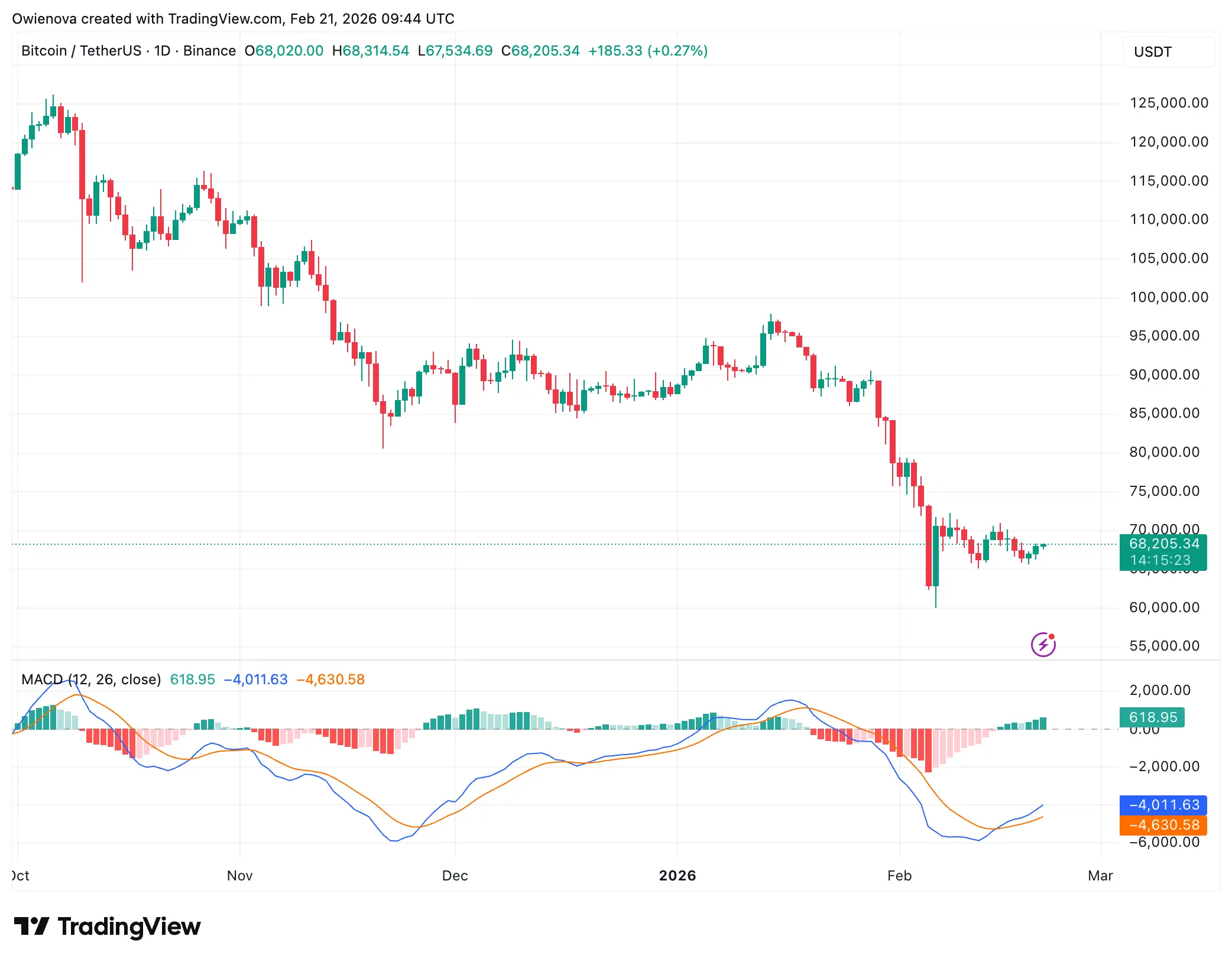 BTC trading at $68,205 on the 1D chart | Source: BTCUSDT on Tradingview.comFeatured image from Getty Images, chart from Tradingview.com
![]() Editorial Process for bitcoinist is centered on delivering thoroughly researched, accurate, and unbiased content. We uphold strict sourcing standards, and each page undergoes diligent review by our team of top technology experts and seasoned editors. This process ensures the integrity, relevance, and value of our content for our readers.
Editorial Process for bitcoinist is centered on delivering thoroughly researched, accurate, and unbiased content. We uphold strict sourcing standards, and each page undergoes diligent review by our team of top technology experts and seasoned editors. This process ensures the integrity, relevance, and value of our content for our readers.
Disclaimer: The information on this page may come from third parties and does not represent the views or opinions of Gate. The content displayed on this page is for reference only and does not constitute any financial, investment, or legal advice. Gate does not guarantee the accuracy or completeness of the information and shall not be liable for any losses arising from the use of this information. Virtual asset investments carry high risks and are subject to significant price volatility. You may lose all of your invested principal. Please fully understand the relevant risks and make prudent decisions based on your own financial situation and risk tolerance. For details, please refer to
Disclaimer.
Articoli correlati
Trader Adds 307.7 BTC at 5x Leverage in 2 Hours, Total Position Reaches 629.16 BTC
According to Lookonchain, a trader added 307.7 BTC (approximately $25.04 million) at 5x leverage 2 hours ago by creating a new wallet. The trader's total position now stands at 629.16 BTC (approximately $51.18 million).
GateNews5m fa
Sequans Sells 1,025 Bitcoin to Fund Debt Redemption as Q1 Revenue Drops 24.8%
According to Sequans Communications' statement on Tuesday, the Paris-based company sold 1,025 BTC during the first quarter of 2026 to finance convertible debt redemptions and an ADS buyback program. The transaction reduced its bitcoin holdings from 2,139 BTC at the end of 2025 to 1,114 BTC by
GateNews15m fa
U.S. Bitcoin ETF Sees 6,668 BTC Inflows, Ethereum ETF Receives 26,480 ETH Today
According to Lookonchain data monitored by ChainCatcher, U.S. spot Bitcoin ETF saw net inflows of 6,668 BTC today, while Ethereum ETF received 26,480 ETH. Solana ETF also recorded net inflows of 41,170 SOL on the same day.
GateNews33m fa
Bitcoin Miner GoMining Launches GoBTC Payment Protocol on May 5, Targeting 0.2% Fee Rate
According to Forbes, Bitcoin mining company GoMining announced on May 5 the launch of GoBTC, a payment protocol designed to leverage its mining pool's block production capacity (approximately 2-4 blocks daily) to settle transactions directly on the Bitcoin mainchain. The system aims to reduce
GateNews41m fa
特朗普拒绝确认美伊停火协议有效性,BTC 创今年 2 月以来新高
特朗普拒绝确认美伊停火协议有效性,比特币突破 81,000 美元创今年 2 月以来新高,Circle 一度大涨超 20%。本文分析地缘风险、BTC 技术阻力与资金结构变化。
GateInstantTrends55m fa
Bitcoin Volatility Halves to 40%: Crypto-Casino Industry Faces Revenue Pressure
Bitcoin's 30-day realised volatility collapsed from approximately 80% in mid-March to 40.7% on April 22, 2026, according to Glassnode's on-chain analysis—the sharpest five-week compression of the cycle. The sharp decline is creating structural pressure on the $81.4 billion crypto-casino industry,
CryptoFrontier1h fa


