![]() Trusted Editorial content, reviewed by leading industry experts and seasoned editors. Ad Disclosure
Bitcoin hashing power pushed the difficulty up about 15% to a little past 144 trillion on Friday, based on data from CoinWarz. That move reversed an earlier drop of 10% that followed widespread outages in parts of the US.
Trusted Editorial content, reviewed by leading industry experts and seasoned editors. Ad Disclosure
Bitcoin hashing power pushed the difficulty up about 15% to a little past 144 trillion on Friday, based on data from CoinWarz. That move reversed an earlier drop of 10% that followed widespread outages in parts of the US.
Related Reading: Crypto’s Changing Landscape Forces On-Chain Firm Parsec To Shut After 5 YearsThe numbers are blunt: machines went quiet during extreme weather, then came back online, and the protocol rebalanced itself.
Winter Outages And The Bounce Back
Foundry USA’s pool saw a dramatic swing in computing power, falling near 198 EH/s before climbing from roughly 400 EH/s. Reports say that many operators in affected regions shut down temporarily during the winter storms to protect equipment and help grids.
Some of the spaces that host miners coordinated with utilities. Power was conserved. Power was redirected.
![]()
Bitcoin mining difficulty graph. Source: CoinWarz
Flexible Power Deals Changed The Game
Reports note that several miners did more than pause operations. LM Funding America reported curtailing machines and sending contracted power back to the grid, pocketing curtailment payments that helped offset lost mining time.
Canaan Inc. also said its US sites took part in demand response moves with local partners. These arrangements are part of why many facilities can afford to go offline when the grid needs relief, then restart when conditions improve.
![]()
Source: CoinWarz
What Higher Difficulty Means
Bitcoin’s difficulty is designed to reset every 2,016 blocks to hold average block times close to the 10-minute target. When more hash power returns, the algorithm raises difficulty. That makes the network harder to attack and raises the work needed to win a block reward.
For miners, higher difficulty reduces the Bitcoin earned per unit of compute, squeezing margins for outfits with older rigs or higher electricity bills.
Price Moves Stay Tied To Headlines
Bitcoin traded near $68,000 as markets reacted to rising geopolitical strain, especially between the US and Iran. Trading has felt cautious. Volume is lighter. Prices have bounced and then stalled on headline-driven flows, showing that investor mood still swings with global news.
At the same time, network metrics kept shifting under the surface — a reminder that technical and macro drivers can pull in different directions.
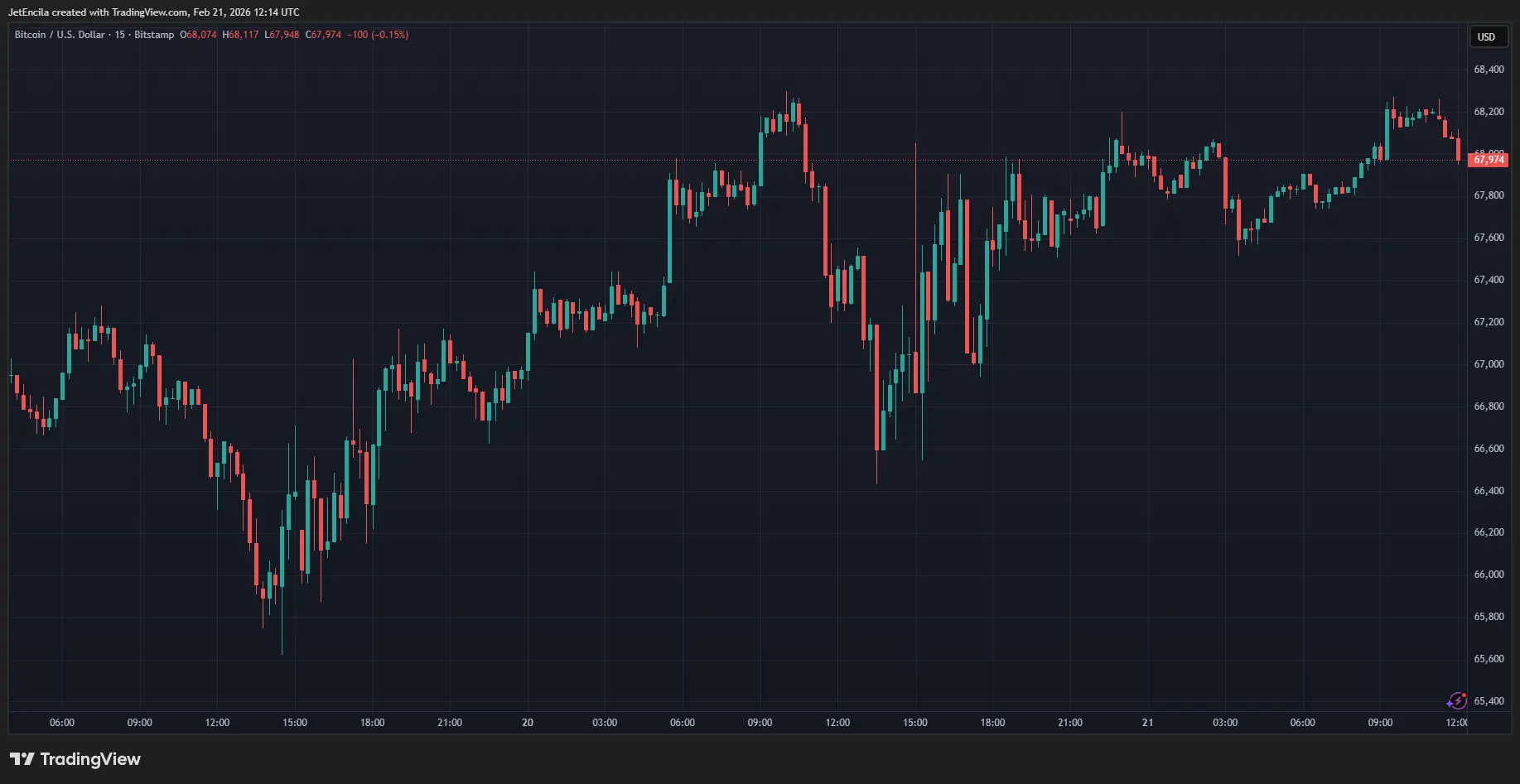 Bitcoin is now trading at $67,974. Chart: TradingViewThe US now supplies a big chunk of global hash power, according to Cambridge Centre for Alternative Finance. That means regional events, weather, and grid policies in the US matter a lot to global security and miner economics.
Some firms have begun to treat mining as a flexible load that can stabilize grids during stress, creating new income streams beyond pure block rewards.
Related Reading: Lightning Strikes Big: Bitcoin Layer-2 Surpasses $1 Billion In Monthly Activity### Politics And Market Tone
Comments from politicians and geopolitical moves add friction. Mentions of US President Donald Trump in recent headlines have been tied to broader market nervousness; geopolitics can pull risk appetite downward and keep crypto prices range-bound.
The difficulty rebound itself didn’t spark a big price jump. Instead, it reinforced a simple truth: the protocol handled the shock, but miners felt the squeeze.
Featured image from Pexels, chart from TradingView
![]() Editorial Process for bitcoinist is centered on delivering thoroughly researched, accurate, and unbiased content. We uphold strict sourcing standards, and each page undergoes diligent review by our team of top technology experts and seasoned editors. This process ensures the integrity, relevance, and value of our content for our readers.
Editorial Process for bitcoinist is centered on delivering thoroughly researched, accurate, and unbiased content. We uphold strict sourcing standards, and each page undergoes diligent review by our team of top technology experts and seasoned editors. This process ensures the integrity, relevance, and value of our content for our readers.
Disclaimer: The information on this page may come from third parties and does not represent the views or opinions of Gate. The content displayed on this page is for reference only and does not constitute any financial, investment, or legal advice. Gate does not guarantee the accuracy or completeness of the information and shall not be liable for any losses arising from the use of this information. Virtual asset investments carry high risks and are subject to significant price volatility. You may lose all of your invested principal. Please fully understand the relevant risks and make prudent decisions based on your own financial situation and risk tolerance. For details, please refer to
Disclaimer.
Articoli correlati
Morgan Stanley Purchases 151.9 BTC Worth $12.4M
Gate News message, Morgan Stanley acquired 151.9 BTC valued at $12.4M seven hours ago. The financial institution now holds a total of 2,830 BTC worth $228.94M.
GateNews26m fa
Strategy Reports Q1 2026 Loss of $12.54B, Holds 818,334 Bitcoin
According to BlockBeats, Strategy reported on May 6 that it held 818,334 Bitcoin as of May 3, 2026, representing a 22% increase since the start of the year with a Bitcoin yield of 9.4%. The company reported Q1 2026 revenue of $124.3 million, up 11.9% year-over-year, but recorded a net loss of $12.54
GateNews1h fa
空頭清算潮推升比特幣行情,市場分析指向上看 9 萬美元
比特幣 BTC 在空頭擠壓與未平倉合約量攀升的帶動下,展現強勁走勢,數據顯示大量空頭部位遭強制平倉,比特幣在 82,500 美元附近有 11.2 億美元空頭曝險,有機會上看九萬美元,市場供需失衡為後續上漲動能提供支撐。
空頭擠壓演變成價格推升動能
比特幣研究員 Axel Adler Jr. 監測數據指出自 2 月以來,市場已累積超過 79 億美元的空頭清算金額。清算波峰主要分佈於 2 月至 4 月間,其中 2 月 13 日單日清算額高達 7.37 億美元。儘管交易員頻繁在 80,000 美元上方建立空頭部位,但價格韌性迫使這些部位遭遇 Short Squeeze「空頭擠壓」,即價格上漲觸發
ChainNewsAbmedia1h fa
Arthur Hayes Says Bitcoin's Value Lies Outside Regulatory Framework at Consensus Miami 2026
At Consensus Miami 2026, Arthur Hayes, CIO of Maelstrom, stated that all that matters for bitcoin's value proposition is fiat liquidity, positioning the cryptocurrency's value outside the regulatory apparatus.
GateNews3h fa
Analyst Cowen Warns Bitcoin Rally May Be Bear Market Rebound
Cryptocurrency strategist Benjamin Cowen has cautioned investors that recent Bitcoin rallies may represent temporary rebounds within a broader bear market rather than the start of a sustained bull season. Cowen stated he continues to view the market through "bear glasses," warning that short-term pr
CryptoFrontier3h fa
CME Group to Launch Cash-Settled Bitcoin Volatility Futures on June 1, Ticker BVI
According to CME Group, the exchange will launch cash-settled Bitcoin volatility futures on June 1, pending regulatory approval. The contracts, trading under ticker BVI, will allow traders to hedge and speculate on Bitcoin's volatility without taking a directional price bet. The futures will be
GateNews3h fa


